



 Chat with AI
Exam 16: Budget Deficits in the Short and Long Run

Exam 1: What Is Economics?227 Questions
Exam 2: The Economy: Myth and Reality150 Questions
Exam 3: The Fundamental Economic Problem: Scarcity and Choice250 Questions
Exam 4: Supply and Demand: An Initial Look308 Questions
Exam 5: An Introduction to Macroeconomics211 Questions
Exam 6: The Goals of Macroeconomic Policy207 Questions
Exam 7: Economic Growth: Theory and Policy223 Questions
Exam 8: Aggregate Demand and the Powerful Consumer214 Questions
Exam 9: Demand-Side Equilibrium: Unemployment or Inflation?211 Questions
Exam 10: Bringing in the Supply Side: Unemployment and Inflation?223 Questions
Exam 11: Managing Aggregate Demand: Fiscal Policy205 Questions
Exam 12: Money and the Banking System219 Questions
Exam 13: Monetary Policy: Conventional and Unconventional205 Questions
Exam 14: The Financial Crisis and the Great Recession61 Questions
Exam 15: The Debate over Monetary and Fiscal Policy214 Questions
Exam 16: Budget Deficits in the Short and Long Run210 Questions
Exam 17: The Trade Off between Inflation and Unemployment214 Questions
Exam 18: International Trade and Comparative Advantage226 Questions
Exam 19: The International Monetary System: Order or Disorder?213 Questions
Exam 20: Exchange Rates and the Macroeconomy214 Questions
Select questions type


The federal budget went $161 billion in fiscal year 2007 to $1 trillion in the next two to three years.What are the main factors that contributed to this increase?
(Essay)
4.8/5  (85)
(85) Japanese Prime Minister Ryutaro Hashimoto was called the "Herbert Hoover of Japan" because he
(Multiple Choice)
4.8/5 (83)
(83) In 2010 and 2011,President Obama advocated deficit reduction through decreased spending while Republicans in Congress advocated increased taxation to achieve the same goal.
(True/False)
4.9/5 (83)
(83) If the economy is in a recessionary gap,and the government attempts to balance the budget,the effect will be to
(Multiple Choice)
4.9/5 (78)
(78) The argument that the national debt imposes a burden on future generations becomes more compelling as
(Multiple Choice)
4.8/5 (70)
(70) Which of the following is t regarding the effect of deficits from 1980-2005 in the U.S.?
(Multiple Choice)
4.8/5 (73)
(73) Monetizing the deficit contributes to the inflationary pressures that are already present in the economy.
(True/False)
4.8/5 (74)
(74) In 2010,the net national debt was about $9 trillion or approximately $29,000 per person.
(True/False)
4.8/5 (79)
(79) If the economy is in an inflationary gap,and the government attempts to balance the budget,the effect will be to
(Multiple Choice)
4.9/5 (85)
(85) If the U.S.government decided to pay off the national debt by creating money,what would be the most likely effect?
(Multiple Choice)
4.8/5 (100)
(100) The policy mix that the Clinton administration sought in early 1993 was a
(Multiple Choice)
4.8/5 (77)
(77) Figure 16-1
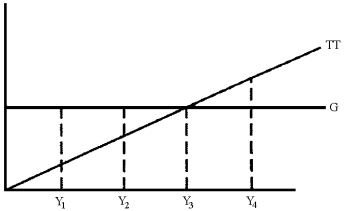 -In Figure 16-1,there are four levels of income.G is government expenditures and TT is taxes less transfers.At which level of income does the official budget produce a surplus?
 (Multiple Choice)
5.0/5 (83)
(83) Suppose that the economy is currently at full employment.All other things being equal,if the government implements expansionary fiscal policy,then the appropriate monetary policy is
(Multiple Choice)
4.9/5 (94)
(94) Analysis indicates that the economy is in a recessionary gap.Which of the following is the most appropriate policy mix in this situation?
(Multiple Choice)
4.9/5 (93)
(93) Figure 16-1
-In Figure 16-1,there are four levels of income.G is government expenditures and TT is taxes less transfers.Y₃ is the full-employment level of income.At Y₃
-In Figure 16-1,there are four levels of income.G is government expenditures and TT is taxes less transfers.Y₃ is the full-employment level of income.At Y₃ (Multiple Choice)
4.7/5 (92)
(92) 
Filters
- Essay(0)
- Multiple Choice(0)
- Short Answer(0)
- True False(0)
- Matching(0)