



 Chat with AI
Exam 10: Bringing in the Supply Side: Unemployment and Inflation?

Exam 1: What Is Economics?227 Questions
Exam 2: The Economy: Myth and Reality150 Questions
Exam 3: The Fundamental Economic Problem: Scarcity and Choice250 Questions
Exam 4: Supply and Demand: An Initial Look308 Questions
Exam 5: An Introduction to Macroeconomics211 Questions
Exam 6: The Goals of Macroeconomic Policy207 Questions
Exam 7: Economic Growth: Theory and Policy223 Questions
Exam 8: Aggregate Demand and the Powerful Consumer214 Questions
Exam 9: Demand-Side Equilibrium: Unemployment or Inflation?211 Questions
Exam 10: Bringing in the Supply Side: Unemployment and Inflation?223 Questions
Exam 11: Managing Aggregate Demand: Fiscal Policy205 Questions
Exam 12: Money and the Banking System219 Questions
Exam 13: Monetary Policy: Conventional and Unconventional205 Questions
Exam 14: The Financial Crisis and the Great Recession61 Questions
Exam 15: The Debate over Monetary and Fiscal Policy214 Questions
Exam 16: Budget Deficits in the Short and Long Run210 Questions
Exam 17: The Trade Off between Inflation and Unemployment214 Questions
Exam 18: International Trade and Comparative Advantage226 Questions
Exam 19: The International Monetary System: Order or Disorder?213 Questions
Exam 20: Exchange Rates and the Macroeconomy214 Questions
Select questions type


Economists do not agree on why wages are more rigid now than they were before World War II.
(True/False)
4.8/5  (72)
(72) The typical movement of the aggregate supply curve resulting from an increase in productivity is that it
(Multiple Choice)
4.9/5 (80)
(80) The diminished employment prospects for the graduates of 2002 is most likely due to the existence of a(n)
(Multiple Choice)
4.9/5 (76)
(76) How is it possible for the economy to have a recessionary gap?
(Multiple Choice)
4.9/5 (75)
(75) Discuss some of the arguments that help explain why wages and prices rarely fall in a modern economy.
(Essay)
4.9/5 (72)
(72) Increases in the prices of imported energy in 2002-2008 caused the aggregate supply curve to shift inward.
(True/False)
4.8/5 (86)
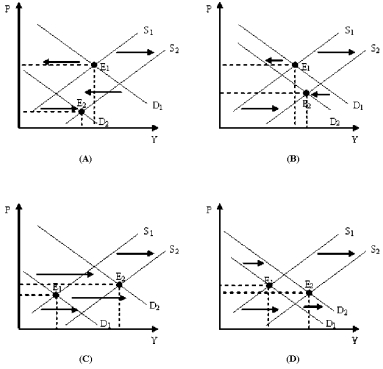
(86) Figure 10-5
 -In Figure 10-5,which graph best illustrates the situation of an economy near full employment that experiences an increase in autonomous consumer spending?
 (Multiple Choice)
4.8/5 (72)
(72) In spite of the fact that unemployment rates were at a 30-year low in 1996-2000,the United States economy also experienced
(Multiple Choice)
4.9/5 (74)
(74) Stabilization policy may be necessary to modify or counteract volatile changes in aggregate demand.
(True/False)
5.0/5 (72)
(72) Figure 10-7
 -Which of the panels in Figure 10-7 shows an economic expansion caused primarily by a change in aggregate demand?
 (Multiple Choice)
4.9/5 (67)
(67) The economy's self-correcting mechanism appears to be more efficient at curing
(Multiple Choice)
4.7/5 (81)
(81) The Japanese economy has been consistently weak throughout the 1990s.This has caused a slight deflation,illustrating the
(Multiple Choice)
4.9/5 (82)
(82) When equilibrium GDP is below potential GDP,jobs are plentiful and unemployment is low.
(True/False)
5.0/5 (70)
(70) The aggregate supply curve slopes upward because as price rises the quantity of output supplied rises.
(True/False)
4.8/5 (86)
(86) Inflation reduces the multiplier effect by reducing consumers' wealth and purchasing power.
(True/False)
4.9/5 (86)
(86) Figure 10-5
-In Figure 10-5,which graph best illustrates the situation of an economy with high unemployment that experiences an increase in investment spending?
-In Figure 10-5,which graph best illustrates the situation of an economy with high unemployment that experiences an increase in investment spending? (Multiple Choice)
4.9/5 (83)
(83) What is the principal reason that economists give for the existence of deflationary and inflationary gaps?
(Multiple Choice)
4.9/5 (84)
(84) 
Filters
- Essay(0)
- Multiple Choice(0)
- Short Answer(0)
- True False(0)
- Matching(0)