



 Chat with AI
Exam 1: Human Geography: A Cultural Approach

Exam 1: Human Geography: A Cultural Approach192 Questions
Exam 2: Geographies of Cultural Difference: One World or Many183 Questions
Exam 3: Population Geography: Shaping the Human Mosaic229 Questions
Exam 4: The Geography of Language: Locating the Spoken Word211 Questions
Exam 5: Geographies of Race and Ethnicity: Melting Pot or Salad Bowl222 Questions
Exam 6: Political Geography: A Divided World262 Questions
Exam 7: The Geography of Religion: Space and Places of Sacredness278 Questions
Exam 8: The Geography of Agriculture and Food: Shaping the Land, Feeding the World248 Questions
Exam 9: Development Geography: Transforming Landscapes of Well-Being184 Questions
Exam 10: Urban Geography: A World of Cities150 Questions
Select questions type


When you go to your polling place, you are visiting a node in a functional region.
(True/False)
4.8/5  (85)
(85) The social activities and interactions, ranging from religious rituals to food and clothing preferences, that collectively distinguish group identity are called:
(Multiple Choice)
4.9/5 (86)
(86) Culture is best understood as a process, not as a static, fixed pattern.
(True/False)
4.8/5 (76)
(76) Airports that have museum exhibits specific to the history of the city or state in which they are located are attempting to overcome:
(Multiple Choice)
4.8/5 (62)
(62) 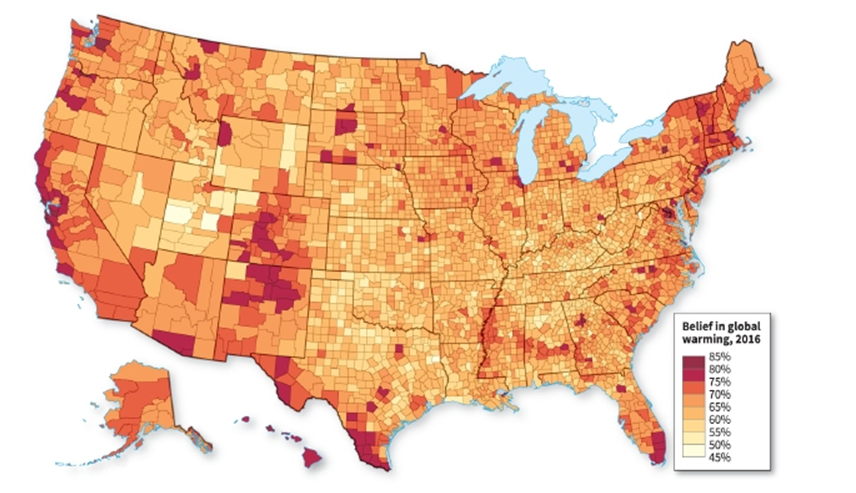 -Using the framework of environmental perception, why is the spatial pattern of belief in global warming significant?
 (Multiple Choice)
4.8/5 (76)
(76) The best conceptual approach to the global diffusion of the H1N1 virus would be hierarchical diffusion and contagious diffusion reinforcing each other.
(True/False)
4.8/5 (82)
(82) 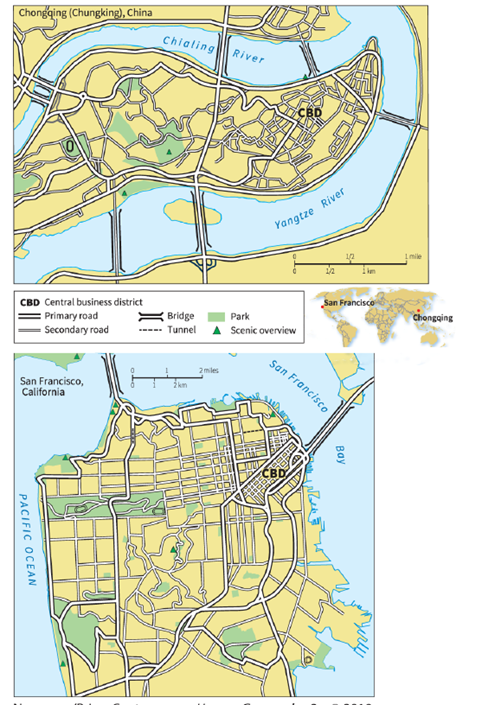 -According to the figure shown here, Chongqing and San Francisco have all of the following characteristics in common EXCEPT:
 (Multiple Choice)
4.8/5 (96)
(96) The Great Zimbabwe National Monument was built completely without mortar.
(True/False)
4.9/5 (71)
(71) Large strip mines, greenhouse gas emissions, and large-scale logging are examples of environmental change that have occurred in:
(Multiple Choice)
4.9/5 (76)
(76) A factor that slows, but does not prevent, diffusion is a(n):
(Multiple Choice)
5.0/5 (95)
(95) In order to investigate the spatial pattern of wheat production in the world, a geographer would investigate:
1) climate and soil characteristics
2) available technology
3) cultural preferences
4) food taboos
5) government policies
(Multiple Choice)
4.9/5 (86)
(86) If a human geographer studies the landscape produced by a human community, that landscape reflects the culture of this group.
(True/False)
4.8/5 (89)
(89) The term _____ is used to refer to the processes of economic, political, and social integration that have collectively created ties that make a difference to lives around the planet.
(Multiple Choice)
4.8/5 (75)
(75) The hippies of the 1960s formed a distinct segment of American society that set itself up in opposition to what it perceived as the problems of the dominant culture. Hippies can be said to have composed a distinctive:
(Multiple Choice)
4.8/5 (76)
(76) Many people believe that the best example of African architecture south of the Sahara can be found in:
(Multiple Choice)
4.9/5 (90)
(90) Which is NOT a type of region recognized by human geographers?
(Multiple Choice)
4.9/5 (80)
(80) Which perspective on human geography tends to generalize diversity in an effort to reveal processes creating spatial patterns?
(Multiple Choice)
4.8/5 (81)
(81) 
Filters
- Essay(0)
- Multiple Choice(0)
- Short Answer(0)
- True False(0)
- Matching(0)