



 Chat with AI
Exam 2: Investing and Financing Decisions and the Accounting System

Exam 1: Financial Statements and Business Decisions122 Questions
Exam 2: Investing and Financing Decisions and the Accounting System132 Questions
Exam 3: Operating Decisions and the Accounting System114 Questions
Exam 4: Adjustments, Financial Statements, and the Quality of Earnings136 Questions
Exam 5: Communicating and Interpreting Accounting Information111 Questions
Exam 6: Reporting and Interpreting Sales Revenue, Receivables, and Cash128 Questions
Exam 7: Reporting and Interpreting Cost of Goods Sold and Inventory124 Questions
Exam 8: Reporting and Interpreting Property, Plant, and Equipment; Intangibles; and Natural Resources126 Questions
Exam 9: Reporting and Interpreting Liabilities113 Questions
Exam 10: Reporting and Interpreting Bonds120 Questions
Exam 11: Reporting and Interpreting Owners Equity118 Questions
Exam 12: Statement of Cash Flows116 Questions
Exam 13: Analyzing Financial Statements110 Questions
Exam 14: Reporting and Interpreting Investments in Other Corporations112 Questions
Select questions type


Which of the following would result when a company purchases a factory building using cash?
(Multiple Choice)
4.9/5  (87)
(87) Which of the following would result when a company pays a previously declared cash dividend?
(Multiple Choice)
5.0/5 (83)
(83) Which of the following would be classified as financing cash flows on a cash flow statement? 1. Paying cash dividends.
2) Lending cash to others.
3) Issuing stock for cash.
4) Purchasing long-term assets for cash.
5) Repurchasing stock with cash.
(Multiple Choice)
4.9/5 (81)
(81) Chad Jones is the sole owner and manager of Jones Glass Repair Shop. Jones purchased a truck, to be used in the business, for its market value of $35,000. Which of the following fundamentals requires Jones to record the truck at the price paid to buy it?
(Multiple Choice)
5.0/5 (85)
(85) A transaction may be an exchange of assets or services by one business for assets, services, or promises to pay from a different business.
(True/False)
4.9/5 (87)
(87) The normal balance for an asset account is a debit and the normal balance for a liability account is a credit.
(True/False)
4.9/5 (96)
(96) Which of the following would not be included under the account category of expenses within the chart of accounts?
(Multiple Choice)
4.8/5 (77)
(77) Which of the following describes the impact on the balance sheet when cash is received from the collection of an account receivable?
(Multiple Choice)
4.8/5 (68)
(68) Which of the following transactions will not change a company's total stockholders' equity?
(Multiple Choice)
4.9/5 (77)
(77) Which of the following describes the impact on the balance sheet of purchasing supplies for cash?
(Multiple Choice)
4.8/5 (66)
(66) Which of the following describes the impact on the balance sheet when a company uses cash to purchase the stock of another company?
(Multiple Choice)
4.8/5 (80)
(80) A company's January 1, 2014 balance sheet reported total assets of $150,000 and total liabilities of $60,000. During January 2014, the company completed the following transactions: (A) paid a note payable using $10,000 cash (no interest was paid); (B) collected a $9,000 accounts receivable; (C) paid a $5,000 accounts payable; and (D) purchased a truck for $5,000 cash and by signing a $20,000 note payable from a bank. The company's January 31, 2014 balance sheet would report which of the following? 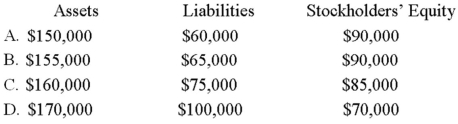
(Multiple Choice)
4.9/5 (72)
(72) Current liabilities are defined as obligations to be paid within six months.
(True/False)
4.9/5 (81)
(81) Which of the following account balances would not be included in the calculation of the current ratio?
(Multiple Choice)
4.7/5 (65)
(65) When a company buys equipment for $150,000 and pays for one third in cash and the other two thirds is financed by a note payable, which of the following are the effects on the accounting equation?
(Multiple Choice)
4.7/5 (75)
(75) Which of the following journal entries is correct when a business entity issues common stock, above par value, to stockholders in exchange for cash? A. Cash
Common stock
Retained Earnings
B. Cash
Common stock
Additional paid-in capital
C. Cash
Investments
D. Common stock
Cash
(Multiple Choice)
4.8/5 (79)
(79) Which of the following journal entries is correct when a business entity purchases land costing $30,000 by signing a one-year note payable? 
(Multiple Choice)
4.9/5 (73)
(73) Which of the following assumptions implies that a business can continue to remain in operation into the foreseeable future?
(Multiple Choice)
4.9/5 (88)
(88) 
Filters
- Essay(0)
- Multiple Choice(0)
- Short Answer(0)
- True False(0)
- Matching(0)