



 Chat with AI
Exam 16: Monopoly

Exam 1: Getting Started347 Questions
Exam 2: The U.S.and Global Economies211 Questions
Exam 3: The Economic Problem283 Questions
Exam 4: Demand and Supply334 Questions
Exam 5: Elasticities of Demand and Supply342 Questions
Exam 6: Efficiency and Fairness of Markets362 Questions
Exam 7: Government Actions in Markets248 Questions
Exam 8: Taxes270 Questions
Exam 9: Global Markets in Action281 Questions
Exam 10: Externalities301 Questions
Exam 11: Public Goods and Common Resources180 Questions
Exam 12: Markets with Private Information103 Questions
Exam 13: Consumer Choice and Demand295 Questions
Exam 14: Production and Cost274 Questions
Exam 15: Perfect Competition285 Questions
Exam 16: Monopoly384 Questions
Exam 17: Monopolistic Competition221 Questions
Exam 18: Oligopoly228 Questions
Exam 19: Markets for Factors of Production188 Questions
Exam 20: Economic Inequality164 Questions
Select questions type


Assume someone organizes all farms in the nation into a monopoly.As a result,consumer surplus will
(Multiple Choice)
4.8/5  (77)
(77) With an average cost pricing rule,the quantity produced by the natural monopoly is ________ the quantity produced with a marginal cost pricing rule.
(Multiple Choice)
4.8/5 (80)
(80) The outcome of regulating a natural monopoly using the marginal cost pricing rule is
(Multiple Choice)
4.9/5 (90)
(90) Explain how a single-price monopoly determines its output and price.Compare this process to how a perfectly competitive firm determines its output and price.
(Essay)
4.8/5 (64)
(64) 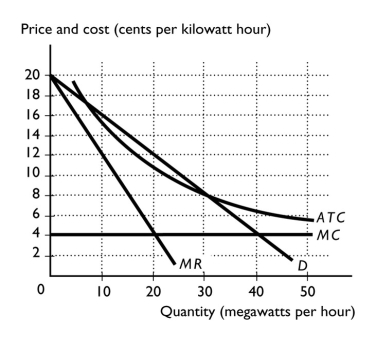 -The above figure illustrates the market for electric power that is served by the one utility in Alberta,Canada.
a.If the government did not regulate this utility,what would be the price of a kilowatt hour in this region and how much power would be generated?
b.If the government regulates the utility and chooses an average cost pricing rule,what would be the price of a kilowatt hour and how much power would be generated?
c.If the government regulates the utility and chooses a marginal cost pricing rule,what would be the price of a kilowatt hour and how much power would be generated?
-The above figure illustrates the market for electric power that is served by the one utility in Alberta,Canada.
a.If the government did not regulate this utility,what would be the price of a kilowatt hour in this region and how much power would be generated?
b.If the government regulates the utility and chooses an average cost pricing rule,what would be the price of a kilowatt hour and how much power would be generated?
c.If the government regulates the utility and chooses a marginal cost pricing rule,what would be the price of a kilowatt hour and how much power would be generated? (Essay)
4.9/5 (93)
(93) If a monopoly wants to sell a greater quantity of output,it must
(Multiple Choice)
4.8/5 (87)
(87) "A single-price monopoly will always charge a price that is on the elastic range of the demand for the monopoly's output." Explain why the previous statement is correct or incorrect.
(Essay)
4.8/5 (82)
(82) Which of the following is NOT a requirement for a firm to be able to price discriminate?
(Multiple Choice)
4.9/5 (72)
(72) When used with a natural monopoly,an average cost pricing rule results in
(Multiple Choice)
4.8/5 (72)
(72) To encourage invention and innovation,the government provides
(Multiple Choice)
4.9/5 (78)
(78)  The figure above shows a monopoly's total revenue and total cost curves.
-Using the figure above,which of the following statements are correct?
i.MR = MC = $42 when 3 haircuts are produced.
ii.If the firm charges each customer the same price for a haircut,the price of a haircut is $14.
iii.The firm's economic profit is $12.
The figure above shows a monopoly's total revenue and total cost curves.
-Using the figure above,which of the following statements are correct?
i.MR = MC = $42 when 3 haircuts are produced.
ii.If the firm charges each customer the same price for a haircut,the price of a haircut is $14.
iii.The firm's economic profit is $12. (Multiple Choice)
4.8/5 (75)
(75) Which of the following goods is the best example of a natural monopoly?
(Multiple Choice)
4.8/5 (83)
(83) A single-price monopoly has marginal revenue and marginal cost equal to $19 at 15 units of output where the price on the demand curve is $38.At what price will this firm sell the output?
(Multiple Choice)
4.7/5 (93)
(93)  -Suppose the grocery store market in Kansas City is perfectly competitive.Then one store buys all the others and becomes a single-price monopoly.The figure above shows the relevant demand and cost curves.When the market is perfectly competitive,the quantity of steak is ________ pounds,and when the market is a monopoly,the quantity of steak is ________ pounds.
 (Multiple Choice)
4.8/5 (79)
(79)  The figure above shows a natural monopoly.
-In the figure above,if the firm is regulated using an average cost pricing rule,the firm
The figure above shows a natural monopoly.
-In the figure above,if the firm is regulated using an average cost pricing rule,the firm (Multiple Choice)
4.8/5 (71)
(71) Monopolies are inefficient because,at the profit-maximizing output level,
(Multiple Choice)
4.9/5 (80)
(80) 
Filters
- Essay(0)
- Multiple Choice(0)
- Short Answer(0)
- True False(0)
- Matching(0)