



 Chat with AI
Exam 13: Sequences

Exam 1: Notation and Symbols329 Questions
Exam 2: Simplifying Expressions285 Questions
Exam 3: Paired Data and Graphing Ordered Pairs217 Questions
Exam 4: Multiplication With Exponents300 Questions
Exam 5: The Greatest Common Factor and Factoring by Grouping295 Questions
Exam 6: Reducing Rational Expressions to Lowest Terms263 Questions
Exam 7: Review of Solving Equations262 Questions
Exam 8: The Slope of a Line190 Questions
Exam 9: Rational Exponents264 Questions
Exam 10: Completing the Square187 Questions
Exam 11: Exponential Functions226 Questions
Exam 12: The Circle95 Questions
Exam 13: Sequences190 Questions
Select questions type


 and
 , find
 and
 .

If a boulder fell from the top of  in Hawaii, the distance, in feet, the boulder would fall in each consecutive second would be modeled by a sequence whose general term is
 where
 represents the number of seconds. Write a sequence for the first 5 seconds the boulder falls. __________ What is the total distance the boulder fell in 5 seconds? __________ ft If
 is approximately 420 feet high, will the boulder hit the ground within 8 seconds? Answer yes or no . __________
in Hawaii, the distance, in feet, the boulder would fall in each consecutive second would be modeled by a sequence whose general term is where represents the number of seconds. Write a sequence for the first 5 seconds the boulder falls. __________ What is the total distance the boulder fell in 5 seconds? __________ ft If is approximately 420 feet high, will the boulder hit the ground within 8 seconds? Answer yes or no . __________ (Short Answer)
4.7/5  (81)
(81) 
After 1 day, a colony of 40 bacteria reproduces to become 200 bacteria. After 2 days, they reproduce to become 1,000 bacteria. If they continue to reproduce at this rate, how many bacteria will be present after 6 days?
(Multiple Choice)
4.9/5 (90)
(90) The first four triangular numbers are {1, 3, 6, 10, . . . }, and are illustrated in the following diagram. 
 Write the recursive general term for the sequence of triangular numbers.
 (Multiple Choice)
4.7/5 (88)
(88) Determine whether the following sequence is an arithmetic progression. If the sequence is an arithmetic progression, identify the common difference d . 
(Multiple Choice)
4.7/5 (80)
(80) 
 for the sequence

Write the first four terms in the expansion of the following. 
(Multiple Choice)
4.7/5 (78)
(78) Find the sum of the first 50 terms of the sequence 5, 10, 15, 20, . . . .  __________
 (Short Answer)
4.8/5 (90)
(90) To save money for holiday presents, a person deposits $5 in a savings account on January 1, and then deposits an additional $5 every week thereafter until Christmas. If there are 50 weeks from January 1 to Christmas, how much money will be available for spending on Christmas presents?
(Multiple Choice)
5.0/5 (78)
(78) Write the first five terms of the sequence defined by the recursion formula. 
(Short Answer)
4.9/5 (72)
(72)  .
Write the first ten terms of the sequence defined by the recursion formula. 
(Short Answer)
4.8/5 (76)
(76) This problem gives some information about a specific geometric progression.  .
. (Multiple Choice)
4.8/5 (92)
(92) Write the first ten terms of the sequence defined by the recursion formula. 
(Multiple Choice)
4.8/5 (70)
(70) Write the first five terms of the sequence with the following general term. 
(Short Answer)
4.8/5 (77)
(77) Determine whether the following sequence is an arithmetic progression. If the sequence is an arithmetic progression, identify the common difference d .  Is the sequence an arithmetic progression? Answer yes or no . __________ What is the common difference? __________
 (Short Answer)
4.9/5 (89)
(89) Write the first five terms of the sequence with the following general term. 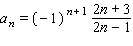
(Short Answer)
4.8/5 (74)
(74) Write the first five terms of the sequence defined by the recursion formula. 
(Multiple Choice)
4.7/5 (92)
(92) 
Filters
- Essay(0)
- Multiple Choice(0)
- Short Answer(0)
- True False(0)
- Matching(0)