



 Chat with AI
Exam 3: The Economic Problem

Exam 1: Getting Started347 Questions
Exam 2: The U.S.and Global Economies211 Questions
Exam 3: The Economic Problem283 Questions
Exam 4: Demand and Supply334 Questions
Exam 5: Elasticities of Demand and Supply342 Questions
Exam 6: Efficiency and Fairness of Markets362 Questions
Exam 7: Government Actions in Markets248 Questions
Exam 8: Taxes270 Questions
Exam 9: Global Markets in Action281 Questions
Exam 10: Externalities301 Questions
Exam 11: Public Goods and Common Resources180 Questions
Exam 12: Markets with Private Information103 Questions
Exam 13: Consumer Choice and Demand295 Questions
Exam 14: Production and Cost274 Questions
Exam 15: Perfect Competition285 Questions
Exam 16: Monopoly384 Questions
Exam 17: Monopolistic Competition221 Questions
Exam 18: Oligopoly228 Questions
Exam 19: Markets for Factors of Production188 Questions
Exam 20: Economic Inequality164 Questions
Select questions type


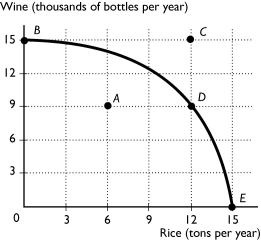 -The above figure shows the production possibility frontier for a country.Suppose the country is producing at point D.What would be the opportunity cost to move to point C?
 (Multiple Choice)
4.8/5  (78)
(78) Mary's production in 1 day Dresses 8 Jackets 12 Mark's production in 1 day Dresses 24 Jackets 16
-In the table above,how many jackets must Mark forgo for every dress he makes?
(Multiple Choice)
4.9/5 (85)
(85) If a nation has an absolute advantage in producing a good,then it
(Multiple Choice)
4.8/5 (85)
(85)  -Suppose that Germany,France,Estonia,and India all have the same production possibilities,illustrated in the figure above.Based on the production points in the figure,India is most likely to expand its PPF to
 (Multiple Choice)
4.8/5 (87)
(87)  -Deb and Pete have volunteered to help their favorite charity mail out fundraiser information.The figure above shows their production possibilities frontiers for assembling packets and stuffing envelopes.What is Deb's opportunity cost of assembling 1 packet?
 (Multiple Choice)
4.8/5 (73)
(73) Why is it likely that the United States has an absolute advantage in goods and yet it still ends up importing them from other countries?
(Essay)
5.0/5 (93)
(93) In one hour John can produce 20 loaves of bread or 16 cakes.In one hour Phyllis can produce 30 loaves of bread or 15 cakes.Which of the following statements is true?
(Multiple Choice)
4.8/5 (67)
(67) If there is increasing opportunity cost,then when moving downward on a production possibilities frontier,the opportunity cost of the good on the horizontal axis ________ as more of the good is produced.
(Multiple Choice)
4.8/5 (82)
(82) \ Production point A B C D Food (pounds) 24 and 16 and 8 and 0 and Clothing (pounds) 0 4 8 12 Production point A B C D Food (pounds) 45 and 30 and 15 and 0 and Clothing (pounds) 0 5 10 15
-In the table above,Jill's opportunity cost for 1 pound of food is ________ and her opportunity cost for 1 pound of clothing is ________.
(Multiple Choice)
4.9/5 (69)
(69) Once you find the opportunity cost of producing one unit of a good,to find the opportunity cost of producing the other good,you must
(Multiple Choice)
4.8/5 (84)
(84) The United States is one of the richest nations in the world,
(Multiple Choice)
4.7/5 (83)
(83) The United States has an absolute advantage in producing sugar over all of the other sugar producing countries.Does this fact mean that we should not import any sugar from the other countries?
(Essay)
4.9/5 (84)
(84) Draw a production possibilities frontier between beans and peas.Label the unattainable points,the attainable points with fully employed resources,and the attainable points with unemployed resources.
(Essay)
4.7/5 (88)
(88) When a nation is producing on its production possibilities frontier,if more resources are used to produce one good,then the production of other goods
(Multiple Choice)
4.9/5 (94)
(94)  -The figure above shows the production possibilities frontiers for the United Kingdom and France.What is the opportunity cost of one bushel of wheat for the United Kingdom?
 (Multiple Choice)
4.8/5 (74)
(74) Production possibilities frontiers usually curve out and away from the origin.The implication is
(Multiple Choice)
5.0/5 (62)
(62) In the movie Cast Away,Tom Hanks plays a FedEx efficiency expert stranded on a deserted island.While on the island,he divides his time between catching fish,gathering coconuts,painting,and building a raft.Suppose that these were Mr.Hanks' only activities.Did he face an opportunity cost from pursuing any of these activities? Why or why not?
(Essay)
4.8/5 (82)
(82) If workers in Mexico produce fewer goods and services per hour than workers in the United States in all areas of production,then
(Multiple Choice)
4.9/5 (89)
(89) 
Filters
- Essay(0)
- Multiple Choice(0)
- Short Answer(0)
- True False(0)
- Matching(0)