



 Chat with AI
Exam 4: Fractions, Decimals, Ratios, and Percents

Exam 1: Using the Calculator31 Questions
Exam 2: Numbers, Symbols of Operations, and the Mill60 Questions
Exam 3: Addition, Subtraction, Multiplication, and Division115 Questions
Exam 4: Fractions, Decimals, Ratios, and Percents80 Questions
Exam 5: Weights and Measures50 Questions
Exam 6: Using the Metric System of Measure93 Questions
Exam 7: Portion Control44 Questions
Exam 8: Converting Recipes, Yields, and Baking Formulas40 Questions
Exam 9: Food, Recipe, and Labor Costing51 Questions
Exam 10: Determining Cost Percentages and Pricing the Menu65 Questions
Exam 11: Inventory Procedures and Controlling Costs35 Questions
Exam 12: Purchasing and Receiving35 Questions
Exam 13: Daily Production Reports and Beverage Costs40 Questions
Exam 14: Front of the House and Managerial Mathematical Operations98 Questions
Exam 15: Personal Taxes, Payroll, and Financial Statements112 Questions
Select questions type


Change the following fractions to decimals. Use a zero when there is no whole number in the answer 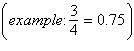 .
 (Round your answer to one decimal place.)
. (Round your answer to one decimal place.) (Short Answer)
4.8/5  (77)
(77) Match the following chapter terms with their definition.
Premises:
The bottom number of a fraction
Responses:
fraction
denominator
unlike fractions
Correct Answer: Verified
Premises:
Responses:
(Matching)
4.9/5 (72)
(72) When the total number of decimal places in the subproducts exceeds the number of numerals that appear in the product, ciphers are added to the right of the digits in the product to complete the decimal places needed.
(True/False)
4.9/5 (81)
(81) Match the following chapter terms with their definition.
Premises:
A fraction whose numerator is smaller than its denominator
Responses:
improper fraction
like fraction
proper fraction
Correct Answer:Verified
VerifiedPremises:
Responses:
(Matching)
4.9/5 (85)
(85) A ____________________ is a relation in size, number, amount, or degree of one thing compared to another.
(Short Answer)
4.7/5 (91)
(91) The numeral below the bar represents the number of equal parts into which the unit is divided and is called the _____.
(Multiple Choice)
4.9/5 (74)
(74) An example of a proportion is when preparing baked beans, the ratio is 2 to 1, that is, 2 parts liquid to 1 part beans.
(True/False)
4.9/5 (79)
(79) The symbol used to separate a whole number and a decimal fraction is a _____.
(Multiple Choice)
4.9/5 (79)
(79) A ____________________ ____________________ is a whole number mixed with a fractional part.
(Short Answer)
4.8/5 (76)
(76) When the total number of decimal places in the multiplicand and multiplier exceeds the number of numerals that appear in the product, _____ _______________ are added to the left of the digits in the product to complete the decimal places needed.
(Short Answer)
4.8/5 (72)
(72) When multiplying two fractions, multiply the two _____ and place the results over the result obtained by multiplying the two _____.
(Multiple Choice)
4.9/5 (82)
(82) When multiplying decimals, the total number of decimal places in the multiplicand and multiplier many times exceeds the number of numerals that appear in the product, so _____ are added to the left of the digits in the product to complete the decimal places needed.
(Multiple Choice)
4.8/5 (78)
(78) The least common numerator is the smallest number that is a multiple of both numerators.
(True/False)
4.9/5 (70)
(70) Match the following chapter terms with their definition.
Premises:
Rate or proportion of each hundred
Responses:
cipher
decimal
ratio
Correct Answer:Verified
VerifiedPremises:
Responses:
(Matching)
4.7/5 (83)
(83) To find what percent one number is of another number, subtract and then divide the number that represents the part by the number that represents the whole.
(True/False)
4.7/5 (80)
(80) Find the sum in each problem. 27 + 4.75 + 301.25 = _____ __________
(Short Answer)
4.8/5 (85)
(85) ____________________ ____________________ are those fractions that are expressed with denominators of 10 or powers of 10.
(Short Answer)
4.9/5 (93)
(93) 
Filters
- Essay(0)
- Multiple Choice(0)
- Short Answer(0)
- True False(0)
- Matching(0)