



 Chat with AI
Exam 8: Roots and Radicals

Exam 1: The Basics329 Questions
Exam 2: Linear Equations and Inequalities310 Questions
Exam 3: Linear Equations and Inequalities in Two Variables155 Questions
Exam 4: Systems of Linear Equations135 Questions
Exam 5: Exponents and Polynomials300 Questions
Exam 6: Factoring295 Questions
Exam 7: Rational Expressions302 Questions
Exam 8: Roots and Radicals215 Questions
Exam 9: Quadratic Equations212 Questions
Select questions type


The following statement is false. Correct the right side to make the statement true. 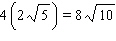
(Multiple Choice)
4.8/5  (96)
(96) Simplify the radical expression as much as possible. Assume the variable represents a positive number. 
(Multiple Choice)
4.9/5 (70)
(70) Simplify each term, if necessary, and then use the distributive property to combine terms, if possible. 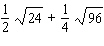
(Essay)
4.8/5 (85)
(85) 

Perform the multiplication. Give your answer in simplified form for radical expressions. 
(Multiple Choice)
4.8/5 (92)
(92) Solve the equation by applying the squaring property of equality. Be sure to check all solutions in the original equation. 
(Multiple Choice)
4.8/5 (69)
(69) Complete the table. If an answer needs rounding, round to the nearest thousandth. 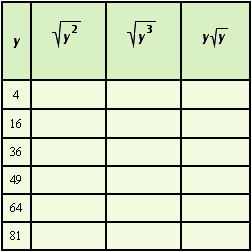
(Multiple Choice)
4.9/5 (97)
(97) Use combinations of properties 1 and 2 for radicals to simplify the following expression as much as possible. Assume all variables represent positive numbers. 
(Essay)
4.8/5 (63)
(63) Use property 2 of the radicals to simplify the following. Assume all variables represent positive numbers. 
(Essay)
4.9/5 (66)
(66) Simplify each term, if necessary, and then use the distributive property to combine terms, if possible. 
(Multiple Choice)
4.8/5 (72)
(72) All variables in the problem below represent positive real numbers. Simplify each term, and combine, if possible. 
(Multiple Choice)
4.8/5 (75)
(75) Perform the multiplication. Give your answer in simplified form for radical expressions. 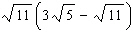
(Essay)
4.9/5 (70)
(70) Use combinations of properties 1 and 2 for radicals to simplify the following expression as much as possible. Assume all variables represent positive numbers. 
(Essay)
4.8/5 (68)
(68) Complete the table. If an answer needs rounding, round to the nearest thousandth. 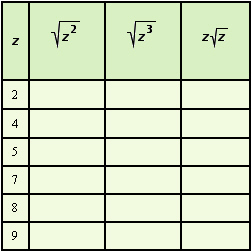
(Multiple Choice)
4.8/5 (74)
(74) The number of seconds T it takes the pendulum of a grandfather clock to swing through one complete cycle is given by the formula below.  L is the length, in feet, of the pendulum. Find how long the pendulum must be for one complete cycle to take 5 seconds by substituting 5 for T in the formula and then solving for L . Round the answer to the nearest tenth.
 (Multiple Choice)
4.9/5 (71)
(71) Simplify each term, if necessary, and then use the distributive property to combine terms, if possible. 
(Multiple Choice)
4.8/5 (85)
(85) 

Solve the equation by applying the squaring property of equality. Be sure to check all solutions in the original equation. 
(Multiple Choice)
4.8/5 (77)
(77) 
Filters
- Essay(0)
- Multiple Choice(0)
- Short Answer(0)
- True False(0)
- Matching(0)