



 Chat with AI
Exam 6: The Economics of Political Action

Exam 1: The Economic Approach185 Questions
Exam 2: Some Tools of the Economist204 Questions
Exam 3: Demand, Supply, and the Market Process339 Questions
Exam 4: Supply and Demand: Applications and Extensions268 Questions
Exam 5: Difficult Cases for the Market, and the Role of Government134 Questions
Exam 6: The Economics of Political Action161 Questions
Exam 7: Taking the Nations Economic Pulse222 Questions
Exam 8: Economic Fluctuations, Unemployment, and Inflation182 Questions
Exam 9: An Introduction to Basic Macroeconomic Markets219 Questions
Exam 10: Dynamic Change, Economic Fluctuations, and the Ad--As Model193 Questions
Exam 11: Fiscal Policy: The Keynesian View and the Historical Development of Macroeconomics112 Questions
Exam 12: Fiscal Policy: Incentives, and Secondary Effects154 Questions
Exam 13: Money and the Banking System198 Questions
Exam 14: Modern Macroeconomics and Monetary Policy204 Questions
Exam 15: Stabilization Policy, Output, and Employment170 Questions
Exam 16: Creating an Environment for Growth and Prosperity125 Questions
Exam 17: Institutions, Policies, and Cross-Country Differences in Income and Growth115 Questions
Exam 18: Gaining From International Trade182 Questions
Exam 19: International Finance and the Foreign Exchange Market148 Questions
Exam 20: Special Topics274 Questions
Select questions type


Pork-barrel legislation typically bundles the pet projects of several special interest groups. Such legislation
(Multiple Choice)
4.8/5  (71)
(71) Use the figure below to answer the following question(s). Figure 6-1
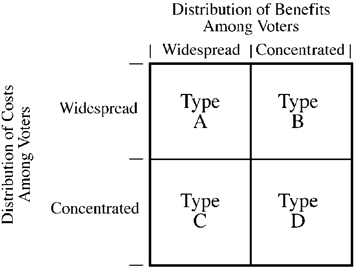 Figure 6-1 illustrates the four possibilities of the distribution of costs and benefits among voters for a government project. For which type would the government most likely fail to undertake many projects that would be considered efficient or productive (in other words, do too few of them relative to economic efficiency)?
 (Multiple Choice)
4.8/5 (74)
(74) In which one of the following situations is the political process most likely to result in both the acceptance of efficient (productive) programs and the rejection of inefficient (counterproductive) political activities?
(Multiple Choice)
4.8/5 (80)
(80) In which case is the political process most likely to result in the acceptance of efficient projects and rejection of inefficient projects?
(Multiple Choice)
4.9/5 (76)
(76) In 2006, the American Association of Retired Persons (AARP) spent over $70 million on lobbying-related expenses in an attempt to get policies enacted that would benefit retirees. In economics, the term used to describe such activity is
(Multiple Choice)
4.9/5 (80)
(80) Which of the following increases the political power of special interest groups and makes counterproductive government action more likely?
(Multiple Choice)
4.8/5 (72)
(72) According to the economic way of thinking, personal benefits and costs influence the actions of
(Multiple Choice)
4.9/5 (82)
(82) Which of the following explains why elected representatives will find borrowing to be an attractive method of financing current government programs?
(Multiple Choice)
4.8/5 (80)
(80) When governments become more heavily involved in taxing one group in order to provide benefits to other groups, which of the following will be encouraged?
(Multiple Choice)
4.9/5 (76)
(76) When politicians support policies that benefit small interest groups, such as farmers, at the expense of unorganized, widely dispersed groups, for example, taxpayers or consumers, this is a reflection of the
(Multiple Choice)
4.9/5 (76)
(76) Assume that you are a member of the U.S. House of Representatives from your home state and district. Which of the following best explains why you have a strong incentive to get the federal government to finance pork-barrel projects in your district?
(Multiple Choice)
4.9/5 (107)
(107) Public choice analysis indicates that politicians will find
(Multiple Choice)
4.9/5 (81)
(81) Which of the following refers to when legislators trade votes on legislation?
(Multiple Choice)
4.9/5 (83)
(83) Senator Blacklung represents a state that grows a significant amount of tobacco. Not only do many of his constituents work for businesses in this industry, but the tobacco firms also make generous contributions to his reelection campaign. According to public choice theory, which of the following bills would Senator Blacklung be most likely to support?
(Multiple Choice)
4.8/5 (84)
(84) In a representative democracy, government action results from the
(Multiple Choice)
4.7/5 (87)
(87) When the tax to fund a government project is allocated among voters in proportion to the benefits they receive from the project,
(Multiple Choice)
5.0/5 (80)
(80) 
Filters
- Essay(0)
- Multiple Choice(0)
- Short Answer(0)
- True False(0)
- Matching(0)