



 Chat with AI
Exam 3: Demand, Supply, and the Market Process

Exam 1: The Economic Approach185 Questions
Exam 2: Some Tools of the Economist204 Questions
Exam 3: Demand, Supply, and the Market Process339 Questions
Exam 4: Supply and Demand: Applications and Extensions268 Questions
Exam 5: Difficult Cases for the Market, and the Role of Government134 Questions
Exam 6: The Economics of Political Action161 Questions
Exam 7: Taking the Nations Economic Pulse222 Questions
Exam 8: Economic Fluctuations, Unemployment, and Inflation182 Questions
Exam 9: An Introduction to Basic Macroeconomic Markets219 Questions
Exam 10: Dynamic Change, Economic Fluctuations, and the Ad--As Model193 Questions
Exam 11: Fiscal Policy: The Keynesian View and the Historical Development of Macroeconomics112 Questions
Exam 12: Fiscal Policy: Incentives, and Secondary Effects154 Questions
Exam 13: Money and the Banking System198 Questions
Exam 14: Modern Macroeconomics and Monetary Policy204 Questions
Exam 15: Stabilization Policy, Output, and Employment170 Questions
Exam 16: Creating an Environment for Growth and Prosperity125 Questions
Exam 17: Institutions, Policies, and Cross-Country Differences in Income and Growth115 Questions
Exam 18: Gaining From International Trade182 Questions
Exam 19: International Finance and the Foreign Exchange Market148 Questions
Exam 20: Special Topics274 Questions
Select questions type


If consumer purchases of a good are highly sensitive to the price of the good, this is illustrated by a
(Multiple Choice)
4.8/5  (82)
(82) Which of the following is true of the interaction of supply and demand?
(Multiple Choice)
4.8/5 (73)
(73) Suppose a person defects from Cuba (a country that generally disregards the use of markets) to the United States and asks to see a market in action. Where would you take her? Did you give her a complete showing of this market?
(Essay)
4.8/5 (79)
(79) Table 3-2 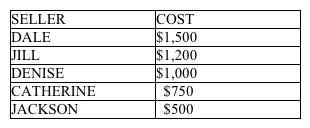 Refer to Table 3-2. Suppose each of the five sellers can supply at most one unit of the good; then the market quantity supplied is exactly 3 if the price is
 (Multiple Choice)
4.7/5 (75)
(75) Figure 3-22 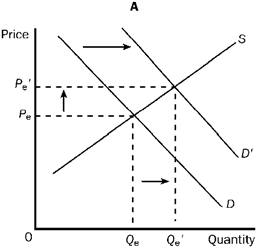
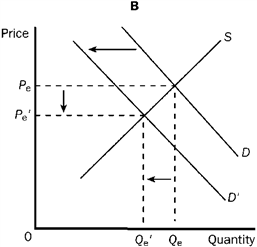
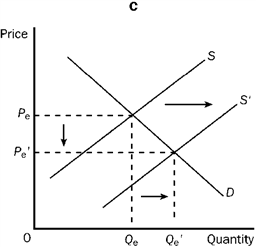
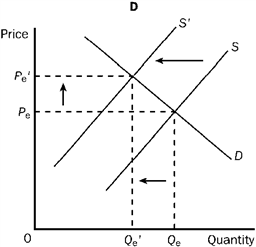 Refer to Figure 3-22. Graph C shows which of the following?
 (Multiple Choice)
4.9/5 (68)
(68) Susan says, "If the price of wool coats goes up, suppliers will offer more of the coats for sale." Brad replies, "It takes three months to harvest wool and employ all the steps necessary to produce a wool coat. Quantity supplied cannot possibly increase for three months." Is Brad correct? Why or why not?
(Essay)
4.9/5 (88)
(88) Table 3-2 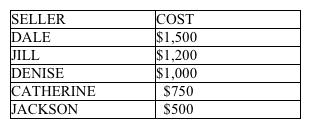 Refer to Table 3-2. If the market price is $1,000, the producer surplus in the market is
 (Multiple Choice)
4.7/5 (86)
(86) If price falls, what happens to the quantity demanded for a product?
(Multiple Choice)
4.9/5 (87)
(87) Other things constant, an increase in consumer income will
(Multiple Choice)
4.8/5 (77)
(77) Figure 3-12 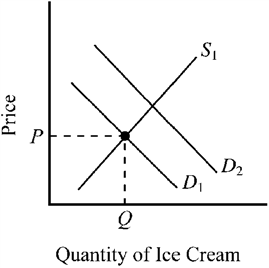 In Figure 3-12, suppose D1 and S1 indicate initial conditions in the market for ice cream. Which of the following changes would tend to shift this market from D1 to D2?
 (Multiple Choice)
4.8/5 (74)
(74) Which of the following best explains the source of consumer surplus for a particular product?
(Multiple Choice)
5.0/5 (81)
(81) If the supply of a good is relatively elastic, this means that the quantity supplied of the good is
(Multiple Choice)
4.8/5 (78)
(78) How will consumers generally react to an increase in the price of butter?
(Multiple Choice)
4.7/5 (87)
(87) If price rises, what happens to quantity supplied of a product?
(Multiple Choice)
4.9/5 (69)
(69) Figure 3-22 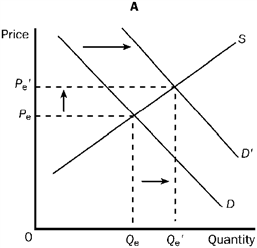
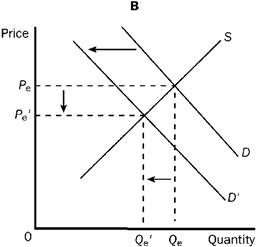
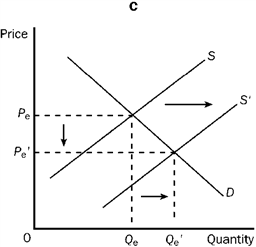
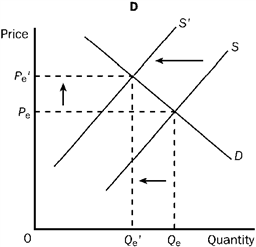 Refer to Figure 3-22. Which of the four graphs represents the market for peanut butter after a major hurricane hits the peanut-growing south?
 (Multiple Choice)
4.8/5 (97)
(97) When economists say the demand for a product has decreased, they mean
(Multiple Choice)
4.8/5 (77)
(77) 
Filters
- Essay(0)
- Multiple Choice(0)
- Short Answer(0)
- True False(0)
- Matching(0)