



 Chat with AI
Exam 3: Preparing Your Taxes

Exam 1: Understanding the Financial Planning Process124 Questions
Exam 2: Developing Your Financial Statements and Plans122 Questions
Exam 3: Preparing Your Taxes87 Questions
Exam 4: Managing Your Cash and Savings101 Questions
Exam 5: Making Automobile and Housing Decisions100 Questions
Exam 6: Using Credit108 Questions
Exam 7: Using Consumer Loans94 Questions
Exam 8: Insuring Your Life107 Questions
Exam 9: Insuring Your Health82 Questions
Exam 10: Protecting Your Property75 Questions
Exam 11: Investment Planning102 Questions
Exam 12: Investing in Stocks and Bonds97 Questions
Exam 13: Investing in Mutual Funds and Real Estate80 Questions
Exam 14: Planning for Retirement81 Questions
Exam 15: Preserving Your Estate73 Questions
Select questions type


The Internal Revenue Service (IRS) will compute taxes for those whose taxable income is less than $100,000 and who do not itemize deductions.
(True/False)
4.9/5  (86)
(86) Which of the following determines the amount of income subject to federal income taxes?
(Multiple Choice)
4.7/5 (97)
(97) Jamie has taxable income of $45,000. She is single, and her tax rate is 10% on the first $9,525 of the taxable income, 12% on the amount over $9,525 up to $38,700 of the taxable income, and 22% on the remainder. What are Jamie's tax liability, marginal tax rate, and average tax rate? (Show all work. Round dollar amounts to the nearest cent and percentages to two decimal places.)
(Essay)
4.9/5 (88)
(88) Ben and Jack both earned $60,000 this year. Ben (age 30) is married with two children, and Jack (age 68) is single with no dependents. Which of the following statements regarding the amount of Social Security taxes they will have to pay is true?
(Multiple Choice)
4.7/5 (63)
(63) Based on the given information, what is Max's portfolio income?
Interest from savings account $1,000
Capital gains realized 5,000
Salary 8,000
(Multiple Choice)
4.9/5 (71)
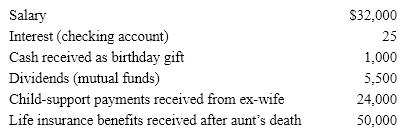
(71) From the following information, determine Steve's gross income for tax purposes.
(Essay)
4.8/5 (71)
(71) A taxpayer can file for an automatic extension of _____ months.
(Multiple Choice)
5.0/5 (75)
(75) INSTRUCTIONS: Choose the word or phrase in [ ] which will correctly complete the statement. Select A for the first item, B for the second item, and C if neither item will correctly complete the statement.
[ Itemized deductions | Exemptions ] allow taxpayers to reduce their adjusted gross income (AGI) by the amount of their personal expenditures.
(Short Answer)
4.9/5 (73)
(73) Mr. and Mrs. Davenport, ages 40 and 38, respectively, have three children, ages 3, 6, and 13. For 2019, they have adjusted gross income (AGI) of $65,000 and unreimbursed medical expenses of $6,750. The Davenports' claim for itemized deductions for medical expenses is:
(Multiple Choice)
5.0/5 (89)
(89) Pete and Pam are married with four dependent children. Which of the following filing statuses can Pete and Pam use if they want to legally file one tax return?
(Multiple Choice)
4.9/5 (67)
(67) Your take-home pay is what you are left with after subtracting withholdings from your:
(Multiple Choice)
4.8/5 (86)
(86) Melinda sold mutual fund shares, which she had owned for 5 years, so that she could use the proceeds to travel with her sister. Melinda is in the 32% ordinary tax bracket, and her capital gain from the sale was $40,000. Melinda's tax liability on the gain is:
(Multiple Choice)
4.7/5 (78)
(78) Which of the following is an illegal method of reducing your current tax liability?
(Multiple Choice)
4.8/5 (75)
(75) All taxpayers have an equal probability of having their tax returns audited.
(True/False)
4.8/5 (76)
(76) Shawn earns $65,000. If the total Social Security tax rate is 15.3%, how much is his Social Security tax? How much does his employer pay toward Social Security taxes for Shawn? (Show all work and round to the nearest dollar.)
(Essay)
4.8/5 (80)
(80) 
Filters
- Essay(0)
- Multiple Choice(0)
- Short Answer(0)
- True False(0)
- Matching(0)