



 Chat with AI
Exam 12: Valuation: Cash-Flow Based Approaches

Exam 1: Overview of Financial Reporting, Financial Statement Analysis, and Valuation91 Questions
Exam 2: Asset and Liability Valuation and Income Recognition70 Questions
Exam 3: Income Flows Versus Cash Flows: Understanding the Statement of Cash Flows74 Questions
Exam 4: Profitability Analysis86 Questions
Exam 5: Risk Analysis69 Questions
Exam 6: Financing Activities70 Questions
Exam 7: Investing Activities60 Questions
Exam 8: Operating Activities92 Questions
Exam 9: Accounting Quality68 Questions
Exam 10: Forecasting Financial Statements51 Questions
Exam 11: Risk-Adjusted Expected Rates of Return and the Dividends Valuation Approach44 Questions
Exam 12: Valuation: Cash-Flow Based Approaches52 Questions
Exam 13: Valuation: Earnings-Based Approaches49 Questions
Exam 14: Valuation: Market-Based Approaches55 Questions
Select questions type


The risk-adjusted discount rate used to compute the present value of all the projected free cash flows for common equity shareholders equals the _______________________________________________________.
(Short Answer)
5.0/5  (80)
(80) ________________________________________ typically include accounts payable, accrued expenses, accrued taxes, deferred taxes, pension obligations and other retirement benefit obligations.
(Short Answer)
4.7/5 (75)
(75) Regarding the equity buyout, compute the cost of equity capital with the new capital structure that results from the LBO. Assume a risk-free rate of 3.75percent and a market risk premium of 5.0 percent.
(Essay)
4.9/5 (91)
(91) Houston, Inc.
The following information pertains to Houston, Inc. a manufacturer of belt buckles:
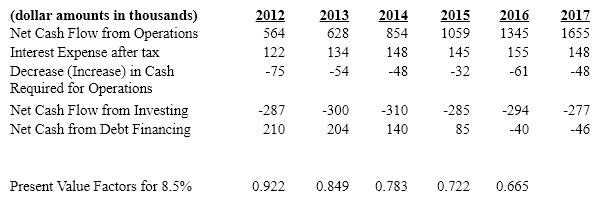 What is Houston's free cash flow for all debt and equity holders for year 2012?
 (Multiple Choice)
4.8/5 (78)
(78) The present value of future free cash flows valuation method focuses on free cash flows, a base that economists argue has more economic meaning than ____________________.
(Short Answer)
4.9/5 (81)
(81) The cash-flow-based valuation approach measures and values the cash flows that are "free" to be ________________________________________ unencumbered by necessary reinvestments in operating assets or required payments to debt holders.
(Short Answer)
4.9/5 (75)
(75) Net cash flow from operations ________________ dividends equals_______________________
(Short Answer)
4.7/5 (84)
(84) When should an analyst use nominal cash flows and when should an analyst use real cash flows?
(Essay)
5.0/5 (97)
(97) Provide the rationale for using expected free cash flow in valuation.
(Essay)
4.7/5 (71)
(71) Discuss under which scenario it is appropriate to use free cash flows for all debt and equity capital stakeholders.
(Essay)
4.7/5 (66)
(66) If the objective is to value operating assets net of operating liabilities of a firm then the appropriate free cash flow measure to be used is ______________________________________________________________________.
(Short Answer)
4.9/5 (89)
(89) If an analyst wants to value a potential investment in the common stock equity of a firm, the analyst should discount the projected free cash flows at the:
(Multiple Choice)
4.8/5 (76)
(76) Explain "free" cash flows. Describe which types of cash flows are free and which are not. How do free cash flows available for debt and equity stakeholders differ from free cash flows available for common equity shareholders?
(Essay)
4.8/5 (83)
(83) The conceptual framework for free cash flows separates all assets and liabilities into the following categories:
(Multiple Choice)
4.8/5 (79)
(79) Even in relatively efficient securities markets, ______ is observable but ______ is not; therefore, ______ must be estimated.
(Short Answer)
4.9/5 (83)
(83) Steady-state growth in ___________________________________ could be driven by long-run expectations for growth attributable to economy-wide inflation, general economic productivity, the population, or long-run growth in industry's sales.
(Short Answer)
4.8/5 (72)
(72) Regarding the equity buyout, compute the weighted average cost of capital of the new capital structure.
(Essay)
4.9/5 (85)
(85) 
Filters
- Essay(0)
- Multiple Choice(0)
- Short Answer(0)
- True False(0)
- Matching(0)