



 Chat with AI
Exam 17: Taxation and Resource Allocation

Exam 1: What Is Economics261 Questions
Exam 2: The Economy: Myth and Reality185 Questions
Exam 3: The Fundamental Economic Problem: Scarcity and Choice290 Questions
Exam 4: Supply and Demand: an Initial Look337 Questions
Exam 5: Consumer Choice: Individual and Market Demand243 Questions
Exam 6: Demand and Elasticity254 Questions
Exam 7: Production, Inputs, and Cost: Building Blocks for Supply Analysis260 Questions
Exam 8: Output, Price, and Profit: the Importance of Marginal Analysis234 Questions
Exam 9: The Financial Markets and the Economy: the Tail That Wags the Dog227 Questions
Exam 10: The Firm and the Industry Under Perfect Competition253 Questions
Exam 11: The Case for Free Markets: the Price System259 Questions
Exam 12: Monopoly244 Questions
Exam 13: Between Competition and Monopoly254 Questions
Exam 14: Limiting Market Power: Antitrust and Regulation155 Questions
Exam 15: The Shortcomings of Free Markets219 Questions
Exam 16: Externalities, Externaliteis, the Environment, and Natural Resources222 Questions
Exam 17: Taxation and Resource Allocation221 Questions
Exam 18: Pricing the Factors of Production233 Questions
Exam 19: Labor and Entrepreneurship: the Human Inputs271 Questions
Exam 20: Poverty, Inequality, and Discrimination171 Questions
Exam 21: International Trade and Comparative Advantage226 Questions
Exam 22: Contemporary Issues in the Us Economy23 Questions
Select questions type


The way in which most persons pay their personal income tax is in the form of
(Multiple Choice)
4.9/5  (90)
(90) Horizontal equity is a difficult concept to implement because
(Multiple Choice)
4.8/5 (78)
(78) Figure 18-3
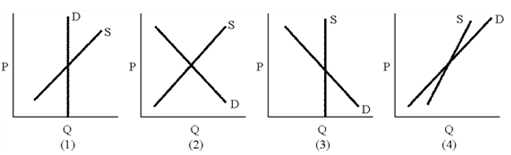 In which panel of Figure 18-3 would an excise tax be borne entirely by the supplier?
 (Multiple Choice)
4.7/5 (92)
(92) One major problem with Social Security is that it is a "pay as you go" system.
(True/False)
4.8/5 (89)
(89) If Ron earns $50,000 in salary and pays income taxes of $15,000, and Harry earns $50,000 from investment dividends taxed at 20 percent, this would be
(Multiple Choice)
4.9/5 (68)
(68) Which of the following is most consistent with the benefits principle?
(Multiple Choice)
4.7/5 (86)
(86) The share of GDP taken by taxes has increased dramatically since the 1960s.
(True/False)
4.8/5 (76)
(76) If Hermione pays $10.00 in taxes on $100 of income and $10.25 on $101 of income, which of the following is not true?
(Multiple Choice)
5.0/5 (86)
(86) If Linda' annual income is $160,000 and she pays $35,000 in taxes, and Paul's annual income is $100,000 and he pays $25,000 in taxes, the tax system is
(Multiple Choice)
4.9/5 (74)
(74) When we say most Americans are in the 15-percent tax bracket, we mean federal taxes are about 15 percent of the income of most Americans.
(True/False)
4.8/5 (87)
(87) Over the past decade, increasing real wages have offset slower population growth adding to the Social Security Trust Fund.
(True/False)
4.8/5 (78)
(78) For about the past 45 years, federal taxes have remained relatively constant as a percentage of GDP.
(True/False)
4.8/5 (82)
(82) In Country X, the government requires employers to collect 9 percent of every employee's compensation as payroll tax. This is an example of
(Multiple Choice)
4.9/5 (80)
(80) The federal income tax began in the United States with the
(Multiple Choice)
4.8/5 (85)
(85) A head tax applied to each person in the United States would
(Multiple Choice)
4.8/5 (75)
(75) 
Filters
- Essay(0)
- Multiple Choice(0)
- Short Answer(0)
- True False(0)
- Matching(0)