



 Chat with AI
Exam 13: Between Competition and Monopoly

Exam 1: What Is Economics261 Questions
Exam 2: The Economy: Myth and Reality185 Questions
Exam 3: The Fundamental Economic Problem: Scarcity and Choice290 Questions
Exam 4: Supply and Demand: an Initial Look337 Questions
Exam 5: Consumer Choice: Individual and Market Demand243 Questions
Exam 6: Demand and Elasticity254 Questions
Exam 7: Production, Inputs, and Cost: Building Blocks for Supply Analysis260 Questions
Exam 8: Output, Price, and Profit: the Importance of Marginal Analysis234 Questions
Exam 9: The Financial Markets and the Economy: the Tail That Wags the Dog227 Questions
Exam 10: The Firm and the Industry Under Perfect Competition253 Questions
Exam 11: The Case for Free Markets: the Price System259 Questions
Exam 12: Monopoly244 Questions
Exam 13: Between Competition and Monopoly254 Questions
Exam 14: Limiting Market Power: Antitrust and Regulation155 Questions
Exam 15: The Shortcomings of Free Markets219 Questions
Exam 16: Externalities, Externaliteis, the Environment, and Natural Resources222 Questions
Exam 17: Taxation and Resource Allocation221 Questions
Exam 18: Pricing the Factors of Production233 Questions
Exam 19: Labor and Entrepreneurship: the Human Inputs271 Questions
Exam 20: Poverty, Inequality, and Discrimination171 Questions
Exam 21: International Trade and Comparative Advantage226 Questions
Exam 22: Contemporary Issues in the Us Economy23 Questions
Select questions type


A successful cartel may end up charging the ____ price and obtaining ____ profits.
(Multiple Choice)
4.9/5  (80)
(80) An oligopoly can be characterized by production of either identical goods or differentiated goods.
(True/False)
4.8/5 (77)
(77) If two firms form a successful cartel, then the output that the two produce in total will
(Multiple Choice)
5.0/5 (81)
(81) Monopolistically competitive firms can earn large profits in the long run.
(True/False)
4.8/5 (69)
(69) In an oligopoly market, the firms would earn the highest profit if they
(Multiple Choice)
4.9/5 (79)
(79) To understand most of today's economic activity in the U.S. economy, we should look at which of the following models?
(Multiple Choice)
4.8/5 (81)
(81) Monopolistic competitors and perfect competitors are alike in
(Multiple Choice)
4.8/5 (75)
(75) The kinked demand curve model explains pricing in monopoly markets.
(True/False)
4.8/5 (90)
(90) Suppose that we learn that hotels in Los Angeles generally operate with an average vacancy rate of 15 percent (in other words, 85 percent of the hotel rooms are filled with guests). Given this information about excess capacity, we would judge this market to be
(Multiple Choice)
4.9/5 (92)
(92) Figure 13-4
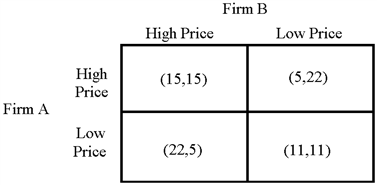
The above matrix (Figure 13-4)displays the possible profit results of two firms, A and B, from following two different possible strategies: charging a high price and charging a low price. In each cell, the first number is the profit of firm A, and the second number is the profit of firm B.
a. Assume that collusion is not possible. Determine the optimal strategy for each firm. Explain why it is the best strategy to follow.
b. Based on your answer to a., explain why firms collude. What are the pitfalls of collusion?
The above matrix (Figure 13-4)displays the possible profit results of two firms, A and B, from following two different possible strategies: charging a high price and charging a low price. In each cell, the first number is the profit of firm A, and the second number is the profit of firm B.
a. Assume that collusion is not possible. Determine the optimal strategy for each firm. Explain why it is the best strategy to follow.
b. Based on your answer to a., explain why firms collude. What are the pitfalls of collusion? (Essay)
4.8/5 (79)
(79) Monopolistically competitive markets feature heterogeneous products.
(True/False)
4.7/5 (76)
(76) OPEC became a successful cartel in the 1970s by deciding to restrict oil production.
(True/False)
4.9/5 (87)
(87) In Figure 13-2, which of the graphs represents a firm that is a sales revenue maximizer?
(Multiple Choice)
5.0/5 (77)
(77) 
Filters
- Essay(0)
- Multiple Choice(0)
- Short Answer(0)
- True False(0)
- Matching(0)