



 Chat with AI
Exam 3: The Fundamental Economic Problem: Scarcity and Choice

Exam 1: What Is Economics261 Questions
Exam 2: The Economy: Myth and Reality185 Questions
Exam 3: The Fundamental Economic Problem: Scarcity and Choice290 Questions
Exam 4: Supply and Demand: an Initial Look337 Questions
Exam 5: Consumer Choice: Individual and Market Demand243 Questions
Exam 6: Demand and Elasticity254 Questions
Exam 7: Production, Inputs, and Cost: Building Blocks for Supply Analysis260 Questions
Exam 8: Output, Price, and Profit: the Importance of Marginal Analysis234 Questions
Exam 9: The Financial Markets and the Economy: the Tail That Wags the Dog227 Questions
Exam 10: The Firm and the Industry Under Perfect Competition253 Questions
Exam 11: The Case for Free Markets: the Price System259 Questions
Exam 12: Monopoly244 Questions
Exam 13: Between Competition and Monopoly254 Questions
Exam 14: Limiting Market Power: Antitrust and Regulation155 Questions
Exam 15: The Shortcomings of Free Markets219 Questions
Exam 16: Externalities, Externaliteis, the Environment, and Natural Resources222 Questions
Exam 17: Taxation and Resource Allocation221 Questions
Exam 18: Pricing the Factors of Production233 Questions
Exam 19: Labor and Entrepreneurship: the Human Inputs271 Questions
Exam 20: Poverty, Inequality, and Discrimination171 Questions
Exam 21: International Trade and Comparative Advantage226 Questions
Exam 22: Contemporary Issues in the Us Economy23 Questions
Select questions type


Table 3-1 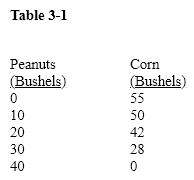 Suppose a farmer is currently producing 50 bushels of corn and 10 bushels of peanuts. According to Table 3-1, the opportunity cost of 10 additional bushels of peanuts is
 (Multiple Choice)
4.8/5  (86)
(86) A student has a chance to see Katy Perry in concert. The student also has a major economics exam the next day. If the student goes to the concert,
(Multiple Choice)
4.9/5 (75)
(75) A decrease in the unemployment rate will shift the production possibilities frontier outward from the origin.
(True/False)
4.8/5 (74)
(74) Which of the following is not an example of a type of factor of production?
(Multiple Choice)
4.9/5 (78)
(78) Suppose a presidential candidate campaigns on the need to improve U.S. infrastructure, a term for capital goods like bridges, highways, and technology (much of it publicly owned). Which would lead to faster growth: government expenditure on capital goods or expenditure on consumption goods such as sports stadiums? Illustrate your answer, drawing appropriate production possibilities frontiers accompanied by an explanation.
(Essay)
4.8/5 (73)
(73) In a market economy, opportunity costs are always synonymous with explicit monetary costs.
(True/False)
4.8/5 (91)
(91) If an economy wants to experience economic growth, what decision must it make and carry out? Explain.
(Essay)
4.9/5 (89)
(89) List the three coordination decisions made by every economy.
(Multiple Choice)
4.7/5 (83)
(83) The principle of comparative advantage was first explained by David Ricardo in the early 1800s.
(True/False)
4.9/5 (73)
(73) An economy that is producing inside its production possibilities frontier can be efficient.
(True/False)
4.9/5 (89)
(89) Although finished goods are scarce, the inputs to produce them are not scarce.
(True/False)
4.9/5 (61)
(61) If the production possibilities frontier for guns and butter is bowed outward from the origin, this indicates constant opportunity cost between the two goods.
(True/False)
4.9/5 (88)
(88) Which of the following is a good example of efficient specialization and voluntary exchange?
(Multiple Choice)
5.0/5 (73)
(73) Probably the most important source of efficiency in production is
(Multiple Choice)
5.0/5 (79)
(79) 
Filters
- Essay(0)
- Multiple Choice(0)
- Short Answer(0)
- True False(0)
- Matching(0)