



 Chat with AI
Exam 1: What Is Economics

Exam 1: What Is Economics261 Questions
Exam 2: The Economy: Myth and Reality185 Questions
Exam 3: The Fundamental Economic Problem: Scarcity and Choice290 Questions
Exam 4: Supply and Demand: an Initial Look337 Questions
Exam 5: Consumer Choice: Individual and Market Demand243 Questions
Exam 6: Demand and Elasticity254 Questions
Exam 7: Production, Inputs, and Cost: Building Blocks for Supply Analysis260 Questions
Exam 8: Output, Price, and Profit: the Importance of Marginal Analysis234 Questions
Exam 9: The Financial Markets and the Economy: the Tail That Wags the Dog227 Questions
Exam 10: The Firm and the Industry Under Perfect Competition253 Questions
Exam 11: The Case for Free Markets: the Price System259 Questions
Exam 12: Monopoly244 Questions
Exam 13: Between Competition and Monopoly254 Questions
Exam 14: Limiting Market Power: Antitrust and Regulation155 Questions
Exam 15: The Shortcomings of Free Markets219 Questions
Exam 16: Externalities, Externaliteis, the Environment, and Natural Resources222 Questions
Exam 17: Taxation and Resource Allocation221 Questions
Exam 18: Pricing the Factors of Production233 Questions
Exam 19: Labor and Entrepreneurship: the Human Inputs271 Questions
Exam 20: Poverty, Inequality, and Discrimination171 Questions
Exam 21: International Trade and Comparative Advantage226 Questions
Exam 22: Contemporary Issues in the Us Economy23 Questions
Select questions type


An introductory course in economics should allow a student to
(Multiple Choice)
4.7/5  (92)
(92) The market price of a transaction always includes all of the costs and benefits associated with the transaction.
(True/False)
4.8/5 (76)
(76) Externalities are costs to society, which have an impact on parties not directly involved into a particular economic transaction.
(True/False)
4.8/5 (81)
(81) In economic theorizing, common sense will always lead to the correct answer.
(True/False)
4.9/5 (77)
(77) When nations trade based upon comparative advantage, only one side of the transaction will benefit.
(True/False)
4.7/5 (76)
(76) A contour map illustrates a cause-and-effect relationship among three variables.
(True/False)
4.8/5 (82)
(82) Suppose Tammy grew up on a farm and is very good at plowing. In addition, suppose she is a popular country singer who earns $4,000 per performance. If her husband Bob can plow (but not as well as Tammy)but he can't carry a tune, then it would be most efficient if
(Multiple Choice)
4.9/5 (67)
(67) How does correlation differ from causation? Give an example of each to illustrate your answer.
(Essay)
4.8/5 (69)
(69) There is an inverse relationship between inflation and unemployment in the short run and this can be seen as an
(Multiple Choice)
4.8/5 (93)
(93) The word "theory" means the same to the scientist as it does to the man on the street.
(True/False)
4.9/5 (89)
(89) A music venue discovers that its concerts consistently have empty seats in the back rows of the facility. If the venue owner uses marginal analysis to evaluate this situation, he should
(Multiple Choice)
4.9/5 (78)
(78) Figure 1-2
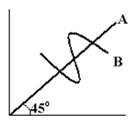 Identify the slope of the two curves A and B in Figure 1-2.
 (Multiple Choice)
4.9/5 (89)
(89) In contrast to the United States, the European Union has chosen
(Multiple Choice)
4.9/5 (67)
(67) The achievement of greater efficiency in the United States has been at the expense of growing inequality.
(True/False)
4.7/5 (78)
(78) In economics, the true cost of making a choice is the value of what must be given up.
(True/False)
4.7/5 (85)
(85) Some economists develop theories concerning policy issues to
(Multiple Choice)
4.8/5 (68)
(68) 
Filters
- Essay(0)
- Multiple Choice(0)
- Short Answer(0)
- True False(0)
- Matching(0)