



 Chat with AI
Exam 36: Exchange Rates and the Macroeconomy

Exam 1: What Is Economics261 Questions
Exam 2: The Economy: Myth and Reality185 Questions
Exam 3: The Fundamental Economic Problem: Scarcity and Choice290 Questions
Exam 4: Supply and Demand: an Initial Look337 Questions
Exam 21: An Introduction to Macroeconomics216 Questions
Exam 22: The Goals of Macroeconomic Policy212 Questions
Exam 23: Economic Growth: Theory and Policy228 Questions
Exam 24: Aggregate Demand and the Powerful Consumer219 Questions
Exam 25: Demand-Side Equilibrium: Unemployment or Inflation216 Questions
Exam 26: Bringing in the Supply Side: Unemployment and Inflation228 Questions
Exam 27: Managing Aggregate Demand: Fiscal Policy210 Questions
Exam 28: Money and the Banking System224 Questions
Exam 29: Monetary Policy: Conventional and Unconventional210 Questions
Exam 30: The Financial Crisis and the Great Recession66 Questions
Exam 31: The Debate Over Monetary and Fiscal Policy219 Questions
Exam 32: Budget Deficits in the Short and Long Run215 Questions
Exam 33: The Trade-Off Between Inflation and Unemployment219 Questions
Exam 34: International Trade and Comparative Advantage226 Questions
Exam 35: The International Monetary System: Order or Disorder218 Questions
Exam 36: Exchange Rates and the Macroeconomy219 Questions
Exam 37: Contemporary Issues in the Us Economy23 Questions
Select questions type


If the United States increased its budget deficit, and it is at or near full employment, the most likely effect is to crowd
(Multiple Choice)
4.8/5  (89)
(89) Table 36-2 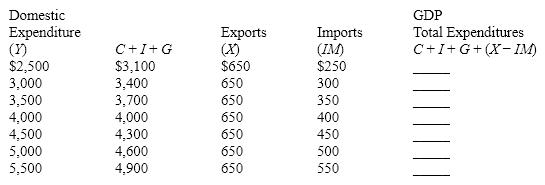 From Table 36-2, what can you conclude about net exports as GDP rises?
 (Multiple Choice)
4.9/5 (70)
(70) What does macroeconomic theory predict as the main economic effect of a reduction in the budget deficit?
(Multiple Choice)
4.7/5 (83)
(83) An exchange rate appreciation will shift the aggregate demand curve inward.
(True/False)
4.9/5 (86)
(86) An increase in the U.S. price level relative to the price level of U.S. trading partners will cause the aggregate expenditures function in the United States to
(Multiple Choice)
4.8/5 (81)
(81) A nation's currency is said to appreciate when exchange rates change so that a unit of its currency can buy more units of foreign currency.
(True/False)
4.9/5 (79)
(79) The international trade response to a contractionary monetary policy will cause aggregate demand to shift ____ and aggregate supply to shift ____.
(Multiple Choice)
4.7/5 (91)
(91) The trade deficit is the mirror image of the required capital inflows. So why worry about these capital inflows?
(Multiple Choice)
4.9/5 (72)
(72) Because one country's imports are another country's exports, rapid (or sluggish) economic growth in one country contributes to rapid (or sluggish) growth in other countries.
(True/False)
4.8/5 (78)
(78) In an open economy, the government deficit is 400 and investment exceeds saving by 300, so in equilibrium the trade deficit ( IM − X ) must be
(Multiple Choice)
4.7/5 (79)
(79) What is the impact of expansionary fiscal policy on the exchange rate? Explain the process through which expansionary fiscal policy affects the exchange rate.
(Essay)
4.9/5 (84)
(84) Which of the following would be cures for the U.S. trade deficit?
(Multiple Choice)
4.9/5 (88)
(88) When the dollar appreciates, the cost to Americans of foreign goods
(Multiple Choice)
4.7/5 (95)
(95) Table 36-2 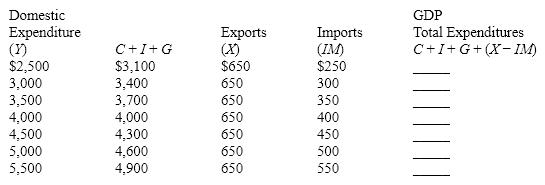 In Table 36-2, assume that exports rise to $900. How large is the multiplier?
 (Multiple Choice)
4.8/5 (88)
(88) A sizable appreciation of the U.S. dollar in the mid-1980s
(Multiple Choice)
4.7/5 (72)
(72) If the U.S. government runs a budget deficit ( G − T ), that deficit must be financed by an excess of
(Multiple Choice)
4.8/5 (79)
(79) Figure 36-6
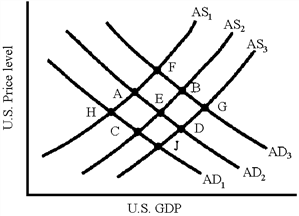 In Figure 36-6, which of the following will cause a movement from equilibrium at point A to equilibrium at point C?
 (Multiple Choice)
4.8/5 (68)
(68) 
Filters
- Essay(0)
- Multiple Choice(0)
- Short Answer(0)
- True False(0)
- Matching(0)