



 Chat with AI
Exam 30: The Financial Crisis and the Great Recession

Exam 1: What Is Economics261 Questions
Exam 2: The Economy: Myth and Reality185 Questions
Exam 3: The Fundamental Economic Problem: Scarcity and Choice290 Questions
Exam 4: Supply and Demand: an Initial Look337 Questions
Exam 21: An Introduction to Macroeconomics216 Questions
Exam 22: The Goals of Macroeconomic Policy212 Questions
Exam 23: Economic Growth: Theory and Policy228 Questions
Exam 24: Aggregate Demand and the Powerful Consumer219 Questions
Exam 25: Demand-Side Equilibrium: Unemployment or Inflation216 Questions
Exam 26: Bringing in the Supply Side: Unemployment and Inflation228 Questions
Exam 27: Managing Aggregate Demand: Fiscal Policy210 Questions
Exam 28: Money and the Banking System224 Questions
Exam 29: Monetary Policy: Conventional and Unconventional210 Questions
Exam 30: The Financial Crisis and the Great Recession66 Questions
Exam 31: The Debate Over Monetary and Fiscal Policy219 Questions
Exam 32: Budget Deficits in the Short and Long Run215 Questions
Exam 33: The Trade-Off Between Inflation and Unemployment219 Questions
Exam 34: International Trade and Comparative Advantage226 Questions
Exam 35: The International Monetary System: Order or Disorder218 Questions
Exam 36: Exchange Rates and the Macroeconomy219 Questions
Exam 37: Contemporary Issues in the Us Economy23 Questions
Select questions type


If the reserve ratio was 10 percent for the bank with the balance sheet listed below, then this bank is being 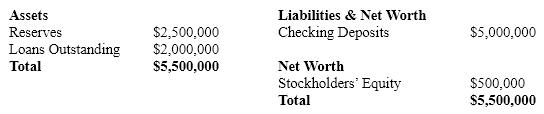
(Multiple Choice)
4.9/5  (90)
(90) An interest rate spread is the difference between an interest rate on a risky asset and the corresponding interest rate on a risk-free treasury security.
(True/False)
4.8/5 (88)
(88) Spending on newly constructed homes is part of the investment component of GDP.
(True/False)
4.9/5 (77)
(77) Did President Obama's $787 billion fiscal stimulus package of early 2009 work? Name several facts in support of the proposition that it did. Also, list the arguments of the skeptics.
(Essay)
4.8/5 (83)
(83) What is the leverage implied by the bank balance sheet listed below? 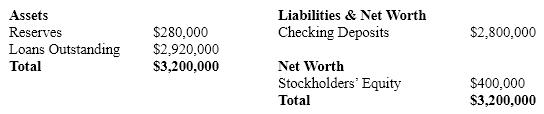
(Multiple Choice)
4.9/5 (84)
(84) The central idea behind the Troubled Asset Relief Program was for the Treasury to sell mortgage-backed securities to interested investors, wait for prices to increase, and then buy these securities back for a profit.
(True/False)
4.9/5 (82)
(82) Why did observers at first believe that the damage from the impending subprime mortgage crisis would be too small to cause a recession?
(Essay)
4.8/5 (80)
(80) As a result of the Great Recession, job growth did not resume until
(Multiple Choice)
4.8/5 (80)
(80) A bank is said to be recapitalized when some investor, private or government, provides new equity capital in return for partial ownership.
(True/False)
4.9/5 (87)
(87) Leverage is essential to a bank's profitability, but it also increases risk.
(True/False)
4.8/5 (76)
(76) In 2008, the Fed utilized expansionary monetary policy, which was made
(Multiple Choice)
4.7/5 (70)
(70) Because the U.S. economy failed to snap back from a mild recession in 2001, the Fed pushed the federal funds rate down to 1 percent. What effect did this have on the economy?
(Essay)
4.9/5 (87)
(87) Which of the following elements of GDP were affected by the financial crisis and the lack of available credit?
(Multiple Choice)
5.0/5 (84)
(84) Suppose that a five-year Treasury bond pays 2.5 percent and a five-year corporate bond pays 8.5 percent, then what is the interest rate spread on this particular corporate bond?
(Multiple Choice)
4.8/5 (69)
(69) When the housing bubble burst, prices fell particularly severely in
(Multiple Choice)
4.7/5 (79)
(79) Subprime mortgages were granted with low or negligible down payments to the borrowers of questionable credit standing who could barely afford their monthly payments.
(True/False)
4.8/5 (85)
(85) As a result of Lehman's collapse, real GDP first began to fall in
(Multiple Choice)
4.9/5 (73)
(73) 
Filters
- Essay(0)
- Multiple Choice(0)
- Short Answer(0)
- True False(0)
- Matching(0)