



 Chat with AI
Exam 27: Managing Aggregate Demand: Fiscal Policy

Exam 1: What Is Economics261 Questions
Exam 2: The Economy: Myth and Reality185 Questions
Exam 3: The Fundamental Economic Problem: Scarcity and Choice290 Questions
Exam 4: Supply and Demand: an Initial Look337 Questions
Exam 21: An Introduction to Macroeconomics216 Questions
Exam 22: The Goals of Macroeconomic Policy212 Questions
Exam 23: Economic Growth: Theory and Policy228 Questions
Exam 24: Aggregate Demand and the Powerful Consumer219 Questions
Exam 25: Demand-Side Equilibrium: Unemployment or Inflation216 Questions
Exam 26: Bringing in the Supply Side: Unemployment and Inflation228 Questions
Exam 27: Managing Aggregate Demand: Fiscal Policy210 Questions
Exam 28: Money and the Banking System224 Questions
Exam 29: Monetary Policy: Conventional and Unconventional210 Questions
Exam 30: The Financial Crisis and the Great Recession66 Questions
Exam 31: The Debate Over Monetary and Fiscal Policy219 Questions
Exam 32: Budget Deficits in the Short and Long Run215 Questions
Exam 33: The Trade-Off Between Inflation and Unemployment219 Questions
Exam 34: International Trade and Comparative Advantage226 Questions
Exam 35: The International Monetary System: Order or Disorder218 Questions
Exam 36: Exchange Rates and the Macroeconomy219 Questions
Exam 37: Contemporary Issues in the Us Economy23 Questions
Select questions type


If a "liberal" wanted to increase aggregate demand, which of the following would he or she tend to favor?
(Multiple Choice)
4.8/5  (73)
(73) President George W. Bush, who favored a smaller government sector,
(Multiple Choice)
4.7/5 (73)
(73) When government spending is added to the basic macroeconomic model, the multiplier for G would
(Multiple Choice)
4.9/5 (83)
(83) If the government decides to change the level of government spending, what happens to the value of the multiplier?
(Multiple Choice)
4.8/5 (93)
(93) Define the following terms and explain their significance to the study of macroeconomics.
a. Fiscal policy
b. Transfer payments
c. Effect of income taxes on the multiplier
d. Supply-side tax cuts
(Essay)
5.0/5 (78)
(78) Critics of supply-side economics argue that a major flaw is
(Multiple Choice)
4.7/5 (77)
(77) The multiplier is reduced by an income tax because an income tax reduces the fraction of each dollar of GDP that consumers actually receive and spend.
(True/False)
4.9/5 (75)
(75) If the demand-side effects of supply-side tax cuts are greater than the supply-side effects, then we can expect the result to be a(n)
(Multiple Choice)
4.8/5 (72)
(72) Figure 11-1
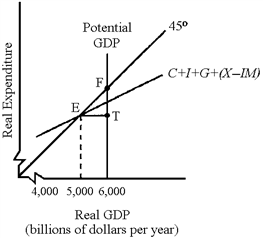 In Figure 11-1, to reach the level of potential GDP, the administration of President Obama would most likely advocate
 (Multiple Choice)
4.9/5 (68)
(68) Liberals tend to favor increasing taxes as the method of counteracting inflation.
(True/False)
4.9/5 (70)
(70) Figure 11-1
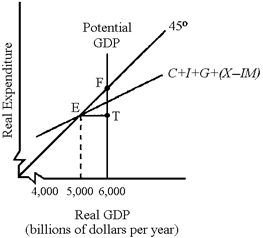 In Figure 11-1, to achieve equilibrium at potential GDP, the government could
 (Multiple Choice)
4.8/5 (71)
(71) Discuss some of the general conclusions arrived at about supply-side tax initiatives.
(Essay)
4.8/5 (95)
(95) Table 11-1 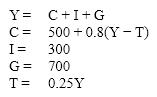 Refer to Table 11-1. What is the level of tax revenues in this model?
 (Multiple Choice)
4.8/5 (60)
(60) 
Filters
- Essay(0)
- Multiple Choice(0)
- Short Answer(0)
- True False(0)
- Matching(0)