



 Chat with AI
Exam 24: Aggregate Demand and the Powerful Consumer

Exam 1: What Is Economics261 Questions
Exam 2: The Economy: Myth and Reality185 Questions
Exam 3: The Fundamental Economic Problem: Scarcity and Choice290 Questions
Exam 4: Supply and Demand: an Initial Look337 Questions
Exam 21: An Introduction to Macroeconomics216 Questions
Exam 22: The Goals of Macroeconomic Policy212 Questions
Exam 23: Economic Growth: Theory and Policy228 Questions
Exam 24: Aggregate Demand and the Powerful Consumer219 Questions
Exam 25: Demand-Side Equilibrium: Unemployment or Inflation216 Questions
Exam 26: Bringing in the Supply Side: Unemployment and Inflation228 Questions
Exam 27: Managing Aggregate Demand: Fiscal Policy210 Questions
Exam 28: Money and the Banking System224 Questions
Exam 29: Monetary Policy: Conventional and Unconventional210 Questions
Exam 30: The Financial Crisis and the Great Recession66 Questions
Exam 31: The Debate Over Monetary and Fiscal Policy219 Questions
Exam 32: Budget Deficits in the Short and Long Run215 Questions
Exam 33: The Trade-Off Between Inflation and Unemployment219 Questions
Exam 34: International Trade and Comparative Advantage226 Questions
Exam 35: The International Monetary System: Order or Disorder218 Questions
Exam 36: Exchange Rates and the Macroeconomy219 Questions
Exam 37: Contemporary Issues in the Us Economy23 Questions
Select questions type


Which of the following is an example of a transfer payment?
(Multiple Choice)
4.9/5  (81)
(81) "Men are disposed, as a rule, and on the average, to increase their consumption as their income increases, but not by as much as the increase in their incomes." Which of the following is consistent with this statement by J.M. Keynes?
(Multiple Choice)
4.9/5 (70)
(70) Figure 8-1
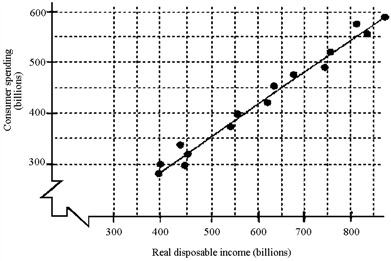 Given the scatter diagram in Figure 8-1, what is the MPC (your best estimate)?
 (Multiple Choice)
5.0/5 (85)
(85) Define the following terms and explain their importance in the study of macroeconomics:
a. Consumer expenditures
b. Investment spending
c. National income
d. Transfer payments
(Essay)
4.7/5 (81)
(81) Households can finance their consumer spending from current
(Multiple Choice)
4.9/5 (82)
(82) We should expect the consumption function to shift downward if
(Multiple Choice)
4.9/5 (87)
(87) Residential construction (new houses and apartments) are included in which component of GDP?
(Multiple Choice)
4.8/5 (77)
(77) The marginal propensity to consume (MPC) is calculated by which formula?
(Multiple Choice)
4.8/5 (81)
(81) The tax cuts of 2008 and 2009 reduced the disposable income of U.S. consumers.
(True/False)
4.7/5 (91)
(91) A decrease in disposable income causes a shift in the consumption function.
(True/False)
4.9/5 (75)
(75) If you suddenly have the misfortune of screening positive for lung cancer, then your consumption function will most likely
(Multiple Choice)
4.7/5 (74)
(74) Both President Bush and President Obama wanted tax cuts to stimulate consumer spending during the 2007-2009 recession.
(True/False)
4.7/5 (78)
(78) Investment spending, in economic terms, includes spending toward physical capital, machinery, new factories, and new housing.
(True/False)
4.7/5 (85)
(85) In economic analysis, which of the following is considered an injection?
(Multiple Choice)
4.9/5 (80)
(80) In 1975, Congress passed a tax rebate to spur consumer spending. Consumers
(Multiple Choice)
4.9/5 (73)
(73) Which of the following observations concerning GDP calculations is true?
(Multiple Choice)
4.7/5 (92)
(92) 
Filters
- Essay(0)
- Multiple Choice(0)
- Short Answer(0)
- True False(0)
- Matching(0)