



 Chat with AI
Exam 1: What Is Economics

Exam 1: What Is Economics261 Questions
Exam 2: The Economy: Myth and Reality185 Questions
Exam 3: The Fundamental Economic Problem: Scarcity and Choice290 Questions
Exam 4: Supply and Demand: an Initial Look337 Questions
Exam 21: An Introduction to Macroeconomics216 Questions
Exam 22: The Goals of Macroeconomic Policy212 Questions
Exam 23: Economic Growth: Theory and Policy228 Questions
Exam 24: Aggregate Demand and the Powerful Consumer219 Questions
Exam 25: Demand-Side Equilibrium: Unemployment or Inflation216 Questions
Exam 26: Bringing in the Supply Side: Unemployment and Inflation228 Questions
Exam 27: Managing Aggregate Demand: Fiscal Policy210 Questions
Exam 28: Money and the Banking System224 Questions
Exam 29: Monetary Policy: Conventional and Unconventional210 Questions
Exam 30: The Financial Crisis and the Great Recession66 Questions
Exam 31: The Debate Over Monetary and Fiscal Policy219 Questions
Exam 32: Budget Deficits in the Short and Long Run215 Questions
Exam 33: The Trade-Off Between Inflation and Unemployment219 Questions
Exam 34: International Trade and Comparative Advantage226 Questions
Exam 35: The International Monetary System: Order or Disorder218 Questions
Exam 36: Exchange Rates and the Macroeconomy219 Questions
Exam 37: Contemporary Issues in the Us Economy23 Questions
Select questions type


Externalities are created when parties not involved in an economic transaction are affected by it.
(True/False)
4.8/5  (88)
(88) A model that is an oversimplification for one purpose will likely be an oversimplification for other purposes as well.
(True/False)
4.8/5 (78)
(78) A price floor on the sale of wheat would be likely to benefit
(Multiple Choice)
4.8/5 (85)
(85) Consider the following information regarding a person's decision to go to college: college tuition is $20,000 per year, room and board is $10,000 per year, and books and materials are $2,000 per year. Suppose that instead of going to college this person could have earned $18,000 working in a store. An economist would calculate the cost of going to college as
(Multiple Choice)
5.0/5 (73)
(73) Opportunity cost is the value of the next best alternative to a given choice.
(True/False)
4.7/5 (80)
(80) Explain why an airline may decide to sell an air ticket to a stand-by passenger at less than the full fare if there are empty seats on the airplane?
(Essay)
4.9/5 (76)
(76) If a government enacts a price floor on agricultural products to protect wheat farmers, the result is likely going to be
(Multiple Choice)
4.9/5 (82)
(82) Suppose that interdiction efforts have stemmed the flow of illegal drugs into the United States. If there is no change in demand, this leads to higher prices for these substances. The result is an increase in crime as users attempt to maintain their now more expensive habits. Economists would call this effect
(Multiple Choice)
4.8/5 (68)
(68) Some college students think that because a college degree greatly increases their earning potential there is no opportunity cost of attending college. How would an economist look at the matter?
(Multiple Choice)
5.0/5 (75)
(75) Harry Truman is credited with the statement, "Give me a one-armed economist," because economists are likely to say, "On the one hand, . . . on the other hand." Why do economists "waffle" more than physicists or chemists?
(Essay)
4.8/5 (101)
(101) A line that slopes downward from left to right has a positive slope.
(True/False)
4.8/5 (82)
(82) Figure 1-2
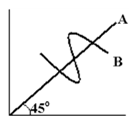 Identify the slope of the two curves A and B in Figure 1-2.
 (Multiple Choice)
4.8/5 (78)
(78) A contour map illustrates a cause-and-effect relationship among three variables.
(True/False)
4.8/5 (87)
(87) 
Filters
- Essay(0)
- Multiple Choice(0)
- Short Answer(0)
- True False(0)
- Matching(0)