



 Chat with AI
Exam 19: The Citric Acid Cycle

Exam 1: Biochemistry and the Organization of Cells76 Questions
Exam 2: Water the Solvent for Biochemical Reactions90 Questions
Exam 3: Amino Acids and Peptides80 Questions
Exam 4: The Three Dimensional Structure of Proteins87 Questions
Exam 5: Protein Purification and Characterization Techniques72 Questions
Exam 6: The Behavior of Proteins Enzymes88 Questions
Exam 7: The Behavior of Proteins Enzymes Mechanisms and Control86 Questions
Exam 8: Lipids and Proteins Are Associated in Biological Membranes95 Questions
Exam 9: Nucleic Acids How Structure Conveys Information71 Questions
Exam 10: Biosynthesis of Nucleic Acids Replication91 Questions
Exam 11: Transcription of the Genetic Code the Biosynthesis of Rna103 Questions
Exam 12: Protein Synthesis Translation of the Genetic Message90 Questions
Exam 13: Nucleic Acid Biotechnology Techniques99 Questions
Exam 14: Viruses Cancer and Immunology47 Questions
Exam 15: The Importance of Energy Changes and Electron Transfer in Metabolism65 Questions
Exam 16: Carbohydrates97 Questions
Exam 17: Glycolysis72 Questions
Exam 18: Storage Mechanisms and Control in Carbohydrate Metabolism87 Questions
Exam 19: The Citric Acid Cycle85 Questions
Exam 20: Electron Transport and Oxidative Phosphorylation71 Questions
Exam 21: Lipid Metabolism100 Questions
Exam 22: Photosynthesis79 Questions
Exam 23: The Metabolism of Nitrogen83 Questions
Exam 24: Integration of Metabolism Cellular Signaling73 Questions
Select questions type


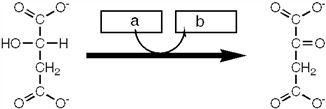
Which group of small molecules best fit the boxes associated with the reaction shown? 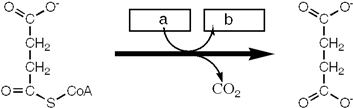
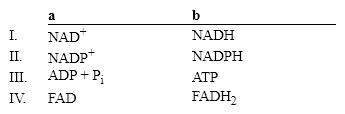
(Multiple Choice)
4.9/5  (87)
(87) The conversion of malate to oxaloacetate has a high + Δ G (it is endergonic). It can take place because:
(Multiple Choice)
4.7/5 (90)
(90) Which of the following statements concerning the glyoxylate pathway is false ?
(Multiple Choice)
4.9/5 (79)
(79) Exhibit 19A The following compounds are all intermediates in the citric acid cycle. 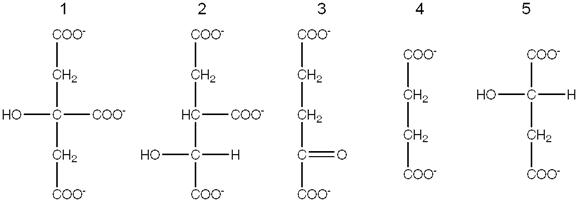 Refer to Exhibit 19A. Which intermediate is formed from acetyl-CoA and oxaloacetate.
 (Multiple Choice)
4.8/5 (73)
(73) Weight loss in humans can be difficult to achieve, since we lack the ability to convert our fats to sugars, and it is difficult to change our metabolism to using fats as a primary energy source.
(True/False)
4.8/5 (84)
(84) The reaction of the citric acid cycle that does not take place in the mitochondrial matrix is the one catalyzed by:
(Multiple Choice)
4.8/5 (86)
(86) Which of the following cannot cross the inner mitochondrial membrane?
(Multiple Choice)
5.0/5 (77)
(77) 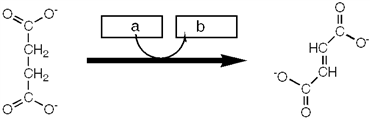
Which of the following reactions involves substrate-level phosphorylation?
(Multiple Choice)
5.0/5 (62)
(62) Which of the following is not a component of the pyruvate dehydrogenase complex?
(Multiple Choice)
4.9/5 (74)
(74) Which of the following statements concerning the citric acid cycle as the central metabolic pathway is true ?
(Multiple Choice)
4.9/5 (88)
(88) Isocitrate has _____ possible isomers, out of which only one is produced in the isomerization of citrate to isocitrate.
(Multiple Choice)
4.8/5 (74)
(74) One round of the citric acid cycle generates about ten equivalents of ATP.
(True/False)
4.8/5 (94)
(94) Which group of small molecules best fit the boxes associated with the reaction shown? 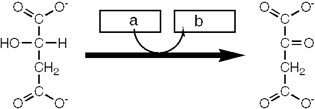
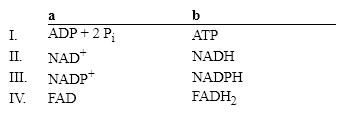
(Multiple Choice)
4.7/5 (80)
(80) Most of the products of the catabolism of sugars, fats and amino acids enter the citric acid cycle as:
(Multiple Choice)
4.8/5 (90)
(90) The "energy charge" in a cell is important in the control of metabolism.
(True/False)
4.8/5 (76)
(76) 
Filters
- Essay(0)
- Multiple Choice(0)
- Short Answer(0)
- True False(0)
- Matching(0)