



 Chat with AI
Exam 11: Chemical Kinetics

Exam 1: Introduction to Chemistry42 Questions
Exam 2: Atoms and Molecules45 Questions
Exam 3: Molecules Moles Chemical Equations45 Questions
Exam 4: Stoichiometry40 Questions
Exam 5: Gases45 Questions
Exam 6: The Periodic Table and Atomic Structure45 Questions
Exam 7: Chemical Bonding and Molecular Structure40 Questions
Exam 8: Molecules and Materials37 Questions
Exam 9: Energy and Chemistry40 Questions
Exam 10: Entropy and the Second Law of Thermodynamics30 Questions
Exam 11: Chemical Kinetics40 Questions
Exam 12: Chemical Equilibrium40 Questions
Exam 13: Electrochemistry40 Questions
Select questions type


If a reaction is 1st order with respect to [A] and 2nd order with respect to [B], doubling the concentration of reactant [B] will result in a four-fold increase in the rate of reaction.
(True/False)
4.9/5  (70)
(70) Which statement best describes the rate of reaction for the production of ammonia via the Haber reaction ( 3 H2 + N2 → 2 NH3)
(Multiple Choice)
4.8/5 (85)
(85) The decomposition of hydrogen peroxide (H2O2) into O2( g ) and liquid H2O produced the following data:
 What is the average rate in mL/min for the third ten-minute period of the reaction?
 (Multiple Choice)
4.8/5 (77)
(77) Which of the following internal combustion engine products plays the largest role in the production of smog?
(Multiple Choice)
4.8/5 (86)
(86) When two concentrations are measured at times separated by a finite difference, the ____ may be calculated:
(Multiple Choice)
4.8/5 (89)
(89) For a 1st order reaction, a plot of concentration with respect to time produces a plot that is:
(Multiple Choice)
4.8/5 (97)
(97) A plot of a reactant concentration vs. time is linear for a zeroth order reaction.
(True/False)
4.8/5 (72)
(72) The rate constant "k" will vary with changes in concentration of 1st order reactants.
(True/False)
4.8/5 (62)
(62) O3, not O2, is the thermodynamically favored allotrope of oxygen for the conditions found at the Earth's surface.
(True/False)
4.8/5 (73)
(73) The catalytic converter on an automobile has a direct role in:
(Multiple Choice)
4.8/5 (74)
(74) Lowering the activation energy of a reaction will increase the rate of reaction by:
(Multiple Choice)
4.8/5 (78)
(78) If the decomposition of reactant A follows first-order kinetics, what concentration of A remains if:
[A]0 = 0.273 M, k = 1.53 × 10 − 2 minutes − 1, and the elapsed time = 1.61 hr?
(Multiple Choice)
4.9/5 (81)
(81) The synthesis of ammonia from hydrogen and nitrogen produced the following kinetic data:
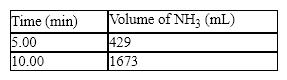 What is the average rate in mL/min for the second five-minute period of the reaction?
 (Multiple Choice)
4.9/5 (84)
(84) Raising the temperature of a reaction elevates the rate of reaction by:
(Multiple Choice)
4.9/5 (91)
(91) A termolecular step in a reaction mechanism is a step that involves two molecules.
(True/False)
4.9/5 (82)
(82) A chemical species that is not consumed by the reaction and increases the rate of the reaction is referred to as a(n):
(Multiple Choice)
4.9/5 (83)
(83) Sulfur trioxide production follows the reaction:
2 SO2( g ) + O2( g ) → 2 SO3( g )
If the rate at which SO3 is produced is 4.28 × 10 − 4 mol L − 1s − 1, at what rate is SO2 consumed?
(Multiple Choice)
4.8/5 (84)
(84) Consider the reaction: 2A + B → C, 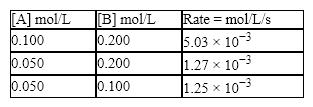 What is the value of the rate constant?
 (Multiple Choice)
4.9/5 (80)
(80) 
Filters
- Essay(0)
- Multiple Choice(0)
- Short Answer(0)
- True False(0)
- Matching(0)