



 Chat with AI
Exam 3: Ethics, Fraud, and Internal Control

Exam 1: The Information System: An Accountant’s Perspective96 Questions
Exam 2: Introduction to Transaction Processing119 Questions
Exam 3: Ethics, Fraud, and Internal Control119 Questions
Exam 4: The Revenue Cycle105 Questions
Exam 5: The Expenditure Cycle Part I: Purchases and Cash Disbursements Procedures102 Questions
Exam 6: The Expenditure Cycle Part II: Payroll Processing and Fixed Asset Procedures87 Questions
Exam 7: The Conversion Cycle102 Questions
Exam 8: General Ledger, Financial Reporting, and Management Reporting Systems94 Questions
Exam 9: Database Management Systems106 Questions
Exam 10: The REA Approach to Business Process Modeling76 Questions
Exam 11: Enterprise Resource Planning Systems97 Questions
Exam 12: Electronic Commerce Systems102 Questions
Exam 13: Managing the Systems Development Life Cycle93 Questions
Exam 14: Construct, Deliver, and Maintain Systems Projects93 Questions
Exam 15: IT Controls : Sarbanes-Oxley and IT Governance130 Questions
Exam 16: IT Controls : Security and Access96 Questions
Exam 17: IT Controls : Systems Development Program Changes and Application Controls96 Questions
Select questions type


In this age of high technology and computer based information systems,why are accountants concerned about physical (human)controls?
(Essay)
4.7/5  (81)
(81) Misappropriation of assets can involve various schemes: expense reimbursement fraud,lapping,and payroll fraud.Explain each and give an example.
(Essay)
4.9/5 (78)
(78) What is the relationship between COSO and SAS 78? How are they similar/different?
(Essay)
4.9/5 (80)
(80) Identify to indicate whether each procedure is a preventive or detective control.
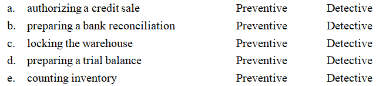
(Essay)
4.8/5 (71)
(71) Preventive controls are passive techniques designed to reduce fraud.
(True/False)
4.9/5 (76)
(76) Use the internal control procedures listed below to complete the statements.
 -The internal audit department recalculates payroll for several employees each pay period.This is an example of __________________________.
 (Short Answer)
4.7/5 (75)
(75) Skimming involves stealing cash from an organization after it is recorded on the organization's books and records
(True/False)
5.0/5 (75)
(75) Use the internal control procedures listed below to complete the statements.
-Approving a price reduction because goods are damaged is an example of __________________________.
-Approving a price reduction because goods are damaged is an example of __________________________. (Short Answer)
4.8/5 (77)
(77) What are the key points of the "Issuer and Management Disclosure" of the Sarbanes-Oxley Act?
(Essay)
4.8/5 (88)
(88) Opportunity involves direct access to assets and/or access to information that controls assets.
(True/False)
4.9/5 (88)
(88) What are the key points of the section 404 of the Sarbanes-Oxley Act?
(Essay)
5.0/5 (78)
(78) The ethical principle of informed consent suggests that the decision should be implemented so as to minimize all of the risks and to avoid any unnecessary risks.
(True/False)
4.9/5 (79)
(79) A key modifying assumption in internal control is that the internal control system is the responsibility of management.
(True/False)
4.9/5 (77)
(77) According to SAS 78,an effective accounting system performs all of the following except
(Multiple Choice)
4.9/5 (82)
(82) Which of the following is not an internal control procedure?
(Multiple Choice)
4.8/5 (84)
(84) Collusion among employees in the commission of a fraud is difficult to prevent but easy to detect.
(True/False)
5.0/5 (88)
(88) 
Filters
- Essay(0)
- Multiple Choice(0)
- Short Answer(0)
- True False(0)
- Matching(0)