



 Chat with AI
Exam 10: Externalities.

Exam 1: Ten Principles of Economics.349 Questions
Exam 2: Thinking Like an Economist.535 Questions
Exam 3: Interdependence and the Gains from Trade.443 Questions
Exam 4: The Market Forces of Supply and Demand.571 Questions
Exam 5: Elasticity and Its Application510 Questions
Exam 6: Supply, Demand, And Government Policies.557 Questions
Exam 7: Consumers, Producers, and the Efficiency of Markets.460 Questions
Exam 8: Application: The Costs of Taxation.424 Questions
Exam 9: Application: International Trade.410 Questions
Exam 10: Externalities.441 Questions
Exam 11: Public Goods and Common Resources.349 Questions
Exam 12: The Design of the Tax System.478 Questions
Exam 13: The Costs of Production.533 Questions
Exam 14: Firms in Competitive Markets.478 Questions
Exam 15: Monopoly.526 Questions
Exam 16: Monopolistic Competition.497 Questions
Exam 17: Oligopoly.410 Questions
Exam 18: The Market For the Factors of Production.463 Questions
Exam 19: Earnings and Discrimination.398 Questions
Exam 20: Income Inequality and Poverty.374 Questions
Exam 21: The Theory of Consumer Choice.462 Questions
Exam 22: Frontiers in Microeconomics.353 Questions
Select questions type


In some circumstances,selling pollution permits may be better than levying a corrective tax.
(True/False)
4.8/5  (81)
(81) If education produces positive externalities,we would expect
(Multiple Choice)
4.9/5 (69)
(69) Suppose that large-scale pork production has the potential to create ground water pollution.Why might this type of pollution be considered an externality?
(Multiple Choice)
4.8/5 (74)
(74) Corrective taxes that are imposed upon the producer of a nasty smell can be successful in reducing that smell because the tax makes the producer
(Multiple Choice)
4.8/5 (70)
(70) In which of the following cases is the Coase theorem most likely to solve the externality?
(Multiple Choice)
4.9/5 (89)
(89)  -Refer to Figure 10-4.At Q₃
Table 10-6
The following table shows the total costs for each of four firms (A, B, C, and D) to eliminate units of pollution from their production processes. For example, for Firm A to eliminate one unit of pollution, it would cost $46, and for Firm A to eliminate two units of pollution, it would cost a total of $103.
 -Refer to Table 10-6.Suppose the government wanted to reduce pollution from 16 units to exactly 8 units.Which of the following fees per unit of pollution would achieve that goal?
 (Multiple Choice)
4.9/5 (83)
(83) A local manufacturing plant that emitted sulfur dioxide was forced to stop production because it did not comply with local clean air standards.This decision provides an example of
(Multiple Choice)
5.0/5 (72)
(72) Table 10-3
 -Refer to Table 10-3.The market equilibrium quantity of output is
 (Multiple Choice)
4.8/5 (90)
(90) Which of the following statements is true of both pollution permits and corrective taxes?
(Multiple Choice)
4.8/5 (94)
(94) Figure 10-10
 -Refer to Figure 10-10.A decrease in output from 160 units to 120 units would
 (Multiple Choice)
4.9/5 (80)
(80) Figure 10-11
 -Refer to Figure 10-11.Taking only private value and private cost into account,total surplus at the market equilibrium amounts to
 (Multiple Choice)
4.9/5 (81)
(81) Table 10-2
The following table shows the private value, private cost, and social value for a market with a positive externality.
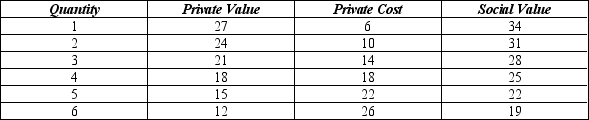 -Refer to Table 10-2.What is the equilibrium quantity of output in this market?
 (Multiple Choice)
4.9/5 (93)
(93) When the government reduces my income tax by $0.30 for every $1.00 that I contribute to a charity,the government is effectively
(Multiple Choice)
4.9/5 (76)
(76) Table 10-3
-Refer to Table 10-3.What amount of subsidy per unit of output would move the market from the equilibrium level of output to the socially optimal level of output?
-Refer to Table 10-3.What amount of subsidy per unit of output would move the market from the equilibrium level of output to the socially optimal level of output? (Multiple Choice)
4.8/5 (76)
(76) Figure 10-9


 -Refer to Figure 10-9,Panel (b)and Panel (c).The overuse of antibiotics leads to the development of antibiotic-resistant diseases.Therefore,the socially optimal quantity of antibiotics is represented by point
 (Multiple Choice)
4.8/5 (88)
(88) 
Filters
- Essay(0)
- Multiple Choice(0)
- Short Answer(0)
- True False(0)
- Matching(0)