



 Chat with AI
Exam 6: Supply, Demand, And Government Policies.

Exam 1: Ten Principles of Economics.349 Questions
Exam 2: Thinking Like an Economist.535 Questions
Exam 3: Interdependence and the Gains from Trade.443 Questions
Exam 4: The Market Forces of Supply and Demand.571 Questions
Exam 5: Elasticity and Its Application510 Questions
Exam 6: Supply, Demand, And Government Policies.557 Questions
Exam 7: Consumers, Producers, and the Efficiency of Markets.460 Questions
Exam 8: Application: The Costs of Taxation.424 Questions
Exam 9: Application: International Trade.410 Questions
Exam 10: Externalities.441 Questions
Exam 11: Public Goods and Common Resources.349 Questions
Exam 12: The Design of the Tax System.478 Questions
Exam 13: The Costs of Production.533 Questions
Exam 14: Firms in Competitive Markets.478 Questions
Exam 15: Monopoly.526 Questions
Exam 16: Monopolistic Competition.497 Questions
Exam 17: Oligopoly.410 Questions
Exam 18: The Market For the Factors of Production.463 Questions
Exam 19: Earnings and Discrimination.398 Questions
Exam 20: Income Inequality and Poverty.374 Questions
Exam 21: The Theory of Consumer Choice.462 Questions
Exam 22: Frontiers in Microeconomics.353 Questions
Select questions type


Figure 6-14
The vertical distance between points A and B represents the tax in the market.
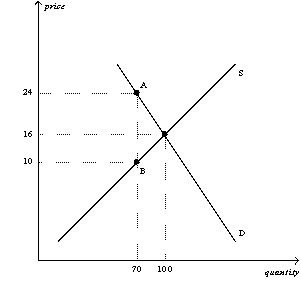 -Refer to Figure 6-14.The per-unit burden of the tax on buyers is
 (Multiple Choice)
4.9/5  (73)
(73) A price ceiling is always a binding price control,whereas a price floor may be either binding or not binding.
(True/False)
4.9/5 (79)
(79) Suppose the government has imposed a price floor on the market for soybeans.Which of the following events could transform the price floor from one that is not binding into one that is binding?
(Multiple Choice)
4.8/5 (73)
(73) A tax of $1 on sellers shifts the supply curve upward by exactly $1.
(True/False)
4.9/5 (85)
(85) Figure 6-17
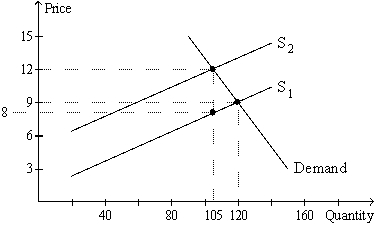 -Refer to Figure 6-17.What is the amount of the tax per unit?
 (Multiple Choice)
4.9/5 (86)
(86) Figure 6-18
 -Refer to Figure 6-18.Sellers pay how much of the tax per unit?
 (Multiple Choice)
5.0/5 (81)
(81) If a price floor is not binding,then it will have no effect on the market.
(True/False)
4.8/5 (77)
(77) A binding minimum wage causes the quantity of labor demanded to exceed the quantity of labor supplied.
(True/False)
4.9/5 (82)
(82) Figure 6-24
Suppose the government imposes a $2 on this market.
 -Refer to Figure 6-24.Suppose D1 represents the demand curve for gasoline in both the short run and long run,S1 represents the supply curve for gasoline in the short run,and S2 represents the supply curve for gasoline in the long run.After the imposition of the $2,
 (Multiple Choice)
5.0/5 (74)
(74) Suppose sellers of liquor are required to send $1.00 to the government for every bottle of liquor they sell.Further,suppose this tax causes the price paid by buyers of liquor to rise by $0.80 per bottle.Which of the following statements is correct?
(Multiple Choice)
4.9/5 (65)
(65) Figure 6-13
 -Refer to Figure 6-13.In this market,a minimum wage of $2.75 is
 (Multiple Choice)
4.7/5 (58)
(58) Which of the following is not correct? In a 2006 survey of Ph.D.economists,
(Multiple Choice)
4.8/5 (66)
(66) Sellers of a good bear the larger share of the tax burden when a tax is placed on a product for which the
(i)supply is more elastic than the demand.
(ii)demand in more elastic than the supply.
(iii)tax is placed on the sellers of the product.
(iv)tax is placed on the buyers of the product.
(Multiple Choice)
5.0/5 (67)
(67) In a free,competitive market,what is the rationing mechanism?
(Multiple Choice)
4.8/5 (77)
(77) There are several criticisms of the minimum wage.Which of the following is not one of those criticisms? The minimum wage
(Multiple Choice)
4.9/5 (57)
(57) A price ceiling set below the equilibrium price causes a shortage in the market.
(True/False)
4.9/5 (87)
(87) 
Filters
- Essay(0)
- Multiple Choice(0)
- Short Answer(0)
- True False(0)
- Matching(0)