



 Chat with AI
Exam 16: The Demand for Resources

Exam 1: Limits, Alternatives, and Choices107 Questions
Exam 2: The Market System and the Circular Flow287 Questions
Exam 3: Demand, Supply, and Market Equilibrium151 Questions
Exam 4: Market Failures Caused by Externalities Asymmetric Information229 Questions
Exam 5: Public Goods, Public Choice, and Government Failure268 Questions
Exam 6: Elasticity399 Questions
Exam 7: Utility Maximization358 Questions
Exam 8: Behavioral Economics311 Questions
Exam 9: Businesses and the Costs of Production445 Questions
Exam 10: Pure Competition in the Short Run342 Questions
Exam 11: Pure Competition in the Long Run250 Questions
Exam 12: Pure Monopoly407 Questions
Exam 13: Monopolistic Competition279 Questions
Exam 14: Oligopoly and Strategic Behavior362 Questions
Exam 15: Technology, RD, and Efficiency309 Questions
Exam 16: The Demand for Resources359 Questions
Exam 17: Wage Determination168 Questions
Exam 18: Rent, Interest, and Profit305 Questions
Exam 19: Natural Resource and Energy Economics337 Questions
Exam 20: Public Finance: Expenditures and Taxes336 Questions
Exam 21: Antitrust Policy and Regulation264 Questions
Exam 22: Agriculture: Economics and Policy265 Questions
Exam 23: Income Inequality, Poverty, and Discrimination324 Questions
Exam 24: Health Care280 Questions
Exam 25: Immigration259 Questions
Exam 26: International Trade347 Questions
Exam 27: The Balance of Payments, Exchange Rates, and Trade Deficits318 Questions
Exam 28: The Economics of Developing Countries277 Questions
Select questions type


The marginal productivity theory of income distribution holds that all resources are paid according to their marginal contribution to society's output.
(True/False)
4.7/5  (91)
(91) A union representative observed that if the union members' wages were increased by some proportion, the workers would eventually suffer a greater than proportional decline in employment. This statement could best be explained if
(Multiple Choice)
4.8/5 (84)
(84) Suppose that the labor cost to total cost ratio in industry A is 82 percent, while in industry B it is 21 percent. Other things equal, labor demand will be
(Multiple Choice)
4.9/5 (85)
(85) When the elasticity coefficient for resource demand is greater than one, resource demand is
(Multiple Choice)
4.9/5 (87)
(87) Before ATMs, the average bank branch employed 20 employees; after ATMs, the average branch employed 13 employees, but banks have opened more branches. These developments suggest that
(Multiple Choice)
4.9/5 (75)
(75) Which of the following occupations is projected to be the fastest growing in the U.S. in terms of percentage increases from 2016 to 2026?
(Multiple Choice)
4.9/5 (101)
(101) Harry owns a barbershop and charges $6 per haircut. By hiring one barber at $10 per hour, the shop can provide 24 haircuts per eight-hour day. By hiring a second barber at the same wage rate, the shop can now provide a total of 42 haircuts per day. The MRP of the second barber is
(Multiple Choice)
4.8/5 (81)
(81) 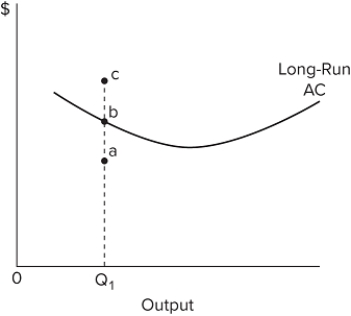 Refer to the diagram. The production of Q ₁ units of output at an average cost of a
 (Multiple Choice)
4.7/5 (86)
(86) A profit-maximizing firm should hire an input as long as the
(Multiple Choice)
4.9/5 (88)
(88) Elasticity of resource demand is measured by dividing "percentage change in resource price" by "percentage change in resource quantity."
(True/False)
4.8/5 (74)
(74) The labor demand curve of a firm that sells its product in a purely competitive market
(Multiple Choice)
4.8/5 (84)
(84) Which of the following increases in labor demand is due to a change in the price of a related resource?
(Multiple Choice)
4.9/5 (89)
(89) Suppose that the labor cost to total cost ratio in industry A is 14 percent, while in industry B it is 68 percent. Other things equal, labor demand will be
(Multiple Choice)
4.9/5 (71)
(71) 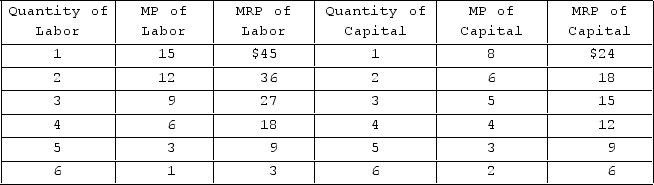 Refer to the given data. If the prices of labor and capital are $9 and $15, respectively, and labor and capital are the only inputs, the firm's economic profits will be
 (Multiple Choice)
4.8/5 (86)
(86) 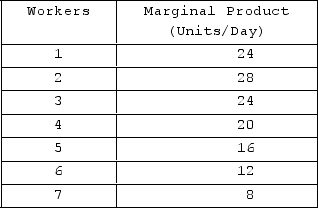 The table contains data for a profit-maximizing firm. The price of the firm's product is $10 per unit, and the wage rate is a constant $110 a day. How many workers will the firm hire, assuming purely competitive product and resource markets?
 (Multiple Choice)
4.9/5 (72)
(72) If a firm is hiring variable resources D and F in perfectly competitive input markets, it will minimize the cost of producing any level of output by employing D and F in such amounts that
(Multiple Choice)
4.9/5 (82)
(82) 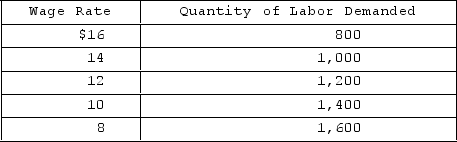 Refer to the given data. Suppose that the union that provides labor to firms in this market successfully negotiates an increase in the wage rate from $10 to$12. As a result of the wage increase, firms will hire
 (Multiple Choice)
5.0/5 (71)
(71) Suppose capital and labor are used in fixed proportions so that each machine requires only one worker. If a decline in the price of capital occurs, then the demand for labor will
(Multiple Choice)
4.9/5 (85)
(85) Other things equal, we would expect the labor demand curve of a monopolistic seller to
(Multiple Choice)
4.9/5 (83)
(83) 
Filters
- Essay(0)
- Multiple Choice(0)
- Short Answer(0)
- True False(0)
- Matching(0)