



 Chat with AI
Exam 7: Utility Maximization

Exam 1: Limits, Alternatives, and Choices107 Questions
Exam 2: The Market System and the Circular Flow287 Questions
Exam 3: Demand, Supply, and Market Equilibrium151 Questions
Exam 4: Market Failures Caused by Externalities Asymmetric Information229 Questions
Exam 5: Public Goods, Public Choice, and Government Failure268 Questions
Exam 6: Elasticity399 Questions
Exam 7: Utility Maximization358 Questions
Exam 8: Behavioral Economics311 Questions
Exam 9: Businesses and the Costs of Production445 Questions
Exam 10: Pure Competition in the Short Run342 Questions
Exam 11: Pure Competition in the Long Run250 Questions
Exam 12: Pure Monopoly407 Questions
Exam 13: Monopolistic Competition279 Questions
Exam 14: Oligopoly and Strategic Behavior362 Questions
Exam 15: Technology, RD, and Efficiency309 Questions
Exam 16: The Demand for Resources359 Questions
Exam 17: Wage Determination168 Questions
Exam 18: Rent, Interest, and Profit305 Questions
Exam 19: Natural Resource and Energy Economics337 Questions
Exam 20: Public Finance: Expenditures and Taxes336 Questions
Exam 21: Antitrust Policy and Regulation264 Questions
Exam 22: Agriculture: Economics and Policy265 Questions
Exam 23: Income Inequality, Poverty, and Discrimination324 Questions
Exam 24: Health Care280 Questions
Exam 25: Immigration259 Questions
Exam 26: International Trade347 Questions
Exam 27: The Balance of Payments, Exchange Rates, and Trade Deficits318 Questions
Exam 28: The Economics of Developing Countries277 Questions
Select questions type


The price of diamonds is substantially greater than the price of water because
(Multiple Choice)
4.9/5  (81)
(81) A consumer is making purchases of products Alpha and Beta such that the marginal utility of product Alpha is 30 and the marginal utility of product Beta is 40. The price of product Alpha is $5, and the price of product Beta is $10. The utility-maximizing rule suggests that, to stay within a given budget constraint, this consumer should
(Multiple Choice)
4.8/5 (79)
(79) From the viewpoint of potential criminals, the probability of being fined or imprisoned
(Multiple Choice)
4.7/5 (67)
(67) Indifference analysis assumes that utility is numerically measurable.
(True/False)
4.8/5 (95)
(95) A change in the slope of a budget line is solely the result of a change in
(Multiple Choice)
4.7/5 (73)
(73) The income of a consumer is $40, the price of A is $8, and the price of B is $4. If the quantity of A is measured vertically, then the slope of the budget line is
(Multiple Choice)
4.8/5 (77)
(77) 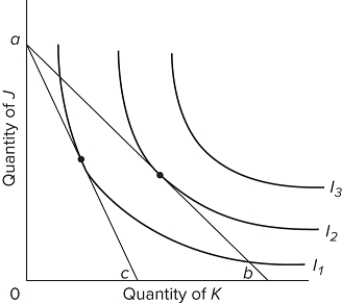 Refer to the diagram. If the budget line shifts from ab to ac, the
 (Multiple Choice)
4.8/5 (79)
(79) A consumer currently spends a given budget on two goods, X and Y, in such quantities that the marginal utility of X is 10 and the marginal utility of Y is 8. The unit price of X is $5 and the unit price of Y is $2. The utility-maximizing rule suggests that this consumer should
(Multiple Choice)
4.8/5 (90)
(90) What happens to the budget line when the price of a product falls? Use indifference curve analysis to explain how this change affects consumption of the product.
(Essay)
4.9/5 (82)
(82) Answer the question on the basis of the following total utility data for products L and M. Assume that the prices of L and M are $3 and $4, respectively, and that the consumer's income is $25  What level of total utility does the rational consumer realize in equilibrium?
 (Multiple Choice)
5.0/5 (78)
(78) Someone who pays $800 to fly from one city to another instead of paying only $100 for a bus trip between the two cities is making an irrational choice and is thus not maximizing his utility.
(True/False)
4.9/5 (90)
(90) A downward-sloping demand curve can be derived for a normal product by increasing its price in the consumer-behavior model and noting
(Multiple Choice)
4.9/5 (93)
(93) A consumer who has a limited budget will maximize utility or satisfaction when the
(Multiple Choice)
5.0/5 (77)
(77) A consumer is in equilibrium and is spending income in such a way that the marginal utility of product X is 40 units and that of Y is 16 units. If the unit price of X is $5, then the price of Y must be
(Multiple Choice)
4.9/5 (79)
(79) Answer the question on the basis of the following total utility data for products L and M. Assume that the prices of L and M are $6 and $2, respectively, and that the consumer's income is $22  How many units of the two products will the rational consumer purchase?
 (Multiple Choice)
4.8/5 (88)
(88) Answer the question based on the table below showing the marginal utility schedules for product X and product Y for a hypothetical consumer. The price of product X is $3, and the price of product Y is $2. The income of the consumer is $15.  If the consumer buys both product X and product Y, how much will the consumer buy of each in order to maximize utility?
 (Multiple Choice)
4.8/5 (84)
(84) If total utility increases as consumption of a good increases, then marginal utility must be increasing also.
(True/False)
4.7/5 (96)
(96) 
Filters
- Essay(0)
- Multiple Choice(0)
- Short Answer(0)
- True False(0)
- Matching(0)