



 Chat with AI
Exam 6: Bonds, Bond Prices, and the Determination of Interest Rates

Exam 1: An Introduction to Money and the Financial System31 Questions
Exam 2: Money and the Payments System109 Questions
Exam 3: Financial Instruments, Financial Markets, and Financial Institutions119 Questions
Exam 4: Future Value, Present Value and Interest Rates118 Questions
Exam 5: Understanding Risk108 Questions
Exam 6: Bonds, Bond Prices, and the Determination of Interest Rates128 Questions
Exam 7: The Risk and Term Structure of Interest Rates130 Questions
Exam 8: Stocks, Stock Markets and Market Efficiency123 Questions
Exam 9: Derivatives: Futures, Options, and Swaps120 Questions
Exam 10: Foreign Exchange114 Questions
Exam 11: The Economics of Financial Intermediation113 Questions
Exam 12:Depository Institutions: Banks and Bank Management116 Questions
Exam 13:Financial Industry Structure125 Questions
Exam 14: Regulating the Financial System120 Questions
Exam 15: Central Banks in the World Today113 Questions
Exam 16: The Structure of Central Banks: The Federal Reserve and the European Central Bank116 Questions
Exam 17: The Central Bank Balance Sheet and the Money Supply Process108 Questions
Exam 18:Monetary Policy: Stabilizing the Domestic Economy103 Questions
Exam 19:Exchange Rate Policy and the Central Bank120 Questions
Exam 20:Money Growth, Money Demand and Modern Monetary Policy108 Questions
Exam 21:Output, Inflation, and Monetary Policy104 Questions
Exam 22:Understanding Business Cycle Fluctuations103 Questions
Exam 23: Modern Monetary Policy and the Challenges Facing Central Bankers98 Questions
Select questions type


An increase in the nation's wealth, all other factors constant, would cause:
(Multiple Choice)
4.8/5  (81)
(81) How can a bond mutual fund report a return of over 13% when the coupon rate of the bonds they are holding are just 7% and interest rates are falling?
(Essay)
5.0/5 (67)
(67) If a consol is offering an annual coupon of $50 and the annual interest rate is 6%, the price of the consol is:
(Multiple Choice)
4.7/5 (81)
(81) The market for bonds is initially described by the supply of bonds - S₀, and the demand for bonds - D₀, with the equilibrium price and quantity being P₀ and Q₀. Suppose that the expected return on bonds falls relative to other assets. In the bond market this will result in: 
(Multiple Choice)
4.8/5 (58)
(58) The price (P) of a consol offering an annual coupon payment (C) is best expressed by:
(Multiple Choice)
4.7/5 (78)
(78) The impact of a decrease in expected inflation in the bond market will have a relatively large effect on the prices of bonds prices because the bond demand curve:
(Multiple Choice)
4.9/5 (80)
(80) A student receives a five-year loan to pay for a $2,000 used car. The lender and the student agree to an 8% interest rate on a fixed-rate loan. Expected inflation was estimated to equal 2.5%, but unexpectedly decreases to 2%. Which of the following is true?
(Multiple Choice)
4.9/5 (70)
(70) As general business conditions deteriorate, all other factors constant:
(Multiple Choice)
4.9/5 (82)
(82) Suppose there is a decrease in the price at which a bondholder sells her bond. In this case, the holding period return will:
(Multiple Choice)
4.7/5 (72)
(72) A $1,000 face value bond, with an annual coupon of $40, one year to maturity and a purchase price of $980 has a:
(Multiple Choice)
5.0/5 (82)
(82) As general business conditions improve, we would witness the following in the bond market:
(Multiple Choice)
4.9/5 (82)
(82) If the U.S. government's borrowing needs increase, all other factors constant the:
(Multiple Choice)
4.9/5 (65)
(65) Use our model of the bond market (supply and demand) to explain what happens if the U.S. economy continues to grow at robust rates.
(Essay)
4.9/5 (79)
(79) Notice the following model of a bond market. In each situation given, explain what happens to the bond price and yield and why.
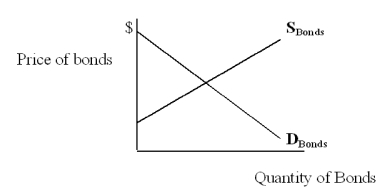 a) Expected inflation increases
b) The return on bonds rises relative to other assets c) The federal government deficit increases
a) Expected inflation increases
b) The return on bonds rises relative to other assets c) The federal government deficit increases (Essay)
4.7/5 (82)
(82) In the late 1990s, the U.S. government ran a surplus for the first time in decades. It
instituted a buyback program, whereby the Treasury bought outstanding government bonds. How would this program affect the bond market price, yield, and quantity of bonds? How might it affect the liquidity of government bonds?
(Essay)
4.8/5 (76)
(76) Many people are worried that, with the growing number of people that will retire in the US over the next 40 years, the federal government will need to borrow large amounts of money to finance the Social Security System. If we assume that Social Security taxes and the current eligibility age remain constant, explain the likely impact this will have on bond markets.
(Essay)
4.8/5 (84)
(84) 
Filters
- Essay(0)
- Multiple Choice(0)
- Short Answer(0)
- True False(0)
- Matching(0)