



 Chat with AI
Exam 5: Understanding Risk

Exam 1: An Introduction to Money and the Financial System31 Questions
Exam 2: Money and the Payments System109 Questions
Exam 3: Financial Instruments, Financial Markets, and Financial Institutions119 Questions
Exam 4: Future Value, Present Value and Interest Rates118 Questions
Exam 5: Understanding Risk108 Questions
Exam 6: Bonds, Bond Prices, and the Determination of Interest Rates128 Questions
Exam 7: The Risk and Term Structure of Interest Rates130 Questions
Exam 8: Stocks, Stock Markets and Market Efficiency123 Questions
Exam 9: Derivatives: Futures, Options, and Swaps120 Questions
Exam 10: Foreign Exchange114 Questions
Exam 11: The Economics of Financial Intermediation113 Questions
Exam 12:Depository Institutions: Banks and Bank Management116 Questions
Exam 13:Financial Industry Structure125 Questions
Exam 14: Regulating the Financial System120 Questions
Exam 15: Central Banks in the World Today113 Questions
Exam 16: The Structure of Central Banks: The Federal Reserve and the European Central Bank116 Questions
Exam 17: The Central Bank Balance Sheet and the Money Supply Process108 Questions
Exam 18:Monetary Policy: Stabilizing the Domestic Economy103 Questions
Exam 19:Exchange Rate Policy and the Central Bank120 Questions
Exam 20:Money Growth, Money Demand and Modern Monetary Policy108 Questions
Exam 21:Output, Inflation, and Monetary Policy104 Questions
Exam 22:Understanding Business Cycle Fluctuations103 Questions
Exam 23: Modern Monetary Policy and the Challenges Facing Central Bankers98 Questions
Select questions type


Which of the following would not be included in a definition of risk?
(Multiple Choice)
4.9/5  (70)
(70) Consider an individual who plans to buy a new home. He has two options: (i) pay for mortgage insurance (that insures the lender in case the borrower defaults), or (ii) pay the lender a higher interest rate for the mortgage. Describe how these two options are related to the concept
of risk premium and the lender's aversion to risk. Why does the interest rate on the mortgage differ in these two options?
(Essay)
4.8/5 (68)
(68) When considering different investments, a risk-averse investor is most likely to focus on purchasing:
(Multiple Choice)
4.9/5 (77)
(77) In order to benefit from diversification, the returns on assets in a portfolio must:
(Multiple Choice)
4.9/5 (72)
(72) Given a choice between two investments with the same expected payoff most people will:
(Multiple Choice)
5.0/5 (83)
(83) Up to what amount would a risk-neutral gambler pay to enter a game where on the flip of a fair coin, if you call the correct outcome the payoff is $2,000?
(Multiple Choice)
4.9/5 (77)
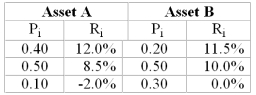
(77) Consider the following two assets with probability of return = Pi and return = Ri. Calculate the expected return for each and the standard deviation. Which one carries the greatest risk? Why?
(Essay)
4.9/5 (86)
(86) If the returns of two assets are perfectly positively correlated, an investor who puts half of his/her savings into each will:
(Multiple Choice)
4.8/5 (72)
(72) A $500 investment has the following payoff frequency: half of the time it will pay $350 and the other half of the time it will pay $900. Its standard deviation and value at risk respectively are:
(Multiple Choice)
4.8/5 (84)
(84) Professional gamblers know that the odds are always in favor of the house (casinos). The fact that they gamble says they are:
(Multiple Choice)
4.9/5 (71)
(71) Explain why returns on assets compensate for systematic risk but not for idiosyncratic risk.
(Essay)
4.9/5 (83)
(83) An investor puts $1,000 into an investment that will return $1,250 one-half of the time and $900 the remainder of the time. The expected return for this investor is:
(Multiple Choice)
4.8/5 (74)
(74) An investment with a large spread between possible payoffs will generally have:
(Multiple Choice)
4.8/5 (72)
(72) Apply the definition of risk provided in the textbook to an individual's decision to purchase a car insurance policy. Suppose that the individual has two possibilities: no accident ($0 gain/loss) and accident (-$30,000 loss). If the probability of an accident is lower than the probability of an accident occurring (say the probability of an accident is 10%), then why do people buy car insurance? How is this related to the concept of value at risk and the time horizon of investment decisions?
(Essay)
5.0/5 (74)
(74) You buy an asset for $2,500. The asset will return $3,300 half of the time and $2,700, the other half. The expected return is 20% (a gain of $500) and the standard deviation is 12% ($300). How would using $1,250 of borrowed funds change the expected return and standard deviation specifically?
(Essay)
5.0/5 (78)
(78) 
Filters
- Essay(0)
- Multiple Choice(0)
- Short Answer(0)
- True False(0)
- Matching(0)