



 Chat with AI
Exam 16: The Sun: Our Parent Star

Exam 1: Charting the Heavens: The Foundations of Astronomy106 Questions
Exam 2: The Copernican Revolution: The Birth of Modern Science105 Questions
Exam 3: Radiation: Information From the Cosmos113 Questions
Exam 4: Spectroscopy: the Inner Workings of Atoms99 Questions
Exam 5: Telescopes: The Tools of Astronomy111 Questions
Exam 6: The Solar System: Comparative Planetology and Formation Models152 Questions
Exam 7: Earth: Our Home in Space108 Questions
Exam 8: The Moon and Mercury: Scorched and Battered Worlds113 Questions
Exam 9: Venus: Earths Sister Planet96 Questions
Exam 10: Mars: a Near Miss for Life110 Questions
Exam 11: Jupiter: Giant of the Solar System115 Questions
Exam 12: Saturn: Spectacular Rings and Mysterious Moons123 Questions
Exam 13: Uranus and Neptune: The Outer Worlds of the Solar System116 Questions
Exam 14: Solar System Debris: Keys to Our Origin141 Questions
Exam 15: Exoplanets: Planetary Systems Beyond Our Own81 Questions
Exam 16: The Sun: Our Parent Star118 Questions
Exam 17: The Stars: Giants, Dwarfs, and the Main Sequence115 Questions
Exam 18: The Interstellar Medium: Gas and Dust Among the Stars105 Questions
Exam 19: Star Formation: a Traumatic Birth114 Questions
Exam 20: Stellar Evolution: The Life and Death of a Star108 Questions
Exam 21: Stellar Explosions: Novae, Supernovae, and the Formation of the Elements108 Questions
Exam 22: Neutron Stars and Black Holes: Strange States of Matter130 Questions
Exam 23: The Milky Way Galaxy: a Spiral in Space110 Questions
Exam 24: Galaxies: Building Blocks of the Universe107 Questions
Exam 25: Galaxies and Dark Matter: The Large-Scale Structure of the Cosmos106 Questions
Exam 26: Cosmology: The Big Bang and the Fate of the Universe102 Questions
Exam 27: The Early Universe: Toward the Beginning of Time113 Questions
Exam 28: Life in the Universe: Are We Alone106 Questions
Select questions type


By what mechanism does solar energy reach the Sun's photosphere from the layer justunderneath it?
(Multiple Choice)
4.8/5  (81)
(81) Describe the method of energy production in the Sun. What is the fuel? What is the endproduct? What kind of interactions occur? What is the role of temperature in the process? Couldwe use this process to produce energy on Earth?
(Essay)
4.8/5 (79)
(79) Granulation is the most obvious proof of solar convective energy transport.
(True/False)
4.9/5 (73)
(73) How is energy transfer from the solar interior to surface similar to a process in Earth'satmosphere?
(Essay)
4.9/5 (83)
(83) Prominences hanging off the limb of the Sun are the same as filaments seen in front of thedisk.
(True/False)
4.8/5 (81)
(81) Large circulation patterns in the Sun, dubbed "Conveyor Belts," that transport material fromthe equator to the poles, then back to the equator at a depth of 300,000 km, take how long tocomplete a cycle?
(Multiple Choice)
4.9/5 (67)
(67) The number of sunspots and their activity peak about every:
(Multiple Choice)
4.9/5 (91)
(91) While observing the Sun, you note a large number of sunspots. What can you conclude?
(Multiple Choice)
4.9/5 (72)
(72) The critical temperature to initiate the proton-proton cycle in the cores of stars is:
(Multiple Choice)
4.9/5 (86)
(86) At very large distances from the Sun, its corona turns into the solar wind.
(True/False)
4.9/5 (85)
(85) 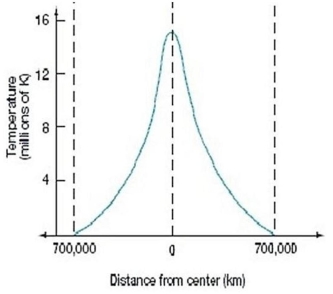 The above diagram indicates that:
If the last peak in sunspot numbers occurred in 2013, then the next solar max is ________.
(Short Answer)
4.7/5 (85)
(85) The photosphere is about 100 times the diameter of the Earth, and large sunspots are largerthan our whole planet.
(True/False)
5.0/5 (87)
(87) In spite of its high temperature, we observe the solar corona best during ________.
(Short Answer)
4.8/5 (80)
(80) 
Filters
- Essay(0)
- Multiple Choice(0)
- Short Answer(0)
- True False(0)
- Matching(0)