



 Chat with AI
Exam 2: The Hebrews: a New View of God and the Individual

Exam 1: The Ancient Near East: the First Civilizations87 Questions
Exam 2: The Hebrews: a New View of God and the Individual92 Questions
Exam 3: The Greek City-State: Democratic Politics78 Questions
Exam 4: Greek Thought: From Myth to Reason77 Questions
Exam 5: The Hellenistic Age: Cultural Diffusion79 Questions
Exam 6: The Roman Republic: City-State to World Empire76 Questions
Exam 7: The Roman Empire: a World-State91 Questions
Exam 8: Early Christianity: a World Religion79 Questions
Exam 9: The Heirs of Rome: Byzantium, Islam, and Latin Christendom97 Questions
Exam 10: The High Middle Ages: Vitality and Renewal83 Questions
Exam 11: The Flowering of Medieval Culture: the Christian Synthesis78 Questions
Exam 12: The Late Middle Ages: Crisis and Dissolution77 Questions
Exam 13: The Renaissance: Transition to the Modern Age89 Questions
Exam 14: The Reformation: the Shattering of Christian Unity85 Questions
Exam 15: European Expansion: Economic and Social Transformations89 Questions
Exam 16: The Rise of Sovereignty: Transition to the Modern State85 Questions
Exam 17: The Scientific Revolution: the Universe Seen As a Mechanism85 Questions
Exam 18: The Age of Enlightenment: Reason and Reform89 Questions
Select questions type


Instructions: Please define the following key terms.Show Who? What? Where? When? Why Important?
-transcendence
(Short Answer)
4.7/5  (73)
(73) Instructions: Please write a thorough, well-organized essay to answer each question.
-The Hebrews believed that they had a special relationship with God.What was that relationship and how did it affect people's lives?
(Essay)
4.8/5 (85)
(85) Instructions: Please write a thorough, well-organized essay to answer each question.
-How did the Hebrews contribute to the Western idea of the individual?
(Essay)
4.7/5 (91)
(91) After the Persians under Cyrus conquered Babylon in 538 B.C.
(Multiple Choice)
4.9/5 (82)
(82) Instructions: Please write a thorough, well-organized essay to answer each question.
-Explain the Hebrew concept of God and how that concept evolved.
(Essay)
4.9/5 (86)
(86) Instructions: Please write a thorough, well-organized essay to answer each question.
-Present a chronological history of the Hebrews, Israelites, and Jews until about 400 B.C.
(Essay)
4.9/5 (63)
(63) Instructions: Please define the following key terms.Show Who? What? Where? When? Why Important?
-Israelite tribal confederation
(Essay)
4.9/5 (77)
(77) Instructions: Please define the following key terms.Show Who? What? Where? When? Why Important?
-prophets
(Short Answer)
4.9/5 (78)
(78) Instructions: Please define the following key terms.Show Who? What? Where? When? Why Important?
-Hebrew Scriptures
(Essay)
4.8/5 (76)
(76) Instructions: Please use this outline map of the Near East to answer the question(s). 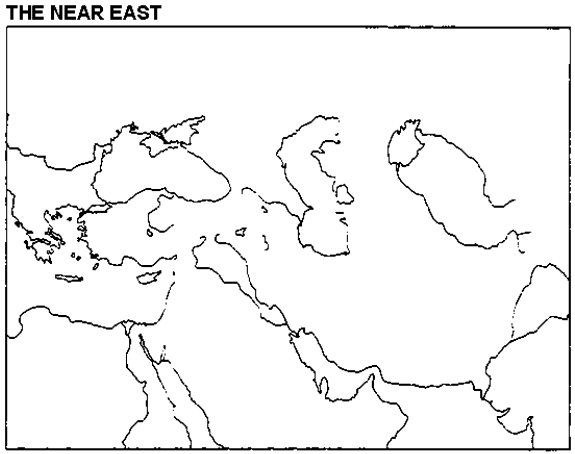 -Locate and label the major rivers and bodies of water associated with ancient Hebrew history.
 (Short Answer)
4.8/5 (72)
(72) Which of the following cannot be associated with mainstream Hebrew traditions?
(Multiple Choice)
4.8/5 (84)
(84) Instructions: Please use this outline map of the Near East to answer the question(s).
-Identify the liberators of the Jewish people from Babylonian Captivity.Clearly mark their homeland and the city of Babylon.
-Identify the liberators of the Jewish people from Babylonian Captivity.Clearly mark their homeland and the city of Babylon. (Short Answer)
4.7/5 (79)
(79) Instructions: Please define the following key terms.Show Who? What? Where? When? Why Important?
-parochialism
(Short Answer)
4.9/5 (76)
(76) Instructions: Please define the following key terms.Show Who? What? Where? When? Why Important?
-Pentateuch
(Essay)
4.9/5 (75)
(75) In Jewish history, the term Second Temple has been used to refer to
(Multiple Choice)
4.8/5 (89)
(89) Instructions: Please define the following key terms.Show Who? What? Where? When? Why Important?
-Torah
(Essay)
4.8/5 (71)
(71) The author connects Hebrew religion with the ultimate rise of a scientific worldview in the West by
(Multiple Choice)
4.8/5 (79)
(79) 
Filters
- Essay(0)
- Multiple Choice(0)
- Short Answer(0)
- True False(0)
- Matching(0)