



 Chat with AI
Exam 3: The Greek City-State: Democratic Politics

Exam 1: The Ancient Near East: the First Civilizations87 Questions
Exam 2: The Hebrews: a New View of God and the Individual92 Questions
Exam 3: The Greek City-State: Democratic Politics78 Questions
Exam 4: Greek Thought: From Myth to Reason77 Questions
Exam 5: The Hellenistic Age: Cultural Diffusion79 Questions
Exam 6: The Roman Republic: City-State to World Empire76 Questions
Exam 7: The Roman Empire: a World-State91 Questions
Exam 8: Early Christianity: a World Religion79 Questions
Exam 9: The Heirs of Rome: Byzantium, Islam, and Latin Christendom97 Questions
Exam 10: The High Middle Ages: Vitality and Renewal83 Questions
Exam 11: The Flowering of Medieval Culture: the Christian Synthesis78 Questions
Exam 12: The Late Middle Ages: Crisis and Dissolution77 Questions
Exam 13: The Renaissance: Transition to the Modern Age89 Questions
Exam 14: The Reformation: the Shattering of Christian Unity85 Questions
Exam 15: European Expansion: Economic and Social Transformations89 Questions
Exam 16: The Rise of Sovereignty: Transition to the Modern State85 Questions
Exam 17: The Scientific Revolution: the Universe Seen As a Mechanism85 Questions
Exam 18: The Age of Enlightenment: Reason and Reform89 Questions
Select questions type


Instructions: Please define the following key terms.Show Who? What? Where? When? Why Important?
-Peloponnesian War
(Essay)
4.8/5  (69)
(69) Instructions: Please use this outline map of Europe to answer the question(s). 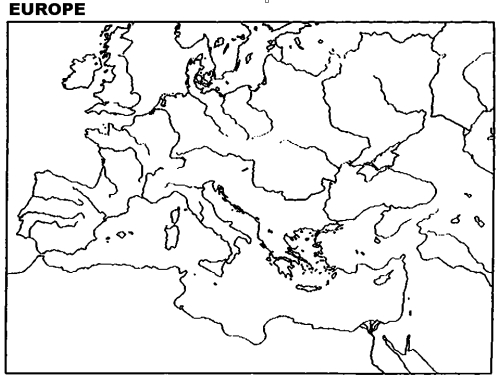 -Locate and clearly label Sparta and Athens.
 (Short Answer)
4.9/5 (78)
(78) Instructions: Please define the following key terms.Show Who? What? Where? When? Why Important?
-ostracism
(Essay)
4.9/5 (97)
(97) Instructions: Please write a thorough, well-organized essay to answer each question.
-Trace and explain the political history of Athens, paying special attention to Athenian democracy.
(Essay)
4.8/5 (77)
(77) Instructions: Please write a thorough, well-organized essay to answer each question.
-Explain how civilization in Greece preceded Hellenic Greece.
(Essay)
4.8/5 (84)
(84) Instructions: Please define the following key terms.Show Who? What? Where? When? Why Important?
-Achilles
(Short Answer)
4.9/5 (77)
(77) Instructions: Please define the following key terms.Show Who? What? Where? When? Why Important?
-isonomy
(Short Answer)
4.7/5 (85)
(85) The surviving biographical information about Demosthenes, the greatest of Greek orators, reveals that
(Multiple Choice)
4.8/5 (70)
(70) In the revival that came after the Dark Age, all the following occurred except
(Multiple Choice)
5.0/5 (78)
(78) The author believes that the tyrant Pisistratus' greatest achievement was
(Multiple Choice)
4.7/5 (78)
(78) The activities of Heinrich Schliemann and Arthur Evans resulted in
(Multiple Choice)
4.9/5 (64)
(64) Which of the following states emerged as a first-rate military power in the fourth century B.C.?
(Multiple Choice)
4.9/5 (91)
(91) After about 800 B.C., the Greeks borrowed all of the following from the Near East except
(Multiple Choice)
5.0/5 (95)
(95) Athenian democratic theory did not produce which of the following?
(Multiple Choice)
4.7/5 (88)
(88) Instructions: Please write a thorough, well-organized essay to answer each question.
-Compare and contrast the rhetoric and practice of democracy in Athens with modern notions and practices of democracy.
(Essay)
4.7/5 (79)
(79) Instructions: Please write a thorough, well-organized essay to answer each question.
-Explain the importance of Homer and the Homeric epics to Greek civilization.
(Essay)
4.8/5 (83)
(83) Considered a garrison state, Sparta could take credit for all the following except
(Multiple Choice)
4.7/5 (75)
(75) 
Filters
- Essay(0)
- Multiple Choice(0)
- Short Answer(0)
- True False(0)
- Matching(0)