



 Chat with AI
Exam 10: The High Middle Ages: Vitality and Renewal

Exam 1: The Ancient Near East: the First Civilizations87 Questions
Exam 2: The Hebrews: a New View of God and the Individual92 Questions
Exam 3: The Greek City-State: Democratic Politics78 Questions
Exam 4: Greek Thought: From Myth to Reason77 Questions
Exam 5: The Hellenistic Age: Cultural Diffusion79 Questions
Exam 6: The Roman Republic: City-State to World Empire76 Questions
Exam 7: The Roman Empire: a World-State91 Questions
Exam 8: Early Christianity: a World Religion79 Questions
Exam 9: The Heirs of Rome: Byzantium, Islam, and Latin Christendom97 Questions
Exam 10: The High Middle Ages: Vitality and Renewal83 Questions
Exam 11: The Flowering of Medieval Culture: the Christian Synthesis78 Questions
Exam 12: The Late Middle Ages: Crisis and Dissolution77 Questions
Exam 13: The Renaissance: Transition to the Modern Age89 Questions
Exam 14: The Reformation: the Shattering of Christian Unity85 Questions
Exam 15: European Expansion: Economic and Social Transformations89 Questions
Exam 16: The Rise of Sovereignty: Transition to the Modern State85 Questions
Exam 17: The Scientific Revolution: the Universe Seen As a Mechanism85 Questions
Exam 18: The Age of Enlightenment: Reason and Reform89 Questions
Select questions type


The medieval Church regarded heretics as all the following except
(Multiple Choice)
4.9/5  (88)
(88) The original impetus to the great increase in papal power during the High Middle Ages was the
(Multiple Choice)
4.8/5 (72)
(72) Which best explains why the Christian Church became the largest property owner in the cities?
(Multiple Choice)
5.0/5 (84)
(84) Instructions: Please use this outline map of Europe to answer the question(s). 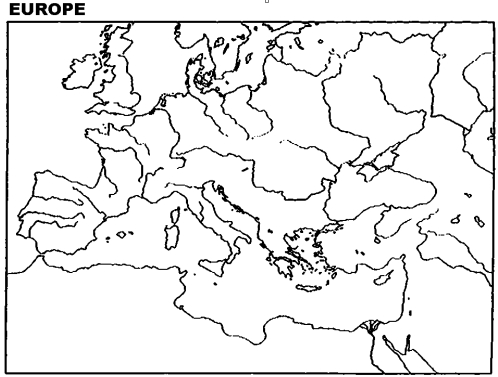 -Draw in the approximate borders of the Holy Roman Empire in 1200.On the same map, draw in Charlemagne's Empire and the Roman Empire at its height.Clearly label all three.
 (Short Answer)
4.8/5 (73)
(73) What was the attitude of lords to peasants opening wastelands to cultivation?
(Multiple Choice)
4.8/5 (87)
(87) The principle export of northern Europe to Italy and the Mediterranean in the High Middle Ages was
(Multiple Choice)
4.7/5 (70)
(70) Instructions: Please use this outline map of Europe to answer the question(s).
-Draw in the approximate borders of the Holy Roman Empire in 1200.On the same map, locate and label the Holy Roman Empire's neighbors: the Kingdoms of Denmark, France, Hungary, and Poland.
-Draw in the approximate borders of the Holy Roman Empire in 1200.On the same map, locate and label the Holy Roman Empire's neighbors: the Kingdoms of Denmark, France, Hungary, and Poland. (Essay)
4.9/5 (70)
(70) From the 1200s on, a safe generalization would be that compared to English kings, French kings had
(Multiple Choice)
4.7/5 (72)
(72) Advances in business techniques in the High Middle Ages included all of the following except
(Multiple Choice)
4.8/5 (96)
(96) The new outlook developed among the townspeople of the High Middle Ages included a
(Multiple Choice)
4.9/5 (88)
(88) Compared to the ancient world, European agricultural technology at the end of the thirteenth century was
(Multiple Choice)
5.0/5 (81)
(81) Instructions: Please define the following key terms.Show Who? What? Where? When? Why Important?
-deicide
(Essay)
5.0/5 (90)
(90) Attitudes toward the Jewish community in medieval Europe were predicated upon the belief that
(Multiple Choice)
4.9/5 (73)
(73) Instructions: Please define the following key terms.Show Who? What? Where? When? Why Important?
-Domesday Book
(Short Answer)
4.9/5 (89)
(89) Instructions: Please define the following key terms.Show Who? What? Where? When? Why Important?
-Inquisition
(Essay)
4.8/5 (93)
(93) At the end of the eleventh century Europe showed all the signs of recovery except
(Multiple Choice)
4.7/5 (83)
(83) 
Filters
- Essay(0)
- Multiple Choice(0)
- Short Answer(0)
- True False(0)
- Matching(0)