



 Chat with AI
Exam 16: The Rise of Sovereignty: Transition to the Modern State

Exam 1: The Ancient Near East: the First Civilizations87 Questions
Exam 2: The Hebrews: a New View of God and the Individual92 Questions
Exam 3: The Greek City-State: Democratic Politics78 Questions
Exam 4: Greek Thought: From Myth to Reason77 Questions
Exam 5: The Hellenistic Age: Cultural Diffusion79 Questions
Exam 6: The Roman Republic: City-State to World Empire76 Questions
Exam 7: The Roman Empire: a World-State91 Questions
Exam 8: Early Christianity: a World Religion79 Questions
Exam 9: The Heirs of Rome: Byzantium, Islam, and Latin Christendom97 Questions
Exam 10: The High Middle Ages: Vitality and Renewal83 Questions
Exam 11: The Flowering of Medieval Culture: the Christian Synthesis78 Questions
Exam 12: The Late Middle Ages: Crisis and Dissolution77 Questions
Exam 13: The Renaissance: Transition to the Modern Age89 Questions
Exam 14: The Reformation: the Shattering of Christian Unity85 Questions
Exam 15: European Expansion: Economic and Social Transformations89 Questions
Exam 16: The Rise of Sovereignty: Transition to the Modern State85 Questions
Exam 17: The Scientific Revolution: the Universe Seen As a Mechanism85 Questions
Exam 18: The Age of Enlightenment: Reason and Reform89 Questions
Select questions type


Instructions: Please use this outline map of Europe to answer the question(s) 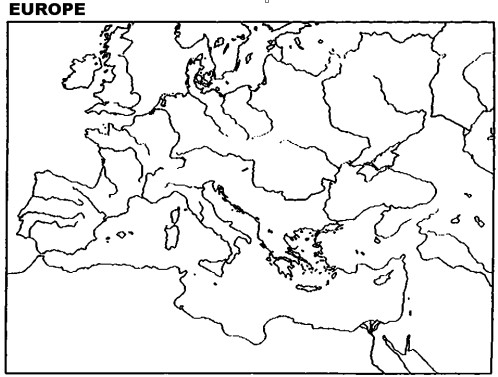 -Indicate the location of two absolute monarchies and two of the most important of the non-absolutist states as of 1700.
 (Essay)
4.8/5  (84)
(84) Instructions: Please define the following key terms.Show Who? What? Where? When? Why Important?
-Magna Carta
(Essay)
4.9/5 (74)
(74) Instructions: Please write a thorough, well-organized essay to answer each question.
-The author states that "[f]rom the thirteenth to the seventeenth century, a new and unique form of political organization emerged in the West: the dynastic, or national, state." What does she mean by "dynastic state," how did it develop and why was it so unique?
(Essay)
4.8/5 (81)
(81) Although the differences between Russia and the West were immense, the political arrangement in Russia resembled somewhat that in
(Multiple Choice)
4.8/5 (72)
(72) Over time, the constitutional system created by the Revolution of 1688-1689
(Multiple Choice)
4.8/5 (68)
(68) Instructions: Please define the following key terms.Show Who? What? Where? When? Why Important?
-dynastic state
(Essay)
4.7/5 (87)
(87) In the "court and country" opposition that shaped seventeenth-century English politics country refers to
(Multiple Choice)
4.9/5 (72)
(72) Instructions: Please use this outline map of Europe to answer the question(s)
-Locate the following sites: the major Dutch urban centers of Amsterdam, Rotterdam, Utrecht, and The Hague; the location where the Fronde occurred, Paris; the site where a Concordat was signed, Bologna; the place from which the Spanish Armada set sail, Lisbon; and finally Antwerp, which was sacked by Spanish soldiers.
-Locate the following sites: the major Dutch urban centers of Amsterdam, Rotterdam, Utrecht, and The Hague; the location where the Fronde occurred, Paris; the site where a Concordat was signed, Bologna; the place from which the Spanish Armada set sail, Lisbon; and finally Antwerp, which was sacked by Spanish soldiers. (Short Answer)
4.9/5 (75)
(75) Instructions: Please define the following key terms.Show Who? What? Where? When? Why Important?
-New Christians
(Essay)
4.9/5 (57)
(57) Instructions: Please define the following key terms.Show Who? What? Where? When? Why Important?
-"Time of Troubles"
(Not Answered)
This question doesn't have any answer yet
Instructions: Please write a thorough, well-organized essay to answer each question.
-Explain the dramatic increase of Spanish power in the fifteenth and sixteenth centuries and the dramatic decline in Spanish power in the seventeenth century.
(Essay)
4.9/5 (68)
(68) According to the author, the last chance to unify the Holy Roman Empire ended with
(Multiple Choice)
4.9/5 (95)
(95) Instructions: Please define the following key terms.Show Who? What? Where? When? Why Important?
-Versailles
(Essay)
4.9/5 (78)
(78) The crucial difference between a parliament and an estates general was
(Multiple Choice)
4.8/5 (79)
(79) Instructions: Please define the following key terms.Show Who? What? Where? When? Why Important?
-Gallican Church
(Essay)
4.7/5 (91)
(91) The formative group or force in most early modern European states was/were the
(Multiple Choice)
4.8/5 (85)
(85) In plotting against James II in 1688, England's elite attempted to
(Multiple Choice)
5.0/5 (90)
(90) 
Filters
- Essay(0)
- Multiple Choice(0)
- Short Answer(0)
- True False(0)
- Matching(0)