



 Chat with AI
Exam 2: Measurement

Exam 1: Introduction61 Questions
Exam 2: Measurement73 Questions
Exam 3: Business Cycle Measurement59 Questions
Exam 4: Consumer and Firm Behavior: the Workleisure Decision and Profit Maximization74 Questions
Exam 5: A Closed-Economy One-Period Macroeconomic Model63 Questions
Exam 6: Search and Unemployment52 Questions
Exam 7: Economic Growth: Malthus and Solow66 Questions
Exam 8: Income Disparity Among Countries and Endogenous Growth62 Questions
Exam 9: A Two-Period Model: the Consumptionsavings Decision and Credit Markets69 Questions
Exam 10: Credit Market Imperfections: Credit Frictions, Financial Crises, and Social Security39 Questions
Exam 11: A Real Intertemporal Model With Investment71 Questions
Exam 12: Money, Banking, Prices, and Monetary Policy66 Questions
Exam 13: Business Cycle Models With Flexible Prices and Wages83 Questions
Exam 14: New Keynesian Economics: Sticky Prices48 Questions
Exam 15: Inflation: Phillips Curves and Neo-Fisherism69 Questions
Exam 16: International Trade in Goods and Assets69 Questions
Exam 17: Money in the Open Economy30 Questions
Exam 18: Money, Inflation, and Banking: a Deeper Look30 Questions
Select questions type


For the following question(s), suppose that an economy produces only food and clothing, and that price and quantity data
are given in the table below. 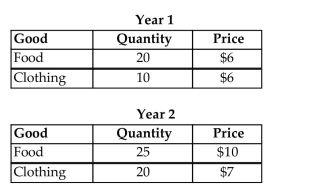 -Year 1 nominal GDP is
 (Multiple Choice)
4.8/5  (66)
(66) If a particular measure of real GDP consistently underestimates growth in real GDP, then the rate of inflation as measured by the GDP deflator
(Multiple Choice)
4.9/5 (68)
(68) Suppose that GDP is equal to 1,000, national saving is equal to 200, the current account deficit is equal to 100, and the government budget deficit is equal to 50. Investment must equal
(Multiple Choice)
4.8/5 (76)
(76) For the following question(s), suppose that an economy produces only bread and computers. Assume that all production is
consumed in each year, and that price and quantity data are given in the table below. Year 1 Good Quantity Price Bread 30 \ 10 Computers 10 \ 50 Year 2 Good Quantity Price Bread 40 \ 15 Computers 30 \ 60
-If Year 1 is the base year, the GDP price deflator for Year 2 is approximately
(Multiple Choice)
5.0/5 (80)
(80) In 2017, which of the following comprised less than 5% of GDP?
(Multiple Choice)
4.8/5 (82)
(82) For the following question(s), suppose an economy produces only pens and pencils, and that the quantity and price data is given by
this table: Pens Pencils Year 1 quantity 15 10 Year 1 price \ 12 \ 12 Year 2 quantity 17 12 Year 2 price \ 14 \ 15
-What is the real GDP in year 2 using base year 2?
(Multiple Choice)
4.7/5 (80)
(80) Changes in the relative prices of goods causes problems measuring real GDP because
(Multiple Choice)
4.8/5 (85)
(85) Value added is equal to the value of a firm's production minus
(Multiple Choice)
4.9/5 (75)
(75) To calculate the change in chain-weighted real GDP from one year to the next, we use
(Multiple Choice)
4.7/5 (71)
(71) For the following question(s), suppose an economy produces only pens and pencils, and that the quantity and price data is given by
this table: Pens Pencils Year 1 quantity 15 10 Year 1 price \ 12 \ 12 Year 2 quantity 17 12 Year 2 price \ 14 \ 15
-What is the real GDP in year 1 using base year 1?
(Multiple Choice)
4.7/5 (85)
(85) The value of a producer's output minus the value of all intermediate goods used in the production of that output is called the producer's
(Multiple Choice)
4.9/5 (86)
(86) 
Filters
- Essay(0)
- Multiple Choice(0)
- Short Answer(0)
- True False(0)
- Matching(0)