



 Chat with AI
Exam 5: Roads to Revolution, 1750-1776

Exam 1: Native Peoples of America, to 150024 Questions
Exam 2: The Rise of the Atlantic World, 1400-162555 Questions
Exam 3: The Emergence of Colonial Societies, 1625-170056 Questions
Exam 4: The Bonds of Empire, 1660-175049 Questions
Exam 5: Roads to Revolution, 1750-177649 Questions
Exam 6: Securing Independence, Defining Nationhood, 1776-178867 Questions
Exam 7: Launching the New Republic, 1788-180045 Questions
Exam 8: America at War and Peace, 1801-182453 Questions
Exam 9: The Transformation of American Society, 1815-184043 Questions
Exam 10: Democratic Politics, Religious Revival, and Reform, 1824-184041 Questions
Exam 11: Technology, Culture, and Everyday Life, 1840-186054 Questions
Exam 12: The Old South and Slavery, 1830-186057 Questions
Exam 13: Immigration, Expansion, and Sectional Conflict, 1840-184837 Questions
Exam 14: From Compromise to Secession, 1850-186151 Questions
Exam 15: Crucible of Freedom: Civil War, 1861-186557 Questions
Exam 16: The Crises of Reconstruction, 1865-187742 Questions
Select questions type


Which of the following statements represents the conception most American colonists held of parliamentary power in the 1760s?
(Multiple Choice)
4.9/5  (92)
(92) Where did British and colonial forces first fight in April 1775?
(Multiple Choice)
4.9/5 (77)
(77) MAP QUESTIONS
Instructions: Choose the letter on the accompanying map of northeastern North America that correctly identifies each of the following:
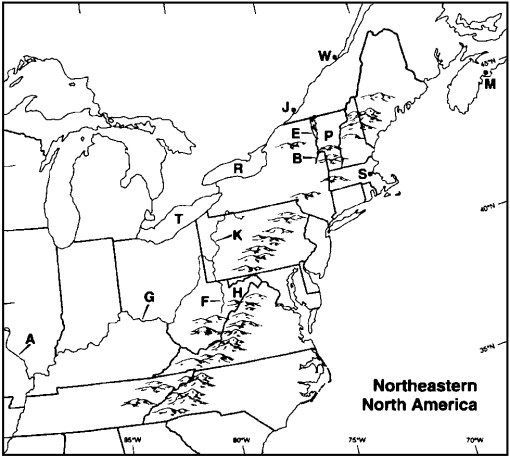 -Lake Ontario
 (Short Answer)
4.8/5 (80)
(80) According to the colonists, what did the American Board of Customs Commissioners do?
(Multiple Choice)
5.0/5 (76)
(76) Which statement is true concerning British tax rates during the 1760s?
(Multiple Choice)
4.7/5 (81)
(81) 
Filters
- Essay(0)
- Multiple Choice(0)
- Short Answer(0)
- True False(0)
- Matching(0)