



 Chat with AI
Exam 7: Markets, Prices, Supply, and Demand

Exam 1: Thinking About Macroeconomics50 Questions
Exam 2: National-Income Accounting: Gross Domestic Product and the Price Level58 Questions
Exam 3: Introduction to Economic Growth63 Questions
Exam 4: Working With the Solow Growth Model60 Questions
Exam 5: Conditional Convergence and Long-Run Economic Growth60 Questions
Exam 6: Macroeconomics Without Microeconomic Foundations60 Questions
Exam 7: Markets, Prices, Supply, and Demand60 Questions
Exam 8: Consumption, Saving, and Investment60 Questions
Exam 9: An Equilibrium Business-Cycle Model60 Questions
Exam 10: Capital Utilization and Unemployment59 Questions
Exam 11: The Demand for Money and the Price Level60 Questions
Exam 12: Inflation, Money Growth, and Interest Rates60 Questions
Exam 13: Government Expenditure60 Questions
Exam 14: Taxes54 Questions
Exam 15: Public Debt60 Questions
Exam 16: Money and Business Cycles I: the Price-Misperceptions Model60 Questions
Exam 17: Money and Business Cycles Ii: Sticky Prices and Nominal Wage Rates60 Questions
Exam 18: World Markets in Goods and Credit60 Questions
Exam 19: Exchange Rates60 Questions
Select questions type


Figure 6.1 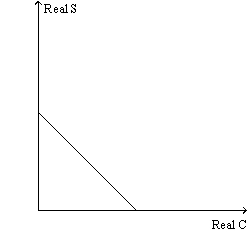 In Figure 6.1 an increase in real income is shown by:
Free
(Multiple Choice)
4.9/5  (70)
(70) Correct Answer: Verified
A
What causes the labour and capital markets to clear in the model of this chapter?
Free
(Essay)
4.8/5 (83)
(83) Correct Answer:Verified
VerifiedThe model is a market clearing model in which prices, w/P and R/P, adjust so that the labour and capital market clear where LD = LS in the labour market and KD = KS in the capital market.
In the market clearing model, nominal saving is:
Free
(Multiple Choice)
4.8/5 (82)
(82) Correct Answer:Verified
VerifiedB
In the market clearing model, the demand for capital and labour come from:
(Multiple Choice)
4.8/5 (70)
(70)  , is:
In the model the nominal interest rate equals the nominal net return on capital, i = (R/P) -  , because:
 (Multiple Choice)
4.8/5 (72)
(72) In the goods market in the model of this chapter households can buy:
(Multiple Choice)
4.8/5 (72)
(72) According to the household nominal budget constraint, PC+  B+P•
 K =
 + wL + i(B + PK), households can use their income to:
B+P• K = + wL + i(B + PK), households can use their income to: (Multiple Choice)
4.8/5 (71)
(71) The household real budget constraint C + (  B/P) +
 K = (
 /P)+ (w/P)•L + i•((B/P) + K). shows that in our model:
B/P) + K = ( /P)+ (w/P)•L + i•((B/P) + K). shows that in our model: (Multiple Choice)
4.9/5 (81)
(81) In the market clearing model, for the whole economy interest income is:
(Multiple Choice)
4.8/5 (72)
(72) If the nominal wage rate is £10 per hour and the price level is 2, then the real wage a worker earns is:
(Multiple Choice)
4.9/5 (85)
(85) 
Filters
- Essay(0)
- Multiple Choice(0)
- Short Answer(0)
- True False(0)
- Matching(0)