



 Chat with AI
Exam 9: Project Scheduling: Pertcpm

Exam 1: Introduction36 Questions
Exam 2: An Introduction to Linear Programming46 Questions
Exam 3: Linear Programming: Sensitivity Analysis and Interpretation of Solution36 Questions
Exam 4: Linear Programming Applications in Marketing, Finance, and Operations Management36 Questions
Exam 5: Advanced Linear Programming Applications30 Questions
Exam 6: Distribution and Network Models55 Questions
Exam 7: Integer Linear Programming41 Questions
Exam 8: Nonlinear Optimization Models44 Questions
Exam 9: Project Scheduling: Pertcpm47 Questions
Exam 10: Inventory Models43 Questions
Exam 11: Waiting Line Models40 Questions
Exam 12: Simulation43 Questions
Exam 13: Decision Analysis36 Questions
Exam 14: Multicriteria Decisions39 Questions
Exam 15: Forecasting38 Questions
Exam 16: Markov Processes31 Questions
Select questions type


Which is not a significant challenge of project scheduling?

Free
(Multiple Choice)
4.9/5  (71)
(71) Correct Answer: Verified
B
When activity times are uncertain, an activity's most likely time is the same as its expected time.
Free
(True/False)
4.8/5 (75)
(75) Correct Answer:Verified
VerifiedFalse
The difference between an activity's earliest finish time and latest finish time equals the difference between its earliest start time and latest start time.
Free
(True/False)
4.9/5 (65)
(65) Correct Answer:Verified
VerifiedTrue
For an activity with more than one immediate predecessor activity, which of the following is used to compute its earliest finish (EF) time?
(Multiple Choice)
4.9/5 (87)
(87) Which of the following is a general rule for crashing activities?
(Multiple Choice)
4.8/5 (80)
(80) Activities G, P, and R are the immediate predecessors for activity W. If the earliest finish times for the three are 12, 15, and 10, then the earliest start time for W
(Multiple Choice)
4.9/5 (89)
(89) PERT and CPM are applicable only when there is no dependence among activities.
(True/False)
4.7/5 (78)
(78) A project network is shown below. Use a forward and a backward pass to determine the critical path, and then fill out the table below. Activity times are in weeks. 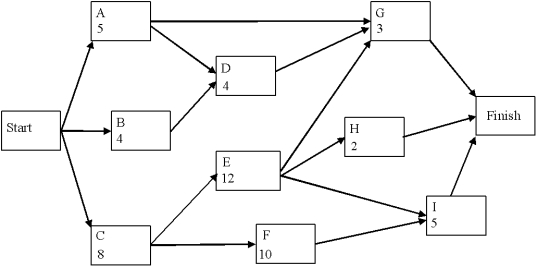
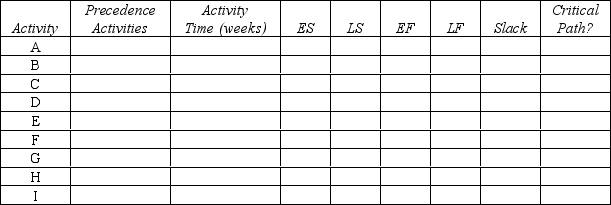 Now assume that the times listed are only the expected times instead of being fixed times. Is the probability of being finished in more than 28 weeks more or less than 50%?
 (Essay)
4.8/5 (87)
(87) From this PERT/CPM network, determine the list of activities and their predecessors. 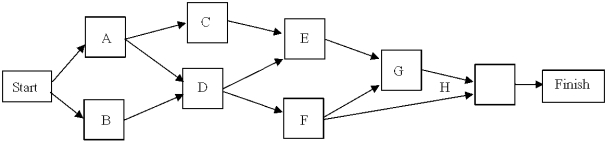
(Essay)
4.8/5 (82)
(82) The earliest start time for an activity is equal to the smallest of the earliest finish times for all its immediate predecessors.
(True/False)
4.7/5 (65)
(65) A project network is shown below. Use a forward and a backward pass to determine the critical path, and then fill out the table below. Activity times are in weeks. 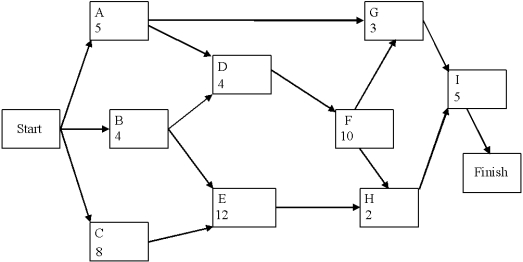
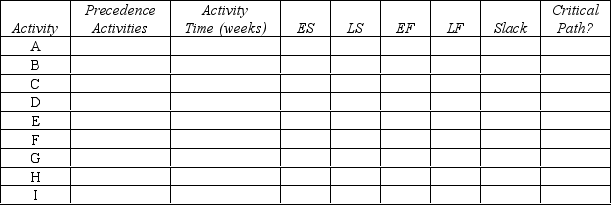 Now assume that the times listed are only the expected times instead of being fixed times. Is the probability of being finished in fewer than 25 weeks more or less than 50%?
 (Essay)
4.9/5 (77)
(77) Activities K, M and S immediately follow activity H, and their latest start times are 14, 18, and 11. The latest finish time for activity H
(Multiple Choice)
4.9/5 (83)
(83) Constraints in the LP models for crashing decisions are required to compare the activity's earliest finish time with the earliest finish time of each predecessor.
(True/False)
4.8/5 (91)
(91) A cookie recipe gives the following numbered steps.
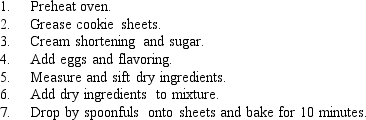 Although the steps are numbered, they do not always reflect immediate precedence relationships. Develop a table that lists the immediate predecessors for each activity.
 (Essay)
4.9/5 (69)
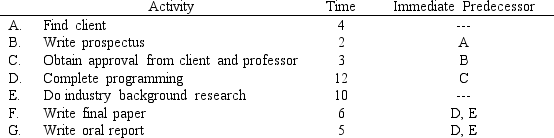
(69) A senior MIS design class project team has developed the following schedule of activities for their project, using their best estimate of completion times. Both written and oral reports are required. Draw the project network. Can they complete the project in the 38 class days remaining until the end of the semester?
(Essay)
4.9/5 (68)
(68) 
Filters
- Essay(0)
- Multiple Choice(0)
- Short Answer(0)
- True False(0)
- Matching(0)