Exam 11: An Introduction to Calculus: Limits, Derivatives, and Integrals

arrow
  • Select Tags
search iconSearch Question
flashcardsStudy Flashcards
  • Select Tags

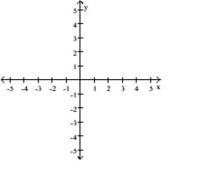
Sketch a possible graph for a function f that has the stated properties. -  The domain of f is [0,5] and the derivative is undefined at x=3. \text { The domain of } \mathrm { f } \text { is } [ 0,5 ] \text { and the derivative is undefined at } \mathrm { x } = 3 \text {. }  Sketch a possible graph for a function f that has the stated properties. - \text { The domain of } \mathrm { f } \text { is } [ 0,5 ] \text { and the derivative is undefined at } \mathrm { x } = 3 \text {. }
(Not Answered)
This question doesn't have any answer yet
Ask our community

Use NINT on a calculator to find the numerical integral of the function over the specified interval. - f(x)=∣sin⁡x∣;[0,32π]f ( x ) = | \sin x | ; \left[ 0 , \frac { 3 } { 2 } \pi \right]

(Multiple Choice)
4.9/5
(83)

Find the definite integral by computing an area. - ∫0749−x2dx\int _ { 0 } ^ { 7 } \sqrt { 49 - x ^ { 2 } } d x

(Multiple Choice)
4.9/5
(100)

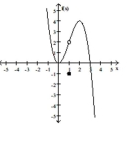
Use the given graph to determine the limit, if it exists. - lim⁡x→1−f(x)\lim _{x \rightarrow 1^{-}} f(x)  Use the given graph to determine the limit, if it exists. - \lim _{x \rightarrow 1^{-}} f(x)
(Multiple Choice)
4.8/5
(71)

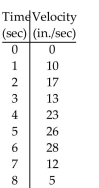
Solve the problem. -The table shows the velocity of a remote controlled race car moving along a dirt path for 8 seconds. Estimate the distance traveled by the car using 8 subintervals of length 1 with left-end point values. Solve the problem. -The table shows the velocity of a remote controlled race car moving along a dirt path for 8 seconds. Estimate the distance traveled by the car using 8 subintervals of length 1 with left-end point values.
(Multiple Choice)
4.8/5
(64)

Find the derivative of the function using the definition of derivative. - f(x)=8x+2f ( x ) = \frac { 8 } { x + 2 }

(Multiple Choice)
4.9/5
(89)

Determine the limit algebraically, if possible. - lim⁡x→0x2cot⁡x2\lim _ { x \rightarrow 0 } x ^ { 2 } \cot x ^ { 2 }

(Multiple Choice)
4.9/5
(88)

Sketch a possible graph for a function f that has the stated properties. -  The domain of f is [−4,4],f is non-increasing on [0,4], and the derivative at x=3 is 0. \text { The domain of } \mathrm { f } \text { is } [ - 4,4 ] , \mathrm { f } \text { is non-increasing on } [ 0,4 ] \text {, and the derivative at } \mathrm { x } = 3 \text { is } 0 \text {. }  Sketch a possible graph for a function f that has the stated properties. - \text { The domain of } \mathrm { f } \text { is } [ - 4,4 ] , \mathrm { f } \text { is non-increasing on } [ 0,4 ] \text {, and the derivative at } \mathrm { x } = 3 \text { is } 0 \text {. }
(Not Answered)
This question doesn't have any answer yet
Ask our community

Find the limit of the function by using direct substitution. - lim⁡x→1(x2−3x)4\lim _ { x \rightarrow 1 } \left( x ^ { 2 } - 3 x \right) ^ { 4 }

(Multiple Choice)
4.8/5
(93)

Find the indicated limit. - lim⁡x→∞(e−x2sin⁡x)\lim _ { x \rightarrow \infty } \left( e ^ { - x ^ { 2 } } \sin x \right)

(Multiple Choice)
4.8/5
(72)

Find the indicated limit. - lim⁡x→∞x2ex\lim _ { x \rightarrow \infty } x ^ { 2 } e ^ { x }

(Multiple Choice)
4.8/5
(76)

Match the function with the correct table values. - f(x)=x3−6x+8x−2f ( x ) = \frac { x ^ { 3 } - 6 x + 8 } { x - 2 }  Match the function with the correct table values. - f ( x ) = \frac { x ^ { 3 } - 6 x + 8 } { x - 2 }

(Multiple Choice)
4.9/5
(85)

Use NDER on a calculator to find the numerical derivative of the function at the specified point. - f(x)=xsin⁡(4x) at x=9f ( x ) = x \sin ( 4 x ) \text { at } x = 9

(Multiple Choice)
4.8/5
(69)

Use NINT on a calculator to find the numerical integral of the function over the specified interval. - f(x)=1x;[1,e6]f ( x ) = \frac { 1 } { x } ; \left[ 1 , e ^ { 6 } \right]

(Multiple Choice)
4.7/5
(78)

Find the indicated limit. - lim⁡u→2+∣u−2∣u−2\lim _ { \mathrm { u } \rightarrow 2 ^ { + } } \frac { | \mathrm { u } - 2 | } { \mathrm { u } - 2 }

(Multiple Choice)
4.8/5
(75)

Find the limit. -Let lim⁡x→8f(x)=1\lim _ { x \rightarrow 8 } f ( x ) = 1 and lim⁡x→8g(x)=−9\lim _ { x \rightarrow 8 } g ( x ) = - 9 . Find lim⁡x→8[f(x)+g(x)]2\lim _ { x \rightarrow 8 } [ f ( x ) + g ( x ) ] ^ { 2 } .

(Multiple Choice)
4.8/5
(84)

Find the limit of the function by using direct substitution. - lim⁡x→0x3−6x+8x−2\lim _ { x \rightarrow 0 } \frac { x ^ { 3 } - 6 x + 8 } { x - 2 }

(Multiple Choice)
4.9/5
(98)

Find the limit. -Let lim⁡x→2f(x)=2\lim _ { x \rightarrow 2 } f ( x ) = 2 and lim⁡x→2g(x)=8\lim _ { x \rightarrow 2 } g ( x ) = 8 . Find lim⁡x→2[f(x)⋅g(x)]\lim _ { x \rightarrow 2 } [ f ( x ) \cdot g ( x ) ] .

(Multiple Choice)
5.0/5
(78)

Find the derivative of the function using the definition of derivative. - f(x)=−5f ( x ) = - 5

(Multiple Choice)
4.8/5
(83)

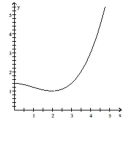
Solve the problem. -Estimate the "LRAM" area under the graph of the function above the xx -axis and under the graph of the function from x=0x = 0 to x=5x = 5 . Use 5 subintervals.  Solve the problem. -Estimate the LRAM area under the graph of the function above the  x -axis and under the graph of the function from  x = 0  to  x = 5 . Use 5 subintervals.

(Multiple Choice)
4.7/5
(91)
Showing 41 - 60 of 167
close modal

Filters

  • Essay(0)
  • Multiple Choice(0)
  • Short Answer(0)
  • True False(0)
  • Matching(0)