



 Chat with AI
Exam 3: Exponential, Logistic, and Logarithmic Functions

Exam 1: Functions and Graphs362 Questions
Exam 2: Polynomial, Power, and Rational Functions494 Questions
Exam 3: Exponential, Logistic, and Logarithmic Functions350 Questions
Exam 4: Trigonometric Functions522 Questions
Exam 5: Analytic Trigonometry313 Questions
Exam 6: Applications of Trigonometry333 Questions
Exam 7: Systems and Matrices354 Questions
Exam 8: Analytic Geometry in Two and Three Dimensions167 Questions
Exam 9: Discrete Mathematics154 Questions
Exam 10: Statistics and Probability147 Questions
Exam 11: An Introduction to Calculus: Limits, Derivatives, and Integrals167 Questions
Exam 12: Prerequisites382 Questions
Select questions type


Solve the problem.
-How long will it take for $1100 to grow to $4800 at an interest rate of 10.9% if the interest is compounded quarterly? Round the number of years to the nearest hundredth.
(Multiple Choice)
4.8/5  (95)
(95) Solve the problem.
-Estimate the -value associated with as predicted by the natural logarithmic regression equation for the following data.

(Multiple Choice)
4.8/5 (74)
(74) State whether the function is an exponential growth function or exponential decay function, and describe its end
behavior using limits.
-
(Multiple Choice)
4.7/5 (76)
(76) Find the following using a calculator. Round to four decimal places.
-
(Multiple Choice)
5.0/5 (71)
(71) Solve the problem.
-Matthew obtains a 30-year $84,000 house loan with an APR of 7.23%. What is his monthly payment?
(Multiple Choice)
4.8/5 (91)
(91) Describe how to transform the graph of the basic function g(x) into the graph of the given function f(x).
-
(Multiple Choice)
4.8/5 (78)
(78) Provide an appropriate response.
-
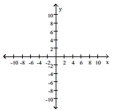
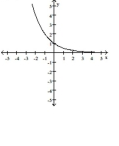 The graph of an exponential function with base a is given. Sketch the graph of . Give the domain and : of .
 (Essay)
4.7/5 (68)
(68) 
Solve the problem.
-The table shows the population of a certain city in various years. The data can be modeled by an exponential function of the form . Use exponential regression to predict the population of the city in the year 2000 . (You will first need to determine the exponential function that models this data).

(Multiple Choice)
4.8/5 (76)
(76) State whether the function is an exponential growth function or exponential decay function, and describe its end
behavior using limits.
-
(Multiple Choice)
5.0/5 (77)
(77) Decide whether the function is an exponential growth or exponential decay function and find the constant percentage
rate of growth or decay.
-
(Multiple Choice)
4.8/5 (92)
(92) Solve the problem.
-The table shows the number of sales of scooters , in thousands, months after they are introduced on the market. Use regression to find a logistic function that models this data. Round the constants to the nearest hundredth.

(Multiple Choice)
4.8/5 (80)
(80) Graph the function and analyze it for domain, range, continuity, increasing or decreasing behavior, asymptotes, and end
behavior.
-f(x) = log3(6x)
(Essay)
4.8/5 (81)
(81) Solve the problem.
-By how many orders of magnitude do a $20 bill and a nickel differ?
(Multiple Choice)
4.9/5 (83)
(83) 
Filters
- Essay(0)
- Multiple Choice(0)
- Short Answer(0)
- True False(0)
- Matching(0)