



 Chat with AI
Exam 6: Applications of Trigonometry

Exam 1: Functions and Graphs362 Questions
Exam 2: Polynomial, Power, and Rational Functions494 Questions
Exam 3: Exponential, Logistic, and Logarithmic Functions350 Questions
Exam 4: Trigonometric Functions522 Questions
Exam 5: Analytic Trigonometry313 Questions
Exam 6: Applications of Trigonometry333 Questions
Exam 7: Systems and Matrices354 Questions
Exam 8: Analytic Geometry in Two and Three Dimensions167 Questions
Exam 9: Discrete Mathematics154 Questions
Exam 10: Statistics and Probability147 Questions
Exam 11: An Introduction to Calculus: Limits, Derivatives, and Integrals167 Questions
Exam 12: Prerequisites382 Questions
Select questions type


Find the unit vector in the direction of the given vector. Write your answer in the indicated form.
-Let . Find the unit vector in the direction of , and write your answer as a linear combination of the standard unit vectors and .
(Multiple Choice)
5.0/5  (72)
(72) Find the product or quotient, as indicated. Leave your answer in polar form.
-Find the product of and .
(Multiple Choice)
4.8/5 (82)
(82) Solve the problem using a graphing calculator.
-Determine which will travel farther: baseball x hit 95 feet per second at an angle of relative to level ground or baseball y hit 125 feet per second at an angle of .
(Multiple Choice)
5.0/5 (84)
(84) Find the rectangular coordinates of the point with the given polar coordinates.
-
(Multiple Choice)
4.8/5 (84)
(84) 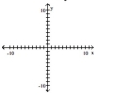
Find the component form and magnitude of the indicated vector.
-Given that and , find the component form and magnitude of the vector .
(Multiple Choice)
4.9/5 (76)
(76) Solve the problem.
-For what values of do maximum r-values occur on the graph of the polar equation ? Note that a maximum -value occurs at a point that is the maximum distance from the pole.
(Multiple Choice)
4.8/5 (82)
(82) Determine whether the vectors u and v are parallel, orthogonal, or neither.
-
(Multiple Choice)
4.7/5 (83)
(83) Use De Moivre's Theorem to find the indicated power of the complex number. Write your answer in standard form a + bi.
-
(Multiple Choice)
4.8/5 (81)
(81) The graph of a limacon curve is given. Without using your graphing calculator, determine which equation is correct for
the graph.
-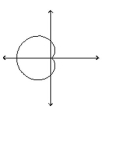 by
by (Multiple Choice)
4.7/5 (82)
(82) 
Find the product or quotient, as indicated. Leave your answer in polar form.
-Find the product of and .
(Multiple Choice)
4.8/5 (93)
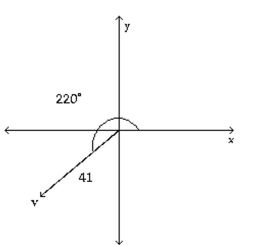
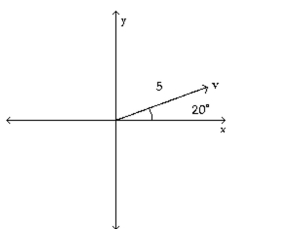
(93) Find the magnitude and direction angle for the following vector. Give the direction angle as an angle in [0°, 360°) rounded to the nearest tenth.
-
(Multiple Choice)
4.9/5 (84)
(84) Find the product or quotient, as indicated. Leave your answer in polar form.
-Find the product of and .
(Multiple Choice)
4.7/5 (87)
(87) Find the magnitude and direction angle for the following vector. Give the direction angle as an angle in [0°, 360°) rounded to the nearest tenth.
-
(Multiple Choice)
4.8/5 (79)
(79) Find the indicated roots. Write the answer in polar form.
-Fourth roots of
(Multiple Choice)
4.7/5 (84)
(84) 
Filters
- Essay(0)
- Multiple Choice(0)
- Short Answer(0)
- True False(0)
- Matching(0)