



 Chat with AI
Exam 8: Compound Interest: Future Value and Present Value

Exam 1: Review and Applications of Basic Mathematics369 Questions
Exam 2: Review and Applications of Algebra453 Questions
Exam 3: Ratios and Proportions272 Questions
Exam 4: Mathematics of Merchandising260 Questions
Exam 5: Cost-Volume-Profit Analysis96 Questions
Exam 6: Simple Interest285 Questions
Exam 7: Applications of Simple Interest128 Questions
Exam 8: Compound Interest: Future Value and Present Value282 Questions
Exam 9: Compound Interest: Further Topics and Applications331 Questions
Exam 10: Annuities: Future Value and Present Value232 Questions
Exam 11: Annuities: Periodic Payment, Number of Payments, and Interest Rate235 Questions
Exam 12: Annuities: Special Situations167 Questions
Exam 13: Loan Amortization: Mortgages108 Questions
Select questions type


Sam invested $3,000 at 3.5% compounded quarterly. After one year, the rate changed to 3.75% compounded semi-annually. How much will Sam have two years after the initial investment?
(Short Answer)
4.9/5  (77)
(77) 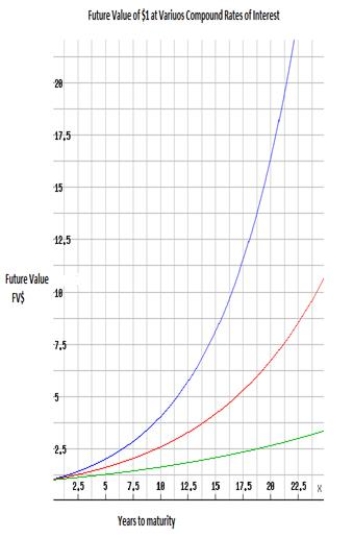 Consider the graph of three investments of $1 above. Match the colour that corresponds with a 5%, 10% and 15% investment, compounded annually.
 (Short Answer)
4.9/5 (66)
(66) The owner of a residential building lot has received two purchase offers. Mrs. A is offering a $20,000 down payment plus $40,000 payable in one year. Mr. B's offer is $15,000 down plus two $25,000 payments due one and two years from now. Which offer has the greater economic value if money can earn 9.5% compounded quarterly? How much more is it worth in current dollars?
(Short Answer)
4.9/5 (85)
(85) First Dominion Bank offers a two-year "Rising Rate" GIC. For the first year the interest rate is 4.5% compounded semi-annually and for the second year the rate is 5.5% compounded semi-annually. What will be the maturity value of a $50,000 two-year "Rising Rate" GIC?
(Multiple Choice)
4.8/5 (69)
(69) 

Duane borrowed $3,000 from his grandmother five years ago. The interest on the loan was to be 5% compounded semi-annually for the first three years, and 6% compounded monthly thereafter. If he made a $1,000 payment 2½ years ago, what is the amount now owed on the loan?
(Short Answer)
4.7/5 (77)
(77) Calculate the combined equivalent value of the scheduled payments on the indicated dates. The rate of return that money can earn is given in the fourth column. Assume that payments due in the past have not yet been made.

(Short Answer)
4.8/5 (82)
(82) Calculate the maturity value of the five-year compound-interest GIC whose interest rate for each year is given. Also calculate the dollar amount of interest earned in the fourth year.

(Short Answer)
4.8/5 (76)
(76) A $5,000 loan at 10% compounded annually is to be repaid by two payments three and five years from the date of the loan. The first payment of $3,000 will be applied to the balance owed after conversion of interest to principal at the end of the first three years. What would an investor pay for the loan contract 20 months after the date of the loan if she requires a rate of return of 9% compounded monthly?
(Short Answer)
4.8/5 (83)
(83) A financial institution is offering a 3-year rate optimizer GIC with annual rates of 4.6%, 5.2% and 5.8%. If $10,000 was invested in the GIC, then determine the total interest earned at the end of the 3 year period.
(Multiple Choice)
4.8/5 (92)
(92) Betty borrowed $50 from Chuckie for 2 years at 9% compounded monthly. How much did she owe at the end of the two years?
(Multiple Choice)
4.9/5 (76)
(76) Payments of $400 due eight months ago and $650 due three months ago were not made. Now the debtor is proposing to "make good" by two future payments that provide for a 7.5% compounded monthly rate of return to the creditor on the missed payments. The first payment will be made in two months. The second payment, twice as large as the first, will be made in seven months. Determine the amount of each payment.
(Short Answer)
4.8/5 (78)
(78) Orlando must be able to take $5,000 from his savings in four years and again in seven years. His savings will earn 7.2% compounded monthly. How much must be in the account now in order to meet his needs?
(Multiple Choice)
4.9/5 (73)
(73) What was the issue price of a 25-year strip bond with a face value of $50,000 and a discount rate of 7% compounded semi-annually?
(Multiple Choice)
4.8/5 (93)
(93) Two payments of $850 and $600 must be made two years and five years from now respectively. If money can earn 4% compounded semi-annually, what single payment, three years from now, would be equivalent to the two scheduled payments?
(Multiple Choice)
4.8/5 (80)
(80) By calculating the maturity value of $100 invested for 1 year at each rate, determine which rate of return an investor would prefer.
a) 8.0% compounded monthly.
b) 8.1% compounded quarterly.
c) 8.2% compounded semi-annually.
d) 8.3% compounded annually.
(Short Answer)
4.9/5 (77)
(77) Payments of $850 due two years ago and $1,760 due six months ago have not been made. The proposed alternative is two equal payments, three months and nine months from now, that will put the payee in an equivalent economic position allowing that money can earn 5.6% compounded quarterly. What is the amount of each of these payments?
(Short Answer)
4.8/5 (88)
(88) Commercial Finance Co. buys conditional sale contracts from furniture retailers at discounts that provide a 16.5% compounded monthly rate of return on the purchase price. What total price should Commercial Finance pay for the following three contracts: $950 due in 4 months, $780 due in 6 months, and $1,270 due in 5 months?
(Short Answer)
5.0/5 (85)
(85) Consider a graph of future values of two investments of $1000. How would you expect the graphs of the future values to look if both investments earn 5% nominal rate, but investment 1 is compounded monthly and investment 2 is compounded semi-annually?
(Multiple Choice)
4.8/5 (59)
(59) 
Filters
- Essay(0)
- Multiple Choice(0)
- Short Answer(0)
- True False(0)
- Matching(0)