



 Chat with AI
Exam 14: Multiple Integration

Exam 1: Preparation for Calculus125 Questions
Exam 2: Limits and Their Properties85 Questions
Exam 3: Differentiation193 Questions
Exam 4: Applications of Differentiation154 Questions
Exam 5: Integration184 Questions
Exam 6: Differential Equations93 Questions
Exam 7: Applications of Integration119 Questions
Exam 8: Integration Techniques and Improper Integrals130 Questions
Exam 9: Infinite Series181 Questions
Exam 10: Conics, Parametric Equations, and Polar Coordinates114 Questions
Exam 11: Vectors and the Geometry of Space130 Questions
Exam 12: Vector-Valued Functions85 Questions
Exam 13: Functions of Several Variables173 Questions
Exam 14: Multiple Integration143 Questions
Exam 15: Vector Anal142 Questions
Select questions type


Find the Jacobian for the change of variables given below.  ,

, (Multiple Choice)
4.9/5  (82)
(82) Sketch the region R of integration and then switch the order of integration for the following integral. 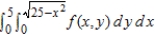
(Multiple Choice)
4.9/5 (85)
(85) The area of a region R is given by the iterated integrals  . Switch the order of integration and show that both orders yield the same area. What is this area?
 (Multiple Choice)
4.9/5 (90)
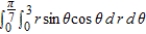
(90) 

Use a change of variables to find the volume of the solid region lying below the surface  and above the plane region R: region bounded by the parallelogram with vertices
 . Round your answer to two decimal places.
and above the plane region R: region bounded by the parallelogram with vertices . Round your answer to two decimal places. (Multiple Choice)
4.9/5 (77)
(77) Find the area of the surface for the portion of the paraboloid  in the first octant.
 (Multiple Choice)
4.7/5 (70)
(70) Set up and evaluate a double integral to find the volume of the solid bounded by the graphs of the equations  and
 .
and . (Multiple Choice)
4.7/5 (76)
(76) Use spherical coordinates to find the volume of the solid inside the torus given by  .
. (Multiple Choice)
5.0/5 (60)
(60) Use a double integral to find the volume of the indicated solid. 
(Multiple Choice)
4.9/5 (89)
(89) Find the centroid of the solid region bounded by the graphs of the equations. Use a computer algebra system to evaluate the triple integral. (Assume uniform density and find the center of mass.) 
(Multiple Choice)
4.8/5 (84)
(84)  . Round your answer to two decimal places.
Convert the integral below from rectangular coordinates to both cylindrical and spherical coordinates, and evaluate the simpler iterated integral. 
(Multiple Choice)
4.8/5 (88)
(88) Evaluate the following iterated integral by converting to polar coordinates. 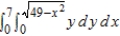
(Multiple Choice)
4.8/5 (85)
(85) Use a triple integral to find the volume of the solid shown below. 

(Multiple Choice)
4.8/5 (82)
(82) Evaluate the following iterated integral by converting to polar coordinates. 
(Multiple Choice)
4.7/5 (68)
(68) Use cylindrical coordinates to find the volume of the solid inside the sphere 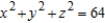 and above the upper nappe of the cone
 .
and above the upper nappe of the cone . (Multiple Choice)
4.8/5 (65)
(65) Find the average value of  over the region Q, where Q is a tetrahedron in the first octant with vertices
 . The average value of a continuous function
 over a solid region Q is
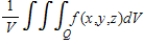 , where V is the volume of the solid region Q.
over the region Q, where Q is a tetrahedron in the first octant with vertices . The average value of a continuous function over a solid region Q is , where V is the volume of the solid region Q. (Multiple Choice)
4.8/5 (83)
(83) Set up a double integral that gives the area of the surface of the graph of f over the region R. 

(Multiple Choice)
4.9/5 (73)
(73) Find the mass of the lamina described by the inequalities  given that its density is
 (Hint: Some of the integrals are simpler in polar coordinates.)
given that its density is
(Hint: Some of the integrals are simpler in polar coordinates.) (Multiple Choice)
4.9/5 (72)
(72) 
Filters
- Essay(0)
- Multiple Choice(0)
- Short Answer(0)
- True False(0)
- Matching(0)