



 Chat with AI
Exam 16: Government and Business

Exam 1: Introduction40 Questions
Exam 2: Supply and Demand129 Questions
Exam 3: Empirical Methods for Demand Analysis85 Questions
Exam 4: Consumer Choice71 Questions
Exam 5: Production128 Questions
Exam 6: Costs117 Questions
Exam 7: Firm Organization and Market Structure80 Questions
Exam 8: Competitive Firms and Markets98 Questions
Exam 9: Monopoly82 Questions
Exam 10: Pricing With Market Power137 Questions
Exam 11: Oligopoly and Monopolistic Competition84 Questions
Exam 12: Game Theory and Business Strategy90 Questions
Exam 13: Strategies Over Time67 Questions
Exam 14: Managerial Decision-Making Under Uncertainty116 Questions
Exam 15: Asymmetric Information114 Questions
Exam 16: Government and Business106 Questions
Exam 17: Global Business72 Questions
Select questions type


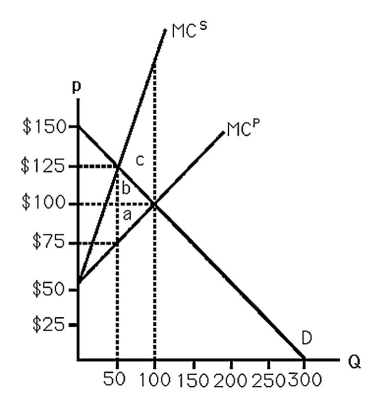 -The above figure shows the market for steel ingots. The optimal quantity of pollution
 (Multiple Choice)
4.9/5  (61)
(61) Suppose twenty neighbors share a park. One of the neighbors, Al, leaves trash in the park. This bothers the other neighbors. According to Coase's Theorem, assigning the property rights to the park to Al
(Multiple Choice)
4.9/5 (73)
(73) Which of the following would be considered open-access common property?
(Multiple Choice)
4.9/5 (78)
(78) A firm charging prices below marginal cost is said to be engaged in
(Multiple Choice)
4.9/5 (84)
(84) The government forcing a monopoly telecommunications company to allow other firms to use its cables is an attempt to
(Multiple Choice)
5.0/5 (81)
(81) The efficient quantity of a pure public good occurs when the marginal cost of producing that good equals the
(Multiple Choice)
4.8/5 (70)
(70) One way for the government to eliminate a negative externality is to
(Multiple Choice)
4.8/5 (84)
(84) If the government regulates the price a monopoly can charge, and the price ceiling is set below what the competitive market price would be, then
(Multiple Choice)
4.8/5 (82)
(82) 
Filters
- Essay(0)
- Multiple Choice(0)
- Short Answer(0)
- True False(0)
- Matching(0)