



 Chat with AI
Exam 15: Nonparametric Statistics

Exam 1: Describing Data With Graphs94 Questions
Exam 2: Describing Data With Numerical Measures186 Questions
Exam 3: Describing Bivariate Data35 Questions
Exam 4: Probability and Probability Distributions136 Questions
Exam 5: Several Useful Discrete Distributions129 Questions
Exam 6: The Normal Probability Distribution196 Questions
Exam 7: Sampling Distributions162 Questions
Exam 8: Large-Sample Estimation173 Questions
Exam 9: Large-Sample Tests of Hypotheses210 Questions
Exam 10: Inference From Small Samples261 Questions
Exam 11: The Analysis of Variance156 Questions
Exam 12: Linear Regression and Correlation165 Questions
Exam 13: Multiple Regression Analysis178 Questions
Exam 14: Analysis of Categorical Data136 Questions
Exam 15: Nonparametric Statistics198 Questions
Select questions type


A two-sample t-test with independent samples corresponds to:
(Multiple Choice)
4.9/5  (80)
(80) Which of the following statements about Spearman's rank-correlation coefficient is false?
(Multiple Choice)
4.9/5 (74)
(74) The sign test is a nonparametric test that 1) uses the directions of differences observed in a matched pairs sample to determine whether the relative frequency distributions of two statistical populations are identical to or different from one another and 2) determines whether a sample comes from a population with a specified median.
(True/False)
4.8/5 (87)
(87) You are performing the Wilcoxon rank-sum test. The 13th through 15th values in an ordered array of pooled sample data all equal $180 (while the 12th value is less and the 16th value is more). The appropriate ranks for the three $180 values are:
(Multiple Choice)
4.8/5 (71)
(71) In a Kruskal-Wallis test, there are four samples, and the value of the test statistic is calculated as H = 13.21. Then the most accurate statement that can be made about the p-value of the test is that it is greater than 0.005 but smaller than 0.01.
(True/False)
4.9/5 (85)
(85) Consider the following data set: 2.2, 2.3, 2.3, 2.5, 2.6, 2.7, 2.8, 2.8, 2.8, 2.9, 3.1, 3.2, and 3.5. The rank assigned to the three observations of value 2.8 is:
(Multiple Choice)
4.8/5 (91)
(91) The Wilcoxon rank-sum test is a nonparametric test that uses two independent simple random samples to determine whether the relative frequency distributions of two statistical populations of continuous values are identical to or different from one another.
(True/False)
4.8/5 (85)
(85) The Friedman test is applied to problems with the following characteristics:
(Multiple Choice)
5.0/5 (87)
(87) The nonparametric counterpart of the randomized block model of the analysis of variance is the:
(Multiple Choice)
4.9/5 (72)
(72) In testing the hypotheses  : The two population locations are the same.
 : The two population locations are different.
The statistics T+ = 238, T- = 582, and n = 40 are calculated with data drawn from a matched pairs experiment.
Test statistic:
z-statistic = ______________
What is the p-value of this test?
______________
Can we infer at the 5% significance level that the population locations differ?
Conclusion: ______________
We ______________infer at the 5% significance level that the population locations differ.
: The two population locations are the same. : The two population locations are different.
The statistics T+ = 238, T- = 582, and n = 40 are calculated with data drawn from a matched pairs experiment.
Test statistic:
z-statistic = ______________
What is the p-value of this test?
______________
Can we infer at the 5% significance level that the population locations differ?
Conclusion: ______________
We ______________infer at the 5% significance level that the population locations differ. (Short Answer)
4.8/5 (68)
(68) Which of the following tests employs matched-pairs sampling?
(Multiple Choice)
4.8/5 (78)
(78) We can use the Friedman test to determine whether two populations differ. The conclusion will be the same as that produced from the sign test.
(True/False)
4.7/5 (74)
(74) Comparing the output of strawberries grown on plots using fertilizer A with that grown on otherwise identical plots using fertilizer B, in order to make a general assessment of relative fertilizer effectiveness, may well call for:
(Multiple Choice)
4.9/5 (79)
(79) Statistical methods that require few assumptions, if any, about the population distribution are known as:
(Multiple Choice)
4.8/5 (68)
(68) Apply the Friedman test to the accompany table of ordinal data to determine whether we can infer at the 10% significance level that at least two population locations differ. 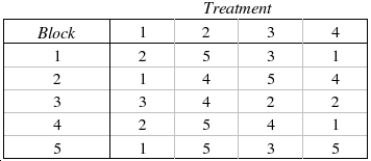 Test Statistic:
 = ______________
Reject Region:
Reject
 if
 > ______________
Conclude: ______________
We ______________ infer at the 10% significance level that at least two population locations differ.
Test Statistic: = ______________
Reject Region:
Reject if > ______________
Conclude: ______________
We ______________ infer at the 10% significance level that at least two population locations differ. (Short Answer)
5.0/5 (81)
(81) In the Wilcoxon Signed-Rank test, if two or more measurements have the same nonzero difference, signs ignored, then:
(Multiple Choice)
4.8/5 (81)
(81) The Kruskal-Wallis Test for Differences in more than 2 Medians is a nonparametric alternative to:
(Multiple Choice)
4.8/5 (86)
(86) 
Filters
- Essay(0)
- Multiple Choice(0)
- Short Answer(0)
- True False(0)
- Matching(0)