



 Chat with AI
Exam 12: Supply Chain Design

Exam 1: Using Operations to Create Value115 Questions
Exam 2: Process Strategy and Analysis239 Questions
Exam 3: Quality and Performance198 Questions
Exam 4: Capacity Planning120 Questions
Exam 5: Constraint Management136 Questions
Exam 6: Lean Systems166 Questions
Exam 7: Project Management139 Questions
Exam 8: Forecasting150 Questions
Exam 9: Inventory Management205 Questions
Exam 10: Operations Planning and Scheduling149 Questions
Exam 11: Resource Planning124 Questions
Exam 12: Supply Chain Design77 Questions
Exam 13: Supply Chain Logistic Networks114 Questions
Exam 14: Supply Chain Integration120 Questions
Exam 15: Supply Chain Sustainability78 Questions
Exam 16: Supplement A Decision Making107 Questions
Exam 17: Supplement J Operations Scheduling123 Questions
Exam 18: Supplement K Layout39 Questions
Exam 19: Supplement B Waiting Lines111 Questions
Exam 20: Supplement C Special Inventory Models53 Questions
Exam 21: Supplement D Linear Programming87 Questions
Exam 22: Supplement E Simulation54 Questions
Exam 23: Supplement F Financial Analysis55 Questions
Exam 24: Supplement G Acceptance Sampling Plans87 Questions
Exam 25: Supplement H Measuring Output Rates108 Questions
Exam 26: Supplement I Learning Curve Analysis50 Questions
Select questions type


Scenario 12.1
You currently make a part on old equipment at a cost of $50,000 per year and a variable cost of $20 / unit. You have found an outside supplier who will make the part for $15 / unit if you will pay their annual fixed costs of $200,000 / year. The following table summarizes the details of this make versus buy decision.
 -Use Scenario 12.1 to answer the question. What are total costs to make a quantity of 40,000 units per year?
 (Multiple Choice)
4.9/5  (83)
(83) The average inventory at Hamilton Industries, comprising raw materials, work-in-process, and finished goods, was found to be $17.2 million last year. If the cost of goods sold per week averaged $1.32 million, what was the inventory turnover experienced by Hamilton Industries? Assume the company had 50 working weeks per year.
(Multiple Choice)
4.9/5 (93)
(93) Scenario 12.2
SAGE Inc. receives too many applications each year for the Global MBA program so they turn to their network of partners for assistance. Nothing in this world is free, of course, so their partners provide quotes that include a per student cost as well as a facilities cost that SAGE would pay regardless of the number of students they sent there. The costs in Rupees (  ) are elegantly summarized in the table below.
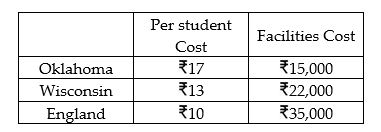 -Use Scenario 12.2 to answer the question. What is the lowest variable cost that causes the Wisconsin option to never be the optimal location?
) are elegantly summarized in the table below.
-Use Scenario 12.2 to answer the question. What is the lowest variable cost that causes the Wisconsin option to never be the optimal location? (Multiple Choice)
4.9/5 (82)
(82) Efficient supply chains work best when contribution margins are high.
(True/False)
4.7/5 (85)
(85) The purpose of supply chain design is to shape a firm's supply chain to meet the competitive priorities of its operations strategies.
(True/False)
4.9/5 (70)
(70) The objective of a firm in a responsive supply chain is likely to be realized if it has a:
(Multiple Choice)
4.9/5 (73)
(73) Last year, RJT Enterprises had average inventories (raw materials, work-in-process, and finished goods) of $7.5 million. During this same year the cost of goods sold was $30 million. The company operates 50 weeks per year.
a. What is their total inventory (measured as weeks of supply)?
b. What is their inventory turnover?
(Essay)
4.9/5 (80)
(80) While it is important to manufacturing firms, little can be done to improve supply chain strategy in most service organizations.
(True/False)
4.8/5 (68)
(68) ________ uses a firm's flexible processes to generate a wide variety of personalized services or products at reasonably low costs.
(Multiple Choice)
4.9/5 (84)
(84) Responsive supply chains work best when frequent product introduction exists.
(True/False)
4.8/5 (62)
(62) What is mass customization and what advantages does a producer benefit from if they can realize it?
(Essay)
4.8/5 (72)
(72) The purpose of supply chain management is to synchronize a firm's processes with those of its suppliers and customers.
(True/False)
4.9/5 (72)
(72) ________ is the process of using members of the distribution channel as if they were assembly stations in the factory.
(Short Answer)
4.9/5 (81)
(81) The VP of Finance studied the printing costs at the university and knew it was time for bold, decisive action. The annual fixed cost of printing at the school was $1,250,000 and the per-page cost was one cent. Fortunately, his brother-in-law happened to own a company that would lease the printers to the university for only $850,000 and charge three cents per page. At what point would the university be indifferent between owning their printers and leasing their printers?
(Essay)
4.9/5 (71)
(71) 
Filters
- Essay(0)
- Multiple Choice(0)
- Short Answer(0)
- True False(0)
- Matching(0)