



 Chat with AI
Exam 10: Standard Costs and Variances

Exam 1: Managerial Accounting and Cost Concepts346 Questions
Exam 2: Job-Order Costing: Calculating Unit Product Costs408 Questions
Exam 3: Job-Order Costing: Cost Flows and External Reporting314 Questions
Exam 4: Process Costing365 Questions
Exam 5: Cost-Volume-Profit Relationships396 Questions
Exam 6: Variable Costing and Segment Reporting: Tools for Management392 Questions
Exam 7: Activity-Based Costing: a Tool to Aid Decision Making382 Questions
Exam 8: Master Budgeting284 Questions
Exam 9: Flexible Budgets and Performance Analysis491 Questions
Exam 10: Standard Costs and Variances469 Questions
Exam 11: Responsibility Accounting Systems335 Questions
Exam 12: Strategic Performance Measurement153 Questions
Exam 13: Differential Analysis: the Key to Decision Making432 Questions
Exam 14: Capital Budgeting Decisions405 Questions
Exam 15: Statement of Cash Flows221 Questions
Exam 16: Financial Statement Analysis327 Questions
Select questions type


Sobus Corporation manufactures one product. It does not maintain any beginning or ending Work in Process inventories. The company uses a standard cost system in which inventories are recorded at their standard costs and any variances are closed directly to Cost of Goods Sold. There is no variable manufacturing overhead. The fixed manufacturing overhead standards for the company's only product specify 0.70 hours per unit at $4.00 per hour. The standard fixed manufacturing overhead rate was based on budgeted fixed manufacturing overhead of $70,000 and budgeted activity of 17,500 hours. During the year, 19,700 units were started and completed. Actual fixed overhead costs for the year were $57,700.Assume that all transactions are recorded on a worksheet as shown in the text. On the left-hand side of the equals sign in the worksheet are columns for Cash, Raw Materials, Work in Process, Finished Goods, and Property, Plant, and Equipment (net). All of the variance columns are on the right-hand-side of the equals sign along with the column for Retained Earnings.When applying fixed manufacturing overhead to production, the Work in Process inventory account will increase (decrease) by:
(Multiple Choice)
4.8/5  (78)
(78) In general, the production manager is responsible for the materials price variance.
(True/False)
4.8/5 (80)
(80) Stallbaumer Incorporated makes a single product--an electrical motor used in many long-haul trucks. The company has a standard cost system in which it applies overhead to this product based on the standard labor-hours allowed for the actual output of the period. Data concerning the most recent year appear below:
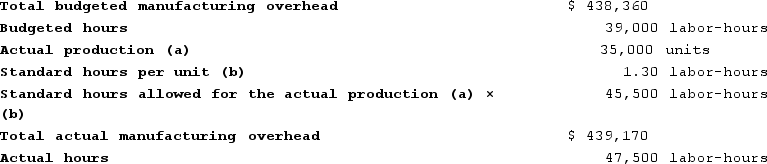 Required:
Determine whether overhead was underapplied or overapplied for the year and by how much.
Required:
Determine whether overhead was underapplied or overapplied for the year and by how much. (Essay)
4.8/5 (71)
(71) Puvo, Incorporated, manufactures a single product in which variable manufacturing overhead is assigned on the basis of standard direct labor-hours. The company uses a standard cost system and has established the following standards for one unit of product: 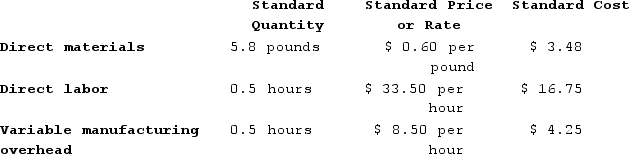 During March, the following activity was recorded by the company:The company produced 2,400 units during the month.A total of 19,400 pounds of material were purchased at a cost of $13,580.There was no beginning inventory of materials on hand to start the month; at the end of the month, 3,620 pounds of material remained in the warehouse.During March, 1,090 direct labor-hours were worked at a rate of $30.50 per hour.Variable manufacturing overhead costs during March totaled $14,061.The direct materials purchases variance is computed when the materials are purchased.The labor efficiency variance for March is:
 (Multiple Choice)
4.9/5 (80)
(80) Solly Corporation produces a product for national distribution. Standards for the product are:Materials: 12 ounces per unit at 60¢ per ounce.Labor: 2 hours per unit at $8 per hour.During the month of December, the company produced 1,000 units. Information for the month follows:Materials: 14,000 ounces purchased and used at a total cost of $7,700.Labor: 2,500 hours worked at a total cost of $20,625.The materials quantity variance is:
(Multiple Choice)
4.8/5 (82)
(82) If demand is insufficient to keep everyone busy and workers are not laid off, a favorable (F) labor efficiency variance often will be a result.
(True/False)
4.7/5 (86)
(86) Alvino Corporation manufactures one product. It does not maintain any beginning or ending Work in Process inventories. The company uses a standard cost system in which inventories are recorded at their standard costs and any variances are closed directly to Cost of Goods Sold. There is no variable manufacturing overhead.The standard cost card for the company's only product is as follows: 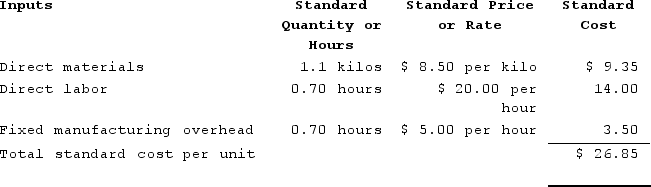 The standard fixed manufacturing overhead rate was based on budgeted fixed manufacturing overhead of $70,000 and budgeted activity of 14,000 hours.During the year, the company completed the following transactions:Purchased 32,200 kilos of raw material at a price of $7.80 per kilo. The materials price variance was $22,540 Favorable.Used 30,480 kilos of the raw material to produce 27,800 units of work in process. The materials quantity variance was $850 Favorable.Assigned direct labor costs to work in process. The direct labor workers (who were paid in cash) worked 18,260 hours at an average cost of $20.50 per hour. The direct labor rate variance was $9,130 Unfavorable. The labor efficiency variance was $24,000 Favorable.Applied fixed overhead to the 27,800 units in work in process inventory using the predetermined overhead rate multiplied by the number of direct labor−hours allowed. Actual fixed overhead costs for the year were $59,500. Of this total, $22,500 related to items such as insurance, utilities, and indirect labor salaries that were all paid in cash and $82,000 related to depreciation of manufacturing equipment. The fixed manufacturing overhead budget variance was $10,500 Favorable. The fixed manufacturing overhead volume variance was $27,300 Favorable.Completed and transferred 27,800 units from work in process to finished goods.Sold (for cash) 29,000 units to customers at a price of $31.90 per unit.Transferred the standard cost associated with the 29,000 units sold from finished goods to cost of goods sold.Paid $101,000 of selling and administrative expenses.Closed all standard cost variances to cost of goods sold.To answer the following questions, you will need to record transactions a through i in the worksheet below. This worksheet is similar to the worksheets in your text except that it has been split into two parts to fit on the page. PP&E (net) stands for Property, Plant, and Equipment net of depreciation.
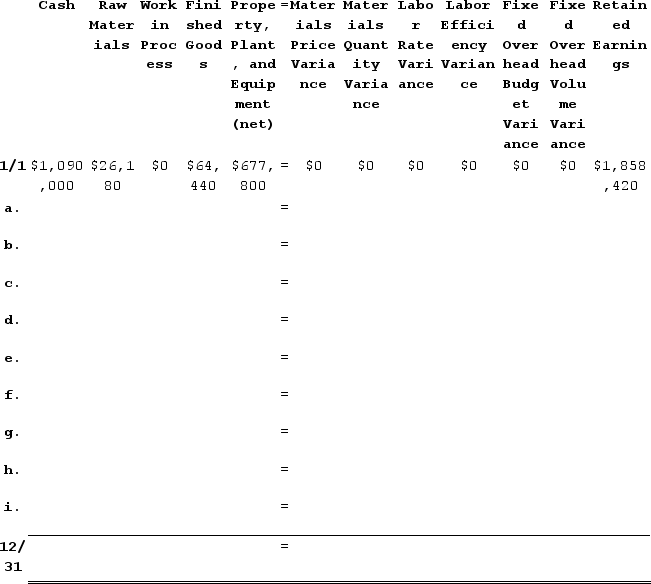 The ending balance in the Work in Process account will be closest to:
The standard fixed manufacturing overhead rate was based on budgeted fixed manufacturing overhead of $70,000 and budgeted activity of 14,000 hours.During the year, the company completed the following transactions:Purchased 32,200 kilos of raw material at a price of $7.80 per kilo. The materials price variance was $22,540 Favorable.Used 30,480 kilos of the raw material to produce 27,800 units of work in process. The materials quantity variance was $850 Favorable.Assigned direct labor costs to work in process. The direct labor workers (who were paid in cash) worked 18,260 hours at an average cost of $20.50 per hour. The direct labor rate variance was $9,130 Unfavorable. The labor efficiency variance was $24,000 Favorable.Applied fixed overhead to the 27,800 units in work in process inventory using the predetermined overhead rate multiplied by the number of direct labor−hours allowed. Actual fixed overhead costs for the year were $59,500. Of this total, $22,500 related to items such as insurance, utilities, and indirect labor salaries that were all paid in cash and $82,000 related to depreciation of manufacturing equipment. The fixed manufacturing overhead budget variance was $10,500 Favorable. The fixed manufacturing overhead volume variance was $27,300 Favorable.Completed and transferred 27,800 units from work in process to finished goods.Sold (for cash) 29,000 units to customers at a price of $31.90 per unit.Transferred the standard cost associated with the 29,000 units sold from finished goods to cost of goods sold.Paid $101,000 of selling and administrative expenses.Closed all standard cost variances to cost of goods sold.To answer the following questions, you will need to record transactions a through i in the worksheet below. This worksheet is similar to the worksheets in your text except that it has been split into two parts to fit on the page. PP&E (net) stands for Property, Plant, and Equipment net of depreciation.
The ending balance in the Work in Process account will be closest to: (Multiple Choice)
4.8/5 (76)
(76) Pippin Incorporated has provided the following data concerning one of the products in its standard cost system. Variable manufacturing overhead is applied to products on the basis of direct labor-hours. 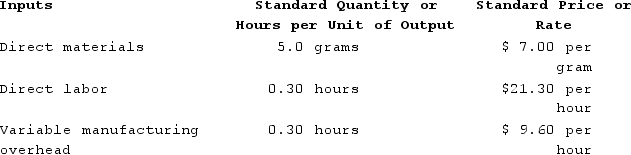 The company has reported the following actual results for the product for June:
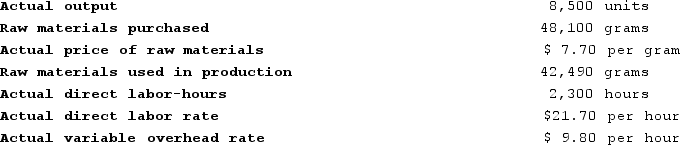 The raw materials price variance for the month is closest to:
The company has reported the following actual results for the product for June:
The raw materials price variance for the month is closest to: (Multiple Choice)
4.9/5 (83)
(83) Phann Corporation manufactures one product. It does not maintain any beginning or ending Work in Process inventories. The company uses a standard cost system in which inventories are recorded at their standard costs and any variances are closed directly to Cost of Goods Sold. There is no variable manufacturing overhead. The standard cost card for the company's only product is as follows: 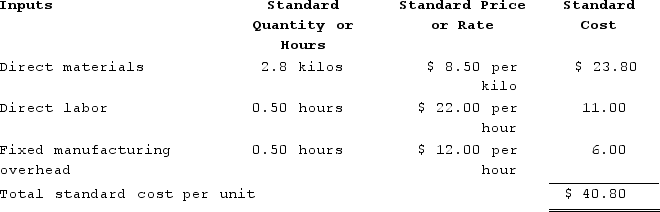 The standard fixed manufacturing overhead rate was based on budgeted fixed manufacturing overhead of $90,000 and budgeted activity of 7,500 hours.During the year, the company completed the following transactions:a. Purchased 59,000 kilos of raw material at a price of $9.20 per kilo.b. Used 51,340 kilos of the raw material to produce 18,300 units of work in process.c. Assigned direct labor costs to work in process. The direct labor workers (who were paid in cash) worked 8,850 hours at an average cost of $23.70 per hour.d. Applied fixed overhead to the 18,300 units in work in process inventory using the predetermined overhead rate multiplied by the number of direct labor-hours allowed. Actual fixed overhead costs for the year were $79,400. Of this total, $22,400 related to items such as insurance, utilities, and indirect labor salaries that were all paid in cash and $57,000 related to depreciation of manufacturing equipment.e. Completed and transferred 18,300 units from work in process to finished goods.Assume that all transactions are recorded on the below worksheet, which is similar to the worksheet shown in your text except that it has been divided into two parts so that it fits on one page. The beginning balances in each of the accounts have been given. PP&E (net) stands for Property, Plant, and Equipment net of depreciation.
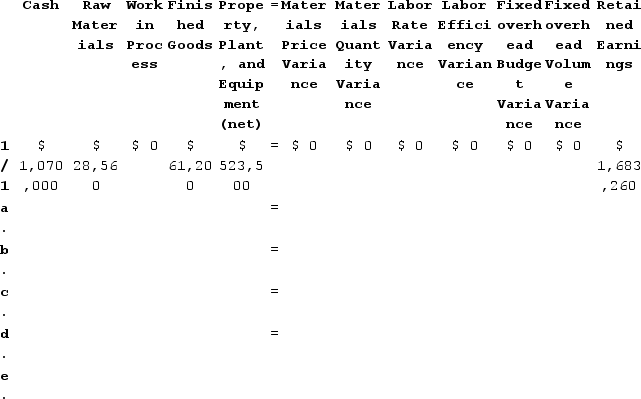 When recording the raw materials purchases in transaction (a) above, the Raw Materials inventory account will increase (decrease) by:
The standard fixed manufacturing overhead rate was based on budgeted fixed manufacturing overhead of $90,000 and budgeted activity of 7,500 hours.During the year, the company completed the following transactions:a. Purchased 59,000 kilos of raw material at a price of $9.20 per kilo.b. Used 51,340 kilos of the raw material to produce 18,300 units of work in process.c. Assigned direct labor costs to work in process. The direct labor workers (who were paid in cash) worked 8,850 hours at an average cost of $23.70 per hour.d. Applied fixed overhead to the 18,300 units in work in process inventory using the predetermined overhead rate multiplied by the number of direct labor-hours allowed. Actual fixed overhead costs for the year were $79,400. Of this total, $22,400 related to items such as insurance, utilities, and indirect labor salaries that were all paid in cash and $57,000 related to depreciation of manufacturing equipment.e. Completed and transferred 18,300 units from work in process to finished goods.Assume that all transactions are recorded on the below worksheet, which is similar to the worksheet shown in your text except that it has been divided into two parts so that it fits on one page. The beginning balances in each of the accounts have been given. PP&E (net) stands for Property, Plant, and Equipment net of depreciation.
When recording the raw materials purchases in transaction (a) above, the Raw Materials inventory account will increase (decrease) by: (Multiple Choice)
4.8/5 (90)
(90) Alberts Corporation manufactures one product. It does not maintain any beginning or ending Work in Process inventories. The company uses a standard cost system in which inventories are recorded at their standard costs. The standard cost card for the company's only product is as follows: 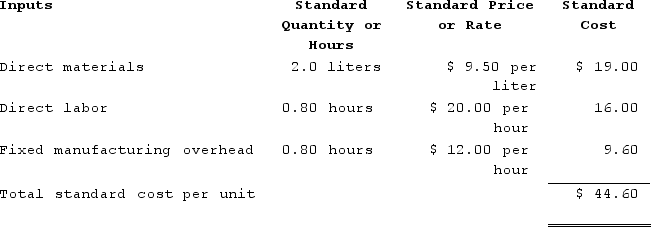 The standard fixed manufacturing overhead rate was based on budgeted fixed manufacturing overhead of $240,000 and budgeted activity of 20,000 hours.During the year, the company applied fixed overhead to the 15,200 units in work in process inventory using the predetermined overhead rate multiplied by the number of direct labor-hours allowed. Actual fixed overhead costs for the year were $223,700. Of this total, $147,700 related to items such as insurance, utilities, and indirect labor salaries that were all paid in cash and $76,000 related to depreciation of manufacturing equipment.Assume that all transactions are recorded on the below worksheet, which is similar to the worksheet shown in your text except that it has been divided into two parts so that it fits on one page. The beginning balances in each of the accounts have been given. PP&E (net) stands for Property, Plant, and Equipment net of depreciation.
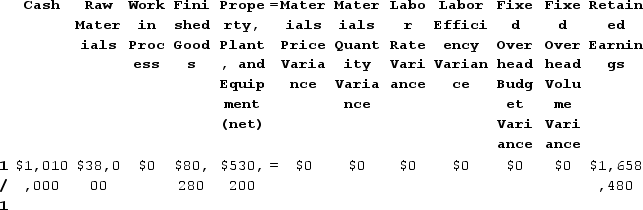 When applying fixed manufacturing overhead to production, the Work in Process inventory account will increase (decrease) by:
The standard fixed manufacturing overhead rate was based on budgeted fixed manufacturing overhead of $240,000 and budgeted activity of 20,000 hours.During the year, the company applied fixed overhead to the 15,200 units in work in process inventory using the predetermined overhead rate multiplied by the number of direct labor-hours allowed. Actual fixed overhead costs for the year were $223,700. Of this total, $147,700 related to items such as insurance, utilities, and indirect labor salaries that were all paid in cash and $76,000 related to depreciation of manufacturing equipment.Assume that all transactions are recorded on the below worksheet, which is similar to the worksheet shown in your text except that it has been divided into two parts so that it fits on one page. The beginning balances in each of the accounts have been given. PP&E (net) stands for Property, Plant, and Equipment net of depreciation.
When applying fixed manufacturing overhead to production, the Work in Process inventory account will increase (decrease) by: (Multiple Choice)
4.9/5 (93)
(93) Majer Corporation makes a product with the following standard costs: 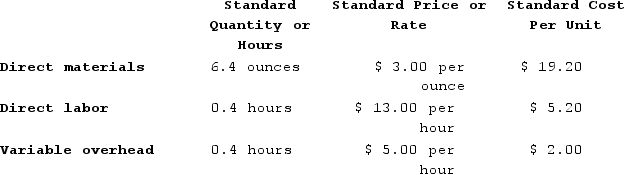 The company reported the following results concerning this product in February.
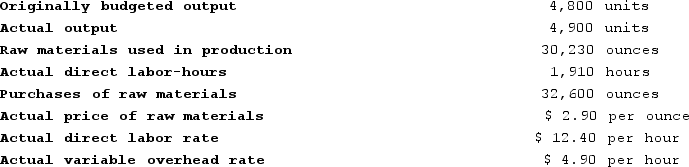 The company applies variable overhead on the basis of direct labor-hours. The direct materials purchases variance is computed when the materials are purchased.The variable overhead efficiency variance for February is:
The company reported the following results concerning this product in February.
The company applies variable overhead on the basis of direct labor-hours. The direct materials purchases variance is computed when the materials are purchased.The variable overhead efficiency variance for February is: (Multiple Choice)
4.8/5 (92)
(92) Sade Incorporated has provided the following data concerning one of the products in its standard cost system. Variable manufacturing overhead is applied to products on the basis of direct labor-hours.
 The company has reported the following actual results for the product for December:
 Required:a. Compute the variable overhead rate variance for December.b. Compute the variable overhead efficiency variance for December.
The company has reported the following actual results for the product for December:
Required:a. Compute the variable overhead rate variance for December.b. Compute the variable overhead efficiency variance for December. (Essay)
4.8/5 (82)
(82) Puvo, Incorporated, manufactures a single product in which variable manufacturing overhead is assigned on the basis of standard direct labor-hours. The company uses a standard cost system and has established the following standards for one unit of product: 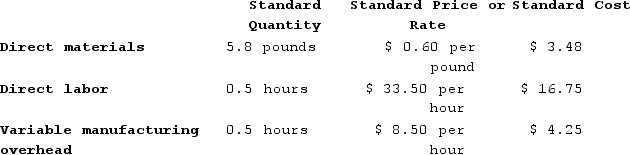 During March, the following activity was recorded by the company:The company produced 2,400 units during the month.A total of 19,400 pounds of material were purchased at a cost of $13,580.There was no beginning inventory of materials on hand to start the month; at the end of the month, 3,620 pounds of material remained in the warehouse.During March, 1,090 direct labor-hours were worked at a rate of $30.50 per hour.Variable manufacturing overhead costs during March totaled $14,061.The direct materials purchases variance is computed when the materials are purchased.The labor rate variance for March is:
 (Multiple Choice)
5.0/5 (79)
(79) The following data have been provided by Liggett Corporation: 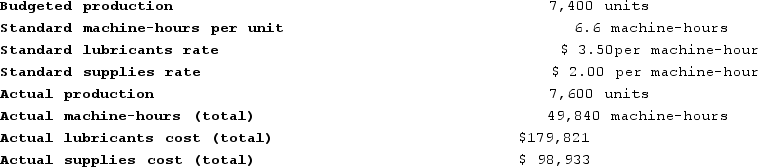 Lubricants and supplies are both elements of variable manufacturing overhead.The variable overhead rate variance for supplies is closest to:
 (Multiple Choice)
4.7/5 (82)
(82) Modine Corporation has provided the following data for September.
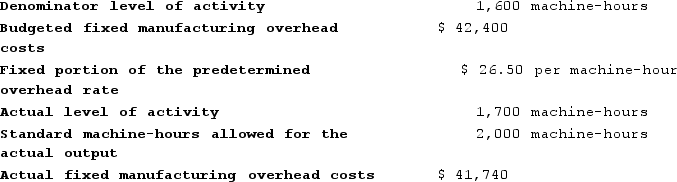 Required:
a. Compute the budget variance for September.
b. Compute the volume variance for September.
Required:
a. Compute the budget variance for September.
b. Compute the volume variance for September. (Essay)
4.9/5 (80)
(80) Mangrum Corporation manufactures one product. It does not maintain any beginning or ending Work in Process inventories. The company uses a standard cost system in which inventories are recorded at their standard costs. Information concerning the direct labor standards for the company's only product is as follows:  During the year, the company assigned direct labor costs to work in process. The direct labor workers (who were paid in cash) worked 12,790 hours at an average cost of $19.50 per hour. The company calculated the following direct labor variances for the year:
 Assume that all transactions are recorded on the below worksheet, which is similar to the worksheet shown in your text except that it has been divided into two parts so that it fits on one page. The beginning balances in each of the accounts have been given. PP&E (net) stands for Property, Plant, and Equipment net of depreciation.
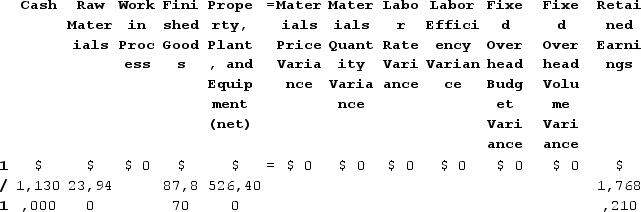 When the direct labor cost is recorded, which of the following entries will be made?
During the year, the company assigned direct labor costs to work in process. The direct labor workers (who were paid in cash) worked 12,790 hours at an average cost of $19.50 per hour. The company calculated the following direct labor variances for the year:
Assume that all transactions are recorded on the below worksheet, which is similar to the worksheet shown in your text except that it has been divided into two parts so that it fits on one page. The beginning balances in each of the accounts have been given. PP&E (net) stands for Property, Plant, and Equipment net of depreciation.
When the direct labor cost is recorded, which of the following entries will be made? (Multiple Choice)
4.8/5 (85)
(85) Warp Manufacturing Corporation uses a standard cost system for the production of its ski lift chairs. Warp uses machine-hours as an overhead base. The variable manufacturing overhead standards for each chair are 1.2 machine-hours at a standard cost of $18 per hour. During the month of September, Warp incurred 34,000 machine-hours in the production of 32,000 ski lift chairs. The total variable manufacturing overhead cost was $649,400. What is Warp's variable overhead rate variance for September?
(Multiple Choice)
4.9/5 (82)
(82) The following data for November have been provided by Hunn Corporation, a producer of precision drills for oil exploration:
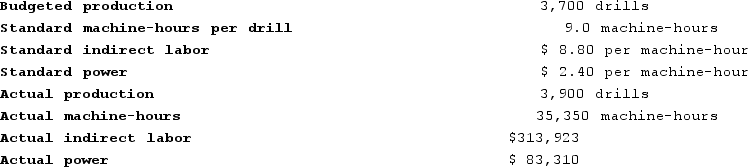 Required: Compute the variable overhead rate variances for indirect labor and for power for November. Indicate whether each of the variances is favorable (F) or unfavorable (U).
 (Essay)
4.8/5 (93)
(93) Phann Corporation manufactures one product. It does not maintain any beginning or ending Work in Process inventories. The company uses a standard cost system in which inventories are recorded at their standard costs and any variances are closed directly to Cost of Goods Sold. There is no variable manufacturing overhead. The standard cost card for the company's only product is as follows: 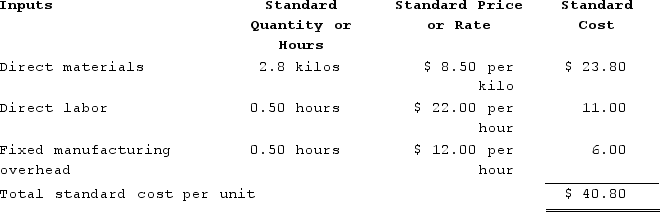 The standard fixed manufacturing overhead rate was based on budgeted fixed manufacturing overhead of $90,000 and budgeted activity of 7,500 hours.During the year, the company completed the following transactions:a. Purchased 59,000 kilos of raw material at a price of $9.20 per kilo.b. Used 51,340 kilos of the raw material to produce 18,300 units of work in process.c. Assigned direct labor costs to work in process. The direct labor workers (who were paid in cash) worked 8,850 hours at an average cost of $23.70 per hour.d. Applied fixed overhead to the 18,300 units in work in process inventory using the predetermined overhead rate multiplied by the number of direct labor-hours allowed. Actual fixed overhead costs for the year were $79,400. Of this total, $22,400 related to items such as insurance, utilities, and indirect labor salaries that were all paid in cash and $57,000 related to depreciation of manufacturing equipment.e. Completed and transferred 18,300 units from work in process to finished goods.Assume that all transactions are recorded on the below worksheet, which is similar to the worksheet shown in your text except that it has been divided into two parts so that it fits on one page. The beginning balances in each of the accounts have been given. PP&E (net) stands for Property, Plant, and Equipment net of depreciation.
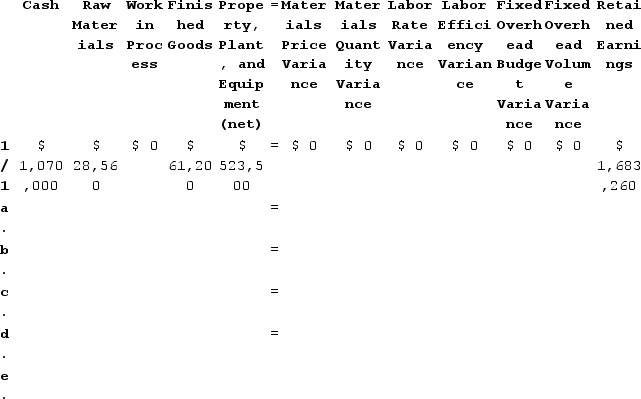 When recording the raw materials used in production in transaction (b) above, the Work in Process inventory account will increase (decrease) by:
The standard fixed manufacturing overhead rate was based on budgeted fixed manufacturing overhead of $90,000 and budgeted activity of 7,500 hours.During the year, the company completed the following transactions:a. Purchased 59,000 kilos of raw material at a price of $9.20 per kilo.b. Used 51,340 kilos of the raw material to produce 18,300 units of work in process.c. Assigned direct labor costs to work in process. The direct labor workers (who were paid in cash) worked 8,850 hours at an average cost of $23.70 per hour.d. Applied fixed overhead to the 18,300 units in work in process inventory using the predetermined overhead rate multiplied by the number of direct labor-hours allowed. Actual fixed overhead costs for the year were $79,400. Of this total, $22,400 related to items such as insurance, utilities, and indirect labor salaries that were all paid in cash and $57,000 related to depreciation of manufacturing equipment.e. Completed and transferred 18,300 units from work in process to finished goods.Assume that all transactions are recorded on the below worksheet, which is similar to the worksheet shown in your text except that it has been divided into two parts so that it fits on one page. The beginning balances in each of the accounts have been given. PP&E (net) stands for Property, Plant, and Equipment net of depreciation.
When recording the raw materials used in production in transaction (b) above, the Work in Process inventory account will increase (decrease) by: (Multiple Choice)
4.9/5 (71)
(71) Decena Corporation manufactures one product. It does not maintain any beginning or ending Work in Process inventories. The company uses a standard cost system in which inventories are recorded at their standard costs. Information concerning the direct labor standards for the company's only product is as follows:  During the year, the company assigned direct labor costs to work in process. The direct labor workers (who were paid in cash) worked 15,830 hours at an average cost of $18.50 per hour. The company calculated the following direct labor variances for the year:
 Assume that all transactions are recorded on the below worksheet, which is similar to the worksheet shown in your text except that it has been divided into two parts so that it fits on one page. The beginning balances in each of the accounts have been given. PP&E (net) stands for Property, Plant, and Equipment net of depreciation.
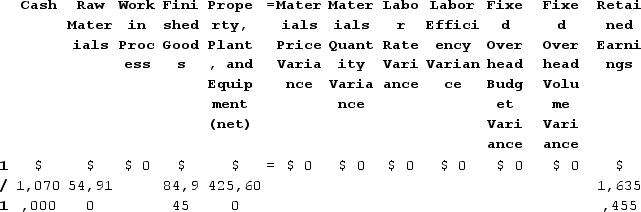 When the direct labor cost is recorded, which of the following entries will be made?
During the year, the company assigned direct labor costs to work in process. The direct labor workers (who were paid in cash) worked 15,830 hours at an average cost of $18.50 per hour. The company calculated the following direct labor variances for the year:
Assume that all transactions are recorded on the below worksheet, which is similar to the worksheet shown in your text except that it has been divided into two parts so that it fits on one page. The beginning balances in each of the accounts have been given. PP&E (net) stands for Property, Plant, and Equipment net of depreciation.
When the direct labor cost is recorded, which of the following entries will be made? (Multiple Choice)
5.0/5 (82)
(82) 
Filters
- Essay(0)
- Multiple Choice(0)
- Short Answer(0)
- True False(0)
- Matching(0)