



 Chat with AI
Exam 6: Lean Systems

Exam 1: Using Operations to Create Value115 Questions
Exam 2: Process Strategy and Analysis239 Questions
Exam 3: Quality and Performance198 Questions
Exam 4: Capacity Planning120 Questions
Exam 5: Constraint Management136 Questions
Exam 6: Lean Systems166 Questions
Exam 7: Project Management139 Questions
Exam 8: Forecasting150 Questions
Exam 9: Inventory Management205 Questions
Exam 10: Operations Planning and Scheduling149 Questions
Exam 11: Resource Planning124 Questions
Exam 12: Supply Chain Design77 Questions
Exam 13: Supply Chain Logistic Networks114 Questions
Exam 14: Supply Chain Integration120 Questions
Exam 15: Supply Chain Sustainability78 Questions
Exam 16: Supplement A Decision Making107 Questions
Exam 17: Supplement J Operations Scheduling123 Questions
Exam 18: Supplement K Layout39 Questions
Exam 19: Supplement B Waiting Lines111 Questions
Exam 20: Supplement C Special Inventory Models53 Questions
Exam 21: Supplement D Linear Programming87 Questions
Exam 22: Supplement E Simulation54 Questions
Exam 23: Supplement F Financial Analysis55 Questions
Exam 24: Supplement G Acceptance Sampling Plans87 Questions
Exam 25: Supplement H Measuring Output Rates108 Questions
Exam 26: Supplement I Learning Curve Analysis50 Questions
Select questions type


Case 6.2
The Jewel Golf Club Company, which recently began using a Kanban system, has had problems with high inventory levels of one of the handle grips used to make several versions of its clubs. Daily demand for the grip is 3,000 units, average waiting time during production is 0.20 day, processing time is 0.10 day per container, and a container holds 150 grips.
-Use the information in Case 6.2. How many Kanban containers would Jewel require if a 5% policy variable is used?
(Multiple Choice)
4.8/5  (75)
(75) One tactic of Total Preventive Maintenance (TPM) is to make workers responsible for routine minor maintenance of their own equipment.
(True/False)
4.7/5 (95)
(95) In a lean system, an item that is manufactured before it is needed is not considered waste, because it helps keep material flowing through the system.
(True/False)
5.0/5 (86)
(86) Scenario 6.1
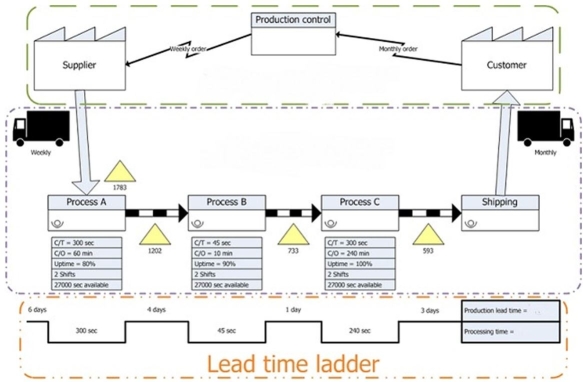
El Gran Raton, the producers of the finest carpincho wallets in all of Argentina, examined their production process in the form of a value stream map, displayed below.
 Daniel Penfield artist
-Use Scenario 6.1 to determine the total production lead time for carpincho wallets.
Daniel Penfield artist
-Use Scenario 6.1 to determine the total production lead time for carpincho wallets. (Multiple Choice)
4.8/5 (83)
(83) Five S practices can be applied to both manufacturing and service settings and can include offices, work spaces, tool rooms, and shop floors.
(True/False)
4.7/5 (79)
(79) Automatically stopping the process when something is wrong and then fixing the problems on the line itself as they occur is called jidoka.
(True/False)
4.9/5 (74)
(74) What are the organizational issues companies must address before implementing a lean system?
(Essay)
4.9/5 (78)
(78) Which of the following statements is True with regard to the eight types of waste that must be eliminated to implement lean systems?
(Multiple Choice)
4.9/5 (80)
(80) ________ is the leveling of production load by both volume and product mix.
(Short Answer)
4.9/5 (73)
(73) With a batch size of 300 units, what is the capacity of process A as shown in Scenario 6.1?
(Multiple Choice)
4.8/5 (81)
(81) Often in value stream mapping, analysts must rely on process information from shop floor workers rather than direct observation in an effort to quickly develop a work plan and accelerate implementing the improved process.
(True/False)
4.9/5 (77)
(77) Productivity tends to increase when components are standardized because each worker performs a standardized task or work method more often each day.
(True/False)
4.8/5 (66)
(66) Preventive maintenance is typically given very low priority in just-in-time systems.
(True/False)
4.9/5 (90)
(90) Takt time is the cycle time needed to match the rate of production to the rate of sales.
(True/False)
4.8/5 (75)
(75) In manufacturing systems, one way to achieve continuous improvement can be to maintain low inventories, and periodically cut safety stocks almost to zero.
(True/False)
4.8/5 (70)
(70) To complete the current state drawing of a process, a map of the current situation is developed, including such items as material and information flows, process times, setup times, batch sizes, scrap rates, and number of people required.
(True/False)
4.8/5 (88)
(88) Long production runs, poor material flows, and processes that are not tightly linked to one another can cause over 90% of a product's lead time to be spent waiting.
(True/False)
4.9/5 (76)
(76) Case 6.1
The Edward James Toy Company uses a Kanban system to make plastic wheels that are a component of several toys. The waiting time for a container of the wheels during production is 0.25 day; average processing time is 0.15 day per container. Each container holds 200 wheels. The company uses 2,000 wheels a day in the production of its products.
-Use the information in Case 6.1. How many Kanban containers would be required if a 10% policy variable is used?
(Multiple Choice)
4.7/5 (95)
(95) 
Filters
- Essay(0)
- Multiple Choice(0)
- Short Answer(0)
- True False(0)
- Matching(0)